Bhagavad Gita 3.5: meaning and translation
Chapter 3: Karma Yoga. Krishna says
No one can stay without acting even for a moment, Krishna says.
Click or tap a word for its meaning and its dictionary page.
Text and layers
Text and layers
These choices stay in this browser.
Bhagavad Gita 3.5
न हि कश्चित्क्षणमपि जातु तिष्ठत्यकर्मकृत् ।कार्यते ह्यवशः कर्म सर्वः प्रकृतिजैर्गुणैः ॥
Na hi kashchitkshanamapi jatu tishthatyakarmakritKaryate hyavashah karma sarvah prakritijairgunaih
na hi kaścitkṣaṇamapi jātu tiṣṭhatyakarmakṛt |kāryate hyavaśaḥ karma sarvaḥ prakṛtijairguṇaiḥ ||
Our explanation No one can stay without acting even for a moment, Krishna says. Everyone is made to act, without a choice, by the qualities (guṇas) that are born of nature (prakṛti).
हिंदी अर्थ कृष्ण कहते हैं कि कोई भी एक क्षण के लिए भी बिना कर्म किए नहीं रह सकता। प्रकृति से उत्पन्न गुण (सत्त्व, रज और तम) हर किसी से, उसके न चाहते हुए भी, कर्म करवाते हैं।
Word by word
Every word, with its dictionary page
Word by word
- न na · not (indeclinable) Dictionary: 2. na, Monier-Williams 1899, p. 523, col. 1 “not, no, nor, neither”
- हि hi · for (indeclinable) Dictionary: 2. hi, Monier-Williams 1899, p. 1297, col. 3 “for, because, on account of”
- कश्चित् kaścit · anyone (pronoun (masculine), nominative singular) Dictionary: kim, Monier-Williams 1899, p. 282, col. 2 “what? how? whence? wherefore? why?”; 2. cid, Monier-Williams 1899, p. 398, col. 1 “even, indeed, also”
- क्षणम् kṣaṇam · for a moment (noun (masculine), accusative singular) Dictionary: 1. kṣaṇa, Monier-Williams 1899, p. 324, col. 3 “any instantaneous point of time, instant, twinkling of an eye, moment”
- अपि api · even (indeclinable) Dictionary: api, Monier-Williams 1899, p. 55, col. 1 “even, also, very”
- जातु jātu · ever (indeclinable) Dictionary: jātu, Monier-Williams 1899, p. 418, col. 2 “Na jātu, not at all, by no means, never”
- तिष्ठति tiṣṭhati · stays, remains (present, 3rd person singular) Dictionary: 1. sthā, Monier-Williams 1899, p. 1262, col. 2 “to stand, stand firmly, station one's self”
- अकर्मकृत् akarmakṛt · not doing action (compound (masculine), nominative singular) Dictionary: a-karman, Monier-Williams 1899, p. 2, col. 1 “absence of work”; 1. kṛt, Monier-Williams 1899, p. 301, col. 3 “making, doing, performing, accomplishing, effecting”
- कार्यते kāryate · is made to act (causative passive, present, 3rd person singular) Dictionary: 1. kṛ, Monier-Williams 1899, p. 301, col. 1 “to do, make, perform, accomplish, cause, effect”
- हि hi · for (indeclinable) Dictionary: 2. hi, Monier-Williams 1899, p. 1297, col. 3 “for, because, on account of”
- अवशः avaśaḥ · helpless, without a choice (adjective (masculine), nominative singular) Dictionary: a-vaśa, Monier-Williams 1899, p. 104, col. 1 “not having one's own free will, doing something against one's desire or unwillingly”
- कर्म karma · action (noun (neuter), accusative singular) Dictionary: karman, Monier-Williams 1899, p. 258, col. 2 “act, action, performance, business”
- सर्वः sarvaḥ · everyone (adjective (masculine), nominative singular) Dictionary: sarva, Monier-Williams 1899, p. 1184, col. 3 “whole, entire, all, every”
- प्रकृतिजैः prakṛtijaiḥ · born of nature (prakṛti) (compound (masculine), instrumental plural) Dictionary: prakṛti-ja, Monier-Williams 1899, p. 654, col. 1 “springing from nature, inborn, innate”; pra-kṛti, Monier-Williams 1899, p. 654, col. 1 “the original producer of (or rather passive power of creating) the material world”
- गुणैः guṇaiḥ · by the qualities (guṇas) (noun (masculine), instrumental plural) Dictionary: guṇa, Monier-Williams 1899, p. 357, col. 1 “a quality, peculiarity, attribute or property”
Old translations
Kashinath Trimbak Telang, 1882. Public domain. Page 52–53.
For nobody ever remains even for an instant without performing some action; since the qualities of nature constrain everybody, not having free-will (in the matter), to some action1.
Footnotes (the translator’s own) - Cf. infra, pp. 122–128. ↩
Compare 3 translations
Kashinath Trimbak Telang, 1882. Public domain. Page 52–53.
For nobody ever remains even for an instant without performing some action; since the qualities of nature constrain everybody, not having free-will (in the matter), to some action1.
Footnotes (the translator’s own) - Cf. infra, pp. 122–128. ↩
You are reading this one
Annie Besant, 1895. Public domain. Page 41.
Nor can anyone, even for an instant, remain actionless; for helplessly is everyone driven to action by the energies1 born of Nature.2
Footnotes (the translator’s own) You are reading this one
Swami Swarupananda, 1909 (first printed 1907). Public domain. Page 65.
Verily none can ever rest for even an instant, without performing action; for all are made to act, helplessly indeed, by the Gunas, born of Prakriti.
You are reading this one
Cite this verse
The translation: K. T. Telang, The Bhagavadgîtâ (The Sacred Books of the East, vol. VIII, Oxford: Clarendon Press, 1882), pp. 52–53. Bhagavad Gita 3.5.
The translation: Annie Besant, The Bhagavad Gîtâ, or The Lord's Song (London: Theosophical Publishing Society, 1895), p. 41. Bhagavad Gita 3.5.
The translation: Swami Swarupananda, Srimad-Bhagavad-Gita (Mayavati: Prabuddha Bharata Press, 1909; first printed in Prabuddha Bharata, 1907–1909), p. 65. Bhagavad Gita 3.5.
Our explanation: “Bhagavad Gita 3.5: meaning and translation.” Pujadeep. Updated October 27, 2026. https://pujadeep.com/bhagavad-gita/3/5/
Pujadeep’s explanations are free to quote with credit: name Pujadeep and link to the page. How to credit
Classical readings, by school
Each reading is named by its school. None is presented as the only meaning.
What Advaita, Vishishtadvaita and Dvaita teach, in short
Shankara Advaita
Shankara says “everyone” here means everyone who does not know the Self, since 14.23 describes the wise as unmoved by the qualities. So, for him, the path of action is meant for those who do not yet know the Self, not for the wise.
Source: The Bhagavad-Gita, with the commentary of Sri Sankaracharya, translated by A. Mahadeva Sastri (2nd ed., Mysore: G. T. A. Printing Works, 1901), commentary on 3.5, pp. 84–85. Summarised in our own words; none of its text is reproduced.
Ramanuja Vishishtadvaita
Ramanuja says that even someone who resolves to do nothing is driven to act by sattva, rajas and tamas, as past deeds stir them. The path of action wears away past faults and gives mastery over the qualities; after that, the path of knowledge becomes possible.
Source: Sri Bhagavad-Gita with Sri Ramanujacharya's Visishtadvaita commentary, translated by A. Govindacharya (Madras, 1898), commentary on 3.5, p. 94. Summarised in our own words; none of its text is reproduced.
Share
Show the ways to share
Send one picture or the text to one chat. The picture names its source and the address of this page.
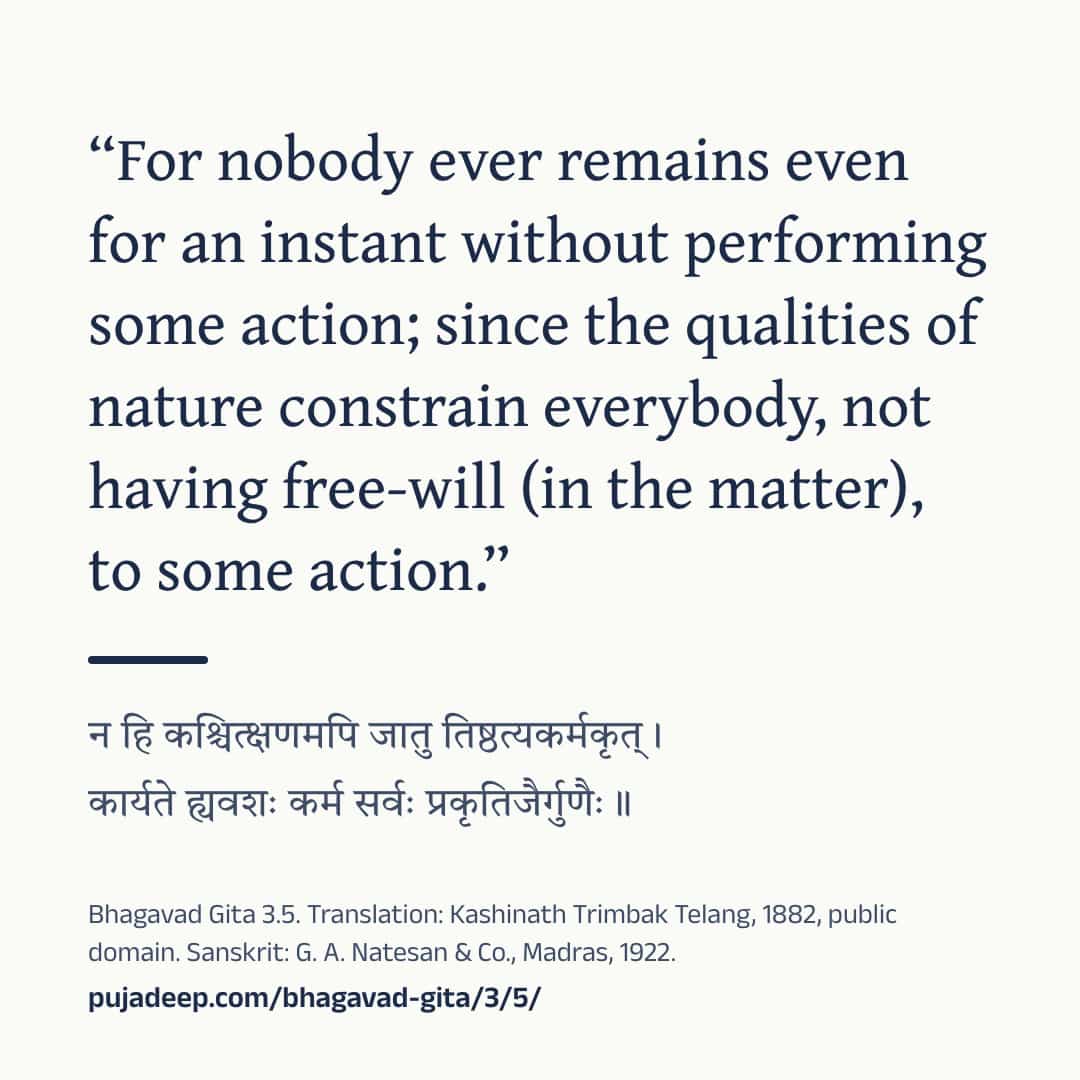
Drawing the picture
See the words
Bhagavad Gita 3.5

न हि कश्चित्क्षणमपि जातु तिष्ठत्यकर्मकृत् ।
कार्यते ह्यवशः कर्म सर्वः प्रकृतिजैर्गुणैः ॥

“For nobody ever remains even for an instant without performing some action; since the qualities of nature constrain everybody, not having free-will (in the matter), to some action.”
(K. T. Telang, The Bhagavadgîtâ (The Sacred Books of the East, vol. VIII, Oxford: Clarendon Press, 1882), pp. 52–53, public domain)

“Nor can anyone, even for an instant, remain actionless; for helplessly is everyone driven to action by the energies born of Nature.”
(Annie Besant, The Bhagavad Gîtâ, or The Lord's Song (London: Theosophical Publishing Society, 1895), p. 41, public domain)

“Verily none can ever rest for even an instant, without performing action; for all are made to act, helplessly indeed, by the Gunas, born of Prakriti.”
(Swami Swarupananda, Srimad-Bhagavad-Gita (Mayavati: Prabuddha Bharata Press, 1909; first printed in Prabuddha Bharata, 1907–1909), p. 65, public domain)

Sanskrit: G. A. Natesan & Co., Madras, 1922.
https://pujadeep.com/bhagavad-gita/3/5/ Nothing is sent from this site. Your own app sends it, to the chat you choose. The picture quotes the translation you chose on this page, with its name and year.
Sanskrit text: The Bhagavad-Gita, or The Lord's Song, with the text in Devanagari and an English translation, 1922. Meanings: written for Pujadeep and checked against the cited edition. Source and changes
Questions families ask
Who speaks Bhagavad Gita 3.5?
Krishna speaks this verse, in chapter 3 (Karma Yoga).
Where does the Sanskrit text come from?
Sanskrit text: The Bhagavad-Gita, or The Lord's Song, with the text in Devanagari and an English translation, 1922. Meanings: written for Pujadeep and checked against the cited edition. See the source
Is the meaning on this page a translation?
Explanation written for this site from the sources listed here, and checked against the cited edition. It is not a translation and not the only way to read the text. Free to quote with credit.
Source and licence
- Sanskrit text
- The Bhagavad-Gita, or The Lord's Song, with the text in Devanagari and an English translation (Annie Besant, G. A. Natesan & Co., Madras, 1922). Public domain. The Sanskrit on these pages was read from this printing’s page images.
- Translation
- The Bhagavadgîtâ with the Sanatsugâtîya and the Anugîtâ, translated by Kâshinâth Trimbak Telang (The Sacred Books of the East, vol. VIII, ed. F. Max Müller) (Kashinath Trimbak Telang, F. Max Müller, Clarendon Press, Oxford, 1882). Public domain. Shown verbatim, as printed.
- Translation
- The Bhagavad Gîtâ, or The Lord's Song, translated by Annie Besant (Annie Besant, Theosophical Publishing Society, London, 1895). Public domain. Shown verbatim, as printed.
- Translation
- Srimad-Bhagavad-Gita, with Sanskrit Text; Paraphrase with Word-by-word Literal Translation; English Rendering and Comments, Index, &c., by the Swami Swarupananda (Himalayan Series, No. XX) (Swami Swarupananda, The Editors and Publishers, Advaita Ashrama, Mayavati, Prabuddha Bharata Press, Mayavati, Almora, Himalayas, 1909). Public domain. Shown verbatim, as printed.
- Commentary
- The Bhagavad-Gita, with the commentary of Sri Sankaracharya, translated by A. Mahadeva Sastri (2nd ed., Mysore: G. T. A. Printing Works, 1901) (Public-domain scan, University of California Libraries). Summarised in our own words; none of its text is reproduced.
- Commentary
- Sri Bhagavad-Gita with Sri Ramanujacharya's Visishtadvaita commentary, translated by A. Govindacharya (Madras, 1898) (Scan uploaded to archive.org (folkscanomy collection)). Summarised in our own words; none of its text is reproduced.
- Common wording
- In this text, 32 words follow today's common wording, checked against sanskritdocuments.org; Sanskrit Wikisource; Gita Press, Gorakhpur; GRETIL, Göttingen and Bhaktivedanta Book Trust.
- Our explanation
- Explanation written for this site from the sources listed here, and checked against the cited edition. It is not a translation and not the only way to read the text. Free to quote with credit.
- Checked
- Checked against the cited edition, October 27, 2026.