Bhagavad Gita 3.9: meaning and translation
Chapter 3: Karma Yoga. Krishna says
Krishna says that this world is bound by action, except action done for the sake of sacrifice (yajña).
Click or tap a word for its meaning and its dictionary page.
Text and layers
Text and layers
These choices stay in this browser.
Bhagavad Gita 3.9
यज्ञार्थात्कर्मणोऽन्यत्र लोकोऽयं कर्मबन्धनः ।तदर्थं कर्म कौन्तेय मुक्तसङ्गः समाचर ॥
Yajnarthatkarmanonyatra lokoyam karmabandhanahTadartham karma kaunteya muktasangah samachara
yajñārthātkarmaṇo’nyatra loko’yaṃ karmabandhanaḥ |tadarthaṃ karma kaunteya muktasaṅgaḥ samācara ||
Our explanation Krishna says that this world is bound by action, except action done for the sake of sacrifice (yajña). So Arjuna, son of Kunti, should do action for that purpose, free from attachment. The schools explain what yajña means here (see the views).
हिंदी अर्थ कृष्ण कहते हैं कि यज्ञ के लिए किए गए कर्म को छोड़कर, बाकी कर्मों से यह संसार बँधता है। इसलिए हे कौन्तेय (कुंती के पुत्र), अर्जुन आसक्ति छोड़कर उसी उद्देश्य से कर्म करें। अलग-अलग परंपराएँ बताती हैं कि यहाँ यज्ञ का अर्थ क्या है।
Word by word
Every word, with its dictionary page
Word by word
- यज्ञार्थात् yajñārthāt · for the sake of sacrifice (compound (neuter), ablative singular) Dictionary: yajña, Monier-Williams 1899, p. 839, col. 2 “act of worship or devotion, offering, oblation, sacrifice”; artha, Monier-Williams 1899, p. 90, col. 3 “aim, purpose”
- कर्मणः karmaṇaḥ · than action (noun (neuter), ablative singular) Dictionary: karman, Monier-Williams 1899, p. 258, col. 2 “act, action, performance, business”
- अन्यत्र anyatra · other than, except (indeclinable) Dictionary: anya-tra, Monier-Williams 1899, p. 45, col. 3 “except, without”
- लोकः lokaḥ · world (noun (masculine), nominative singular) Dictionary: loka, Monier-Williams 1899, p. 906, col. 1 “the wide space or world”
- अयम् ayam · this (pronoun (masculine), nominative singular) Dictionary: 1. idam, Monier-Williams 1899, p. 165, col. 2
- कर्मबन्धनः karmabandhanaḥ · bound by action (compound (masculine), nominative singular) Dictionary: karma-bandhana, Monier-Williams 1899, p. 259, col. 1 “bound by bonds of actions”
- तदर्थम् tadartham · for that purpose (indeclinable) Dictionary: tad-artha, Monier-Williams 1899, p. 434, col. 1 “intended for that”
- कर्म karma · action (noun (neuter), accusative singular) Dictionary: karman, Monier-Williams 1899, p. 258, col. 2 “act, action, performance, business”
- कौन्तेय kaunteya · O son of Kunti (noun (masculine), vocative singular) Dictionary: kaunteya, Monier-Williams 1899, p. 316, col. 2 “metron. fr. Kuntī”
- मुक्तसङ्गः muktasaṅgaḥ · free from attachment (compound (masculine), nominative singular) Dictionary: mukta, Monier-Williams 1899, p. 820, col. 3 “liberated, delivered, emancipated”; saṅga, Monier-Williams 1899, p. 1132, col. 3 “addiction or devotion to, propensity for”
- समाचर samācara · do, perform (imperative, 2nd person singular) Dictionary: sam-ā-car, Monier-Williams 1899, p. 1159, col. 1 “to practise, perform thoroughly, do, accomplish”
Old translations
Kashinath Trimbak Telang, 1882. Public domain. Page 53.
This world is fettered by all action other than action for the purpose of the sacrifice1. Therefore, O son of Kuntî! do you, casting off attachment, perform action for that purpose.
Footnotes (the translator’s own) - Cf. infra, pp. 60, 61. Probably the 'sacrifices' spoken of in that passage must be taken to be the same as those referred to in the Creator's injunction mentioned in this passage. ↩
Compare 3 translations
Kashinath Trimbak Telang, 1882. Public domain. Page 53.
This world is fettered by all action other than action for the purpose of the sacrifice1. Therefore, O son of Kuntî! do you, casting off attachment, perform action for that purpose.
Footnotes (the translator’s own) - Cf. infra, pp. 60, 61. Probably the 'sacrifices' spoken of in that passage must be taken to be the same as those referred to in the Creator's injunction mentioned in this passage. ↩
You are reading this one
Annie Besant, 1895. Public domain. Page 42.
The world is bound by all action, by action with sacrifice for object; with such object, free from attachment, O son of Kuntî, perform thou action.
You are reading this one
Swami Swarupananda, 1909 (first printed 1907). Public domain. Page 67.
The world is bound by actions other than those performed for the sake of Yajna; do thou therefore, O son of Kunti, perform action for Yajna alone, devoid of attachment.
You are reading this one
Cite this verse
The translation: K. T. Telang, The Bhagavadgîtâ (The Sacred Books of the East, vol. VIII, Oxford: Clarendon Press, 1882), p. 53. Bhagavad Gita 3.9.
The translation: Annie Besant, The Bhagavad Gîtâ, or The Lord's Song (London: Theosophical Publishing Society, 1895), p. 42. Bhagavad Gita 3.9.
The translation: Swami Swarupananda, Srimad-Bhagavad-Gita (Mayavati: Prabuddha Bharata Press, 1909; first printed in Prabuddha Bharata, 1907–1909), p. 67. Bhagavad Gita 3.9.
Our explanation: “Bhagavad Gita 3.9: meaning and translation.” Pujadeep. Updated October 27, 2026. https://pujadeep.com/bhagavad-gita/3/9/
Pujadeep’s explanations are free to quote with credit: name Pujadeep and link to the page. How to credit
Classical readings, by school
Each reading is named by its school. None is presented as the only meaning.
What Advaita, Vishishtadvaita and Dvaita teach, in short
Shankara Advaita
Shankara takes yajña here to mean the Lord (Īśvara), quoting the Veda's words “yajña is Vishnu”. Action done for the Lord's sake does not bind.
Source: The Bhagavad-Gita, with the commentary of Sri Sankaracharya, translated by A. Mahadeva Sastri (2nd ed., Mysore: G. T. A. Printing Works, 1901), commentary on 3.9, p. 86. Summarised in our own words; none of its text is reproduced.
Ramanuja Vishishtadvaita
Ramanuja takes yajña to be the worship that scripture prescribes. Work done for selfish ends binds. Work done to make that worship possible, even earning money, becomes worship of the Supreme Person, who then frees the worker from the bonds of past deeds.
Source: Sri Bhagavad-Gita with Sri Ramanujacharya's Visishtadvaita commentary, translated by A. Govindacharya (Madras, 1898), commentary on 3.9, p. 98. Summarised in our own words; none of its text is reproduced.
Share
Show the ways to share
Send one picture or the text to one chat. The picture names its source and the address of this page.
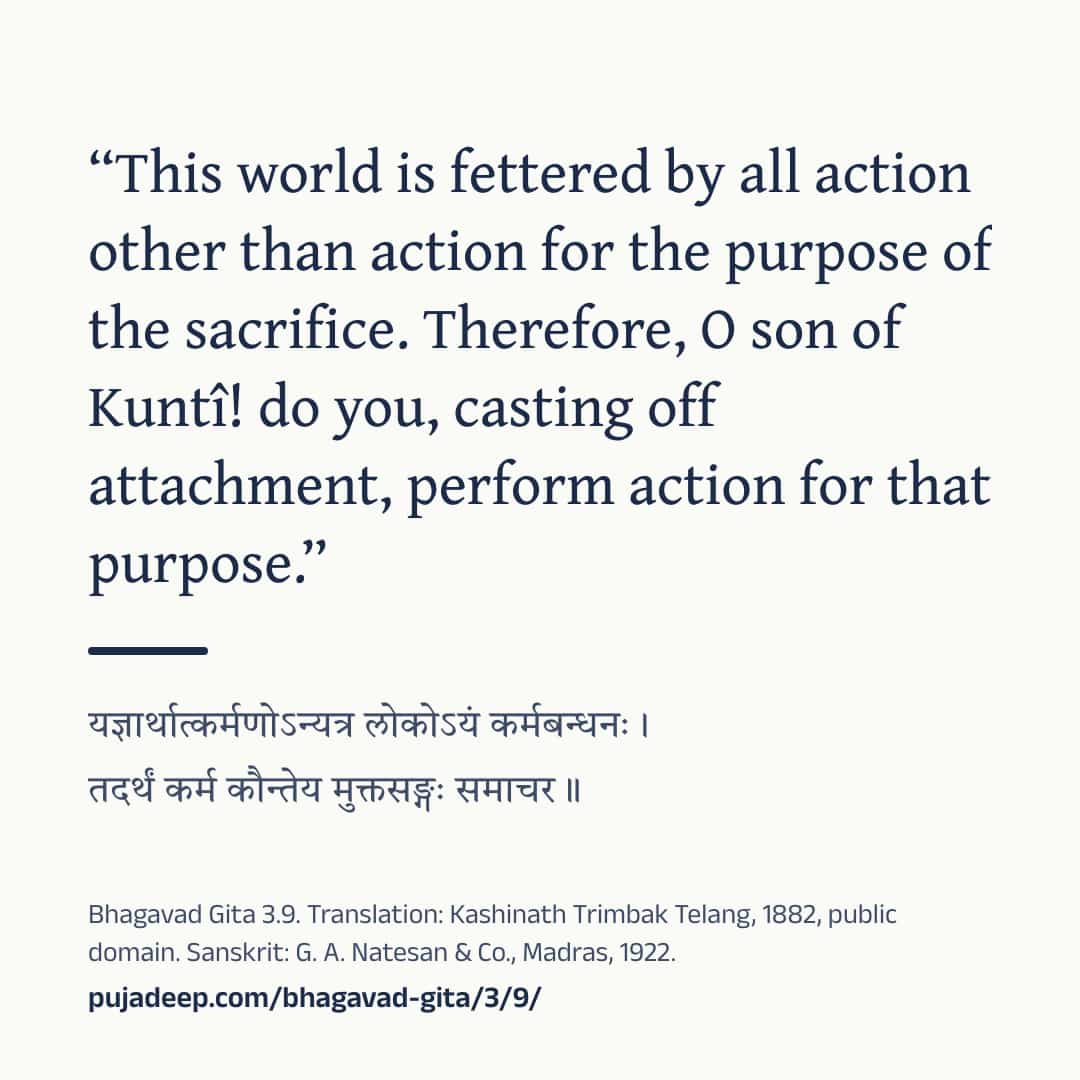
Drawing the picture
See the words
Bhagavad Gita 3.9

यज्ञार्थात्कर्मणोऽन्यत्र लोकोऽयं कर्मबन्धनः ।
तदर्थं कर्म कौन्तेय मुक्तसङ्गः समाचर ॥

“This world is fettered by all action other than action for the purpose of the sacrifice. Therefore, O son of Kuntî! do you, casting off attachment, perform action for that purpose.”
(K. T. Telang, The Bhagavadgîtâ (The Sacred Books of the East, vol. VIII, Oxford: Clarendon Press, 1882), p. 53, public domain)

“The world is bound by all action, by action with sacrifice for object; with such object, free from attachment, O son of Kuntî, perform thou action.”
(Annie Besant, The Bhagavad Gîtâ, or The Lord's Song (London: Theosophical Publishing Society, 1895), p. 42, public domain)

“The world is bound by actions other than those performed for the sake of Yajna; do thou therefore, O son of Kunti, perform action for Yajna alone, devoid of attachment.”
(Swami Swarupananda, Srimad-Bhagavad-Gita (Mayavati: Prabuddha Bharata Press, 1909; first printed in Prabuddha Bharata, 1907–1909), p. 67, public domain)

Sanskrit: G. A. Natesan & Co., Madras, 1922.
https://pujadeep.com/bhagavad-gita/3/9/ Nothing is sent from this site. Your own app sends it, to the chat you choose. The picture quotes the translation you chose on this page, with its name and year.
Sanskrit text: The Bhagavad-Gita, or The Lord's Song, with the text in Devanagari and an English translation, 1922. Meanings: written for Pujadeep and checked against the cited edition. Source and changes
Questions families ask
Who speaks Bhagavad Gita 3.9?
Krishna speaks this verse, in chapter 3 (Karma Yoga).
Where does the Sanskrit text come from?
Sanskrit text: The Bhagavad-Gita, or The Lord's Song, with the text in Devanagari and an English translation, 1922. Meanings: written for Pujadeep and checked against the cited edition. See the source
Is the meaning on this page a translation?
Explanation written for this site from the sources listed here, and checked against the cited edition. It is not a translation and not the only way to read the text. Free to quote with credit.
Source and licence
- Sanskrit text
- The Bhagavad-Gita, or The Lord's Song, with the text in Devanagari and an English translation (Annie Besant, G. A. Natesan & Co., Madras, 1922). Public domain. The Sanskrit on these pages was read from this printing’s page images.
- Translation
- The Bhagavadgîtâ with the Sanatsugâtîya and the Anugîtâ, translated by Kâshinâth Trimbak Telang (The Sacred Books of the East, vol. VIII, ed. F. Max Müller) (Kashinath Trimbak Telang, F. Max Müller, Clarendon Press, Oxford, 1882). Public domain. Shown verbatim, as printed.
- Translation
- The Bhagavad Gîtâ, or The Lord's Song, translated by Annie Besant (Annie Besant, Theosophical Publishing Society, London, 1895). Public domain. Shown verbatim, as printed.
- Translation
- Srimad-Bhagavad-Gita, with Sanskrit Text; Paraphrase with Word-by-word Literal Translation; English Rendering and Comments, Index, &c., by the Swami Swarupananda (Himalayan Series, No. XX) (Swami Swarupananda, The Editors and Publishers, Advaita Ashrama, Mayavati, Prabuddha Bharata Press, Mayavati, Almora, Himalayas, 1909). Public domain. Shown verbatim, as printed.
- Commentary
- The Bhagavad-Gita, with the commentary of Sri Sankaracharya, translated by A. Mahadeva Sastri (2nd ed., Mysore: G. T. A. Printing Works, 1901) (Public-domain scan, University of California Libraries). Summarised in our own words; none of its text is reproduced.
- Commentary
- Sri Bhagavad-Gita with Sri Ramanujacharya's Visishtadvaita commentary, translated by A. Govindacharya (Madras, 1898) (Scan uploaded to archive.org (folkscanomy collection)). Summarised in our own words; none of its text is reproduced.
- Common wording
- In this text, 32 words follow today's common wording, checked against sanskritdocuments.org; Sanskrit Wikisource; Gita Press, Gorakhpur; GRETIL, Göttingen and Bhaktivedanta Book Trust.
- Our explanation
- Explanation written for this site from the sources listed here, and checked against the cited edition. It is not a translation and not the only way to read the text. Free to quote with credit.
- Checked
- Checked against the cited edition, October 27, 2026.