Bhagavad Gita 3.16: meaning and translation
Chapter 3: Karma Yoga. Krishna says
Krishna says that whoever does not help to turn the wheel set going in this way lives a life of sin (aghāyu), delights only in the senses, and lives in vain.
Click or tap a word for its meaning and its dictionary page.
Text and layers
Text and layers
These choices stay in this browser.
Bhagavad Gita 3.16
एवं प्रवर्तितं चक्रं नानुवर्तयतीह यः ।अघायुरिन्द्रियारामो मोघं पार्थ स जीवति ॥
Evam pravartitam chakram nanuvartayatiha yahAghayurindriyaramo mogham partha sa jivati
evaṃ pravartitaṃ cakraṃ nānuvartayatīha yaḥ |aghāyurindriyārāmo moghaṃ pārtha sa jīvati ||
Our explanation Krishna says that whoever does not help to turn the wheel set going in this way lives a life of sin (aghāyu), delights only in the senses, and lives in vain. He calls Arjuna Partha, son of Pritha.
हिंदी अर्थ कृष्ण कहते हैं कि जो इस प्रकार चलाए गए चक्र के अनुसार नहीं चलता, उसका जीवन पापमय (अघायु) है, वह इंद्रियों में ही रमता है और व्यर्थ जीता है। वे अर्जुन को पार्थ (पृथा के पुत्र) कहकर पुकारते हैं।
Word by word
Every word, with its dictionary page
Word by word
- एवम् evam · thus (indeclinable) Dictionary: evam, Monier-Williams 1899, p. 232, col. 2 “thus, in this way, in such a manner”
- प्रवर्तितम् pravartitam · set going (past participle (neuter), accusative singular) Dictionary: pra-vartita, Monier-Williams 1899, p. 693, col. 3 “caused to roll on or forwards, set in motion, set on foot”
- चक्रम् cakram · wheel (noun (neuter), accusative singular) Dictionary: cakra, Monier-Williams 1899, p. 380, col. 3 “a cycle, cycle of years or of seasons”
- न na · not (indeclinable) Dictionary: 2. na, Monier-Williams 1899, p. 523, col. 1 “not, no, nor, neither”
- अनुवर्तयति anuvartayati · keeps turning (causative present, 3rd person singular) Dictionary: anu-vṛt, Monier-Williams 1899, p. 39, col. 1 “to go after; to follow, pursue”
- इह iha · here, in this world (indeclinable) Dictionary: iha, Monier-Williams 1899, p. 169, col. 3 “in this place, here”
- यः yaḥ · who (pronoun (masculine), nominative singular) Dictionary: yad, Monier-Williams 1899, p. 844, col. 2 “who, which, what, whichever, whatever, that”
- अघायुः aghāyuḥ · living in sin (compound (masculine), nominative singular) Dictionary: aghāyu, Monier-Williams 1899, p. 7, col. 1 “intending to injure, malicious”
- इन्द्रियारामः indriyārāmaḥ · delighting in the senses (compound (masculine), nominative singular) Dictionary: indriya, Monier-Williams 1899, p. 167, col. 2 “faculty of sense, sense, organ of sense”; ā-rāma, Monier-Williams 1899, p. 150, col. 1 “delight, pleasure”
- मोघम् mogham · in vain (indeclinable) Dictionary: mogha, Monier-Williams 1899, p. 835, col. 2 “vain, fruitless, useless”
- पार्थ pārtha · O Partha (son of Pritha) (noun (masculine), vocative singular) Dictionary: 2. pārtha, Monier-Williams 1899, p. 621, col. 3
- सः saḥ · he (pronoun (masculine), nominative singular) Dictionary: tad, Monier-Williams 1899, p. 434, col. 1 “m. he, f. she, n. it, that, this”
- जीवति jīvati · lives (present, 3rd person singular) Dictionary: jīv, Monier-Williams 1899, p. 422, col. 2 “to live, be or remain alive”
Old translations
Kashinath Trimbak Telang, 1882. Public domain. Page 54.
He who in this world does not turn round the wheel revolving thus, is of sinful life, indulging his senses, and, O son of Prithâ! he lives in vain.
Compare 3 translations
Kashinath Trimbak Telang, 1882. Public domain. Page 54.
He who in this world does not turn round the wheel revolving thus, is of sinful life, indulging his senses, and, O son of Prithâ! he lives in vain.
You are reading this one
Annie Besant, 1895. Public domain. Page 43.
He who on earth doth not follow the wheel thus revolving, sinful of life and rejoicing in the senses, he, O son of Prithâ, liveth in vain.
You are reading this one
Swami Swarupananda, 1909 (first printed 1907). Public domain. Page 70.
He, who here follows not the wheel thus set revolving, living in sin, and satisfied in the senses, O son of Prithâ,—he, lives in vain.
You are reading this one
Cite this verse
The translation: K. T. Telang, The Bhagavadgîtâ (The Sacred Books of the East, vol. VIII, Oxford: Clarendon Press, 1882), p. 54. Bhagavad Gita 3.16.
The translation: Annie Besant, The Bhagavad Gîtâ, or The Lord's Song (London: Theosophical Publishing Society, 1895), p. 43. Bhagavad Gita 3.16.
The translation: Swami Swarupananda, Srimad-Bhagavad-Gita (Mayavati: Prabuddha Bharata Press, 1909; first printed in Prabuddha Bharata, 1907–1909), p. 70. Bhagavad Gita 3.16.
Our explanation: “Bhagavad Gita 3.16: meaning and translation.” Pujadeep. Updated October 27, 2026. https://pujadeep.com/bhagavad-gita/3/16/
Pujadeep’s explanations are free to quote with credit: name Pujadeep and link to the page. How to credit
Classical readings, by school
No readings by school on this verse yet.
Share
Show the ways to share
Send one picture or the text to one chat. The picture names its source and the address of this page.
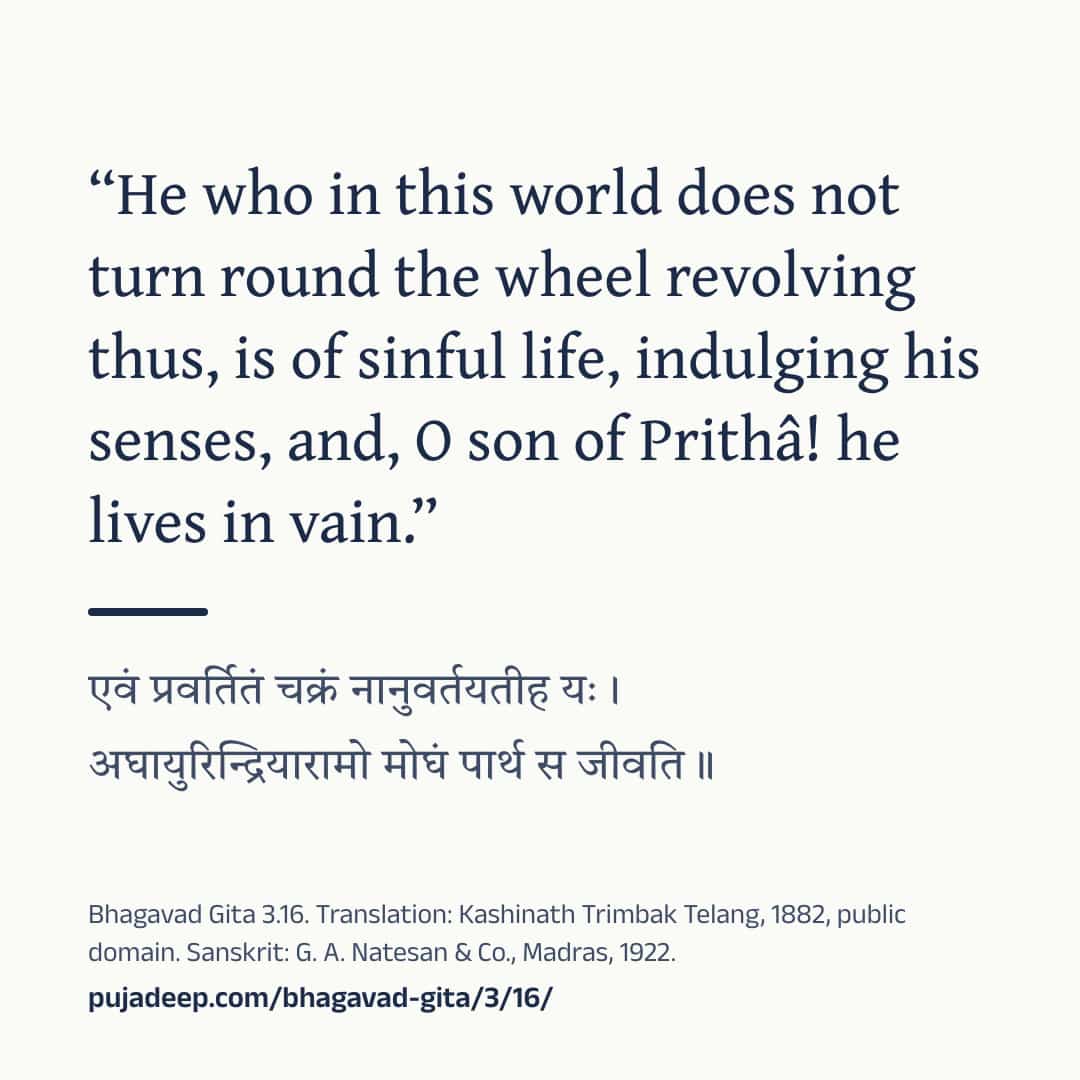
Drawing the picture
See the words
Bhagavad Gita 3.16

एवं प्रवर्तितं चक्रं नानुवर्तयतीह यः ।
अघायुरिन्द्रियारामो मोघं पार्थ स जीवति ॥

“He who in this world does not turn round the wheel revolving thus, is of sinful life, indulging his senses, and, O son of Prithâ! he lives in vain.”
(K. T. Telang, The Bhagavadgîtâ (The Sacred Books of the East, vol. VIII, Oxford: Clarendon Press, 1882), p. 54, public domain)

“He who on earth doth not follow the wheel thus revolving, sinful of life and rejoicing in the senses, he, O son of Prithâ, liveth in vain.”
(Annie Besant, The Bhagavad Gîtâ, or The Lord's Song (London: Theosophical Publishing Society, 1895), p. 43, public domain)

“He, who here follows not the wheel thus set revolving, living in sin, and satisfied in the senses, O son of Prithâ,—he, lives in vain.”
(Swami Swarupananda, Srimad-Bhagavad-Gita (Mayavati: Prabuddha Bharata Press, 1909; first printed in Prabuddha Bharata, 1907–1909), p. 70, public domain)

Sanskrit: G. A. Natesan & Co., Madras, 1922.
https://pujadeep.com/bhagavad-gita/3/16/ Nothing is sent from this site. Your own app sends it, to the chat you choose. The picture quotes the translation you chose on this page, with its name and year.
Sanskrit text: The Bhagavad-Gita, or The Lord's Song, with the text in Devanagari and an English translation, 1922. Meanings: written for Pujadeep and checked against the cited edition. Source and changes
Questions families ask
Who speaks Bhagavad Gita 3.16?
Krishna speaks this verse, in chapter 3 (Karma Yoga).
Where does the Sanskrit text come from?
Sanskrit text: The Bhagavad-Gita, or The Lord's Song, with the text in Devanagari and an English translation, 1922. Meanings: written for Pujadeep and checked against the cited edition. See the source
Is the meaning on this page a translation?
Explanation written for this site from the sources listed here, and checked against the cited edition. It is not a translation and not the only way to read the text. Free to quote with credit.
Source and licence
- Sanskrit text
- The Bhagavad-Gita, or The Lord's Song, with the text in Devanagari and an English translation (Annie Besant, G. A. Natesan & Co., Madras, 1922). Public domain. The Sanskrit on these pages was read from this printing’s page images.
- Translation
- The Bhagavadgîtâ with the Sanatsugâtîya and the Anugîtâ, translated by Kâshinâth Trimbak Telang (The Sacred Books of the East, vol. VIII, ed. F. Max Müller) (Kashinath Trimbak Telang, F. Max Müller, Clarendon Press, Oxford, 1882). Public domain. Shown verbatim, as printed.
- Translation
- The Bhagavad Gîtâ, or The Lord's Song, translated by Annie Besant (Annie Besant, Theosophical Publishing Society, London, 1895). Public domain. Shown verbatim, as printed.
- Translation
- Srimad-Bhagavad-Gita, with Sanskrit Text; Paraphrase with Word-by-word Literal Translation; English Rendering and Comments, Index, &c., by the Swami Swarupananda (Himalayan Series, No. XX) (Swami Swarupananda, The Editors and Publishers, Advaita Ashrama, Mayavati, Prabuddha Bharata Press, Mayavati, Almora, Himalayas, 1909). Public domain. Shown verbatim, as printed.
- Common wording
- In this text, 32 words follow today's common wording, checked against sanskritdocuments.org; Sanskrit Wikisource; Gita Press, Gorakhpur; GRETIL, Göttingen and Bhaktivedanta Book Trust.
- Our explanation
- Explanation written for this site from the sources listed here, and checked against the cited edition. It is not a translation and not the only way to read the text. Free to quote with credit.
- Checked
- Checked against the cited edition, October 27, 2026.