Bhagavad Gita 3.17: meaning and translation
Chapter 3: Karma Yoga. Krishna says
But for the person whose delight is in the self (ātman) alone, who is satisfied with the self and content in the self alone, Krishna says, there is nothing that has to be done (kārya).
Click or tap a word for its meaning and its dictionary page.
Text and layers
Text and layers
These choices stay in this browser.
Bhagavad Gita 3.17
यस्त्वात्मरतिरेव स्यादात्मतृप्तश्च मानवः ।आत्मन्येव च सन्तुष्टस्तस्य कार्यं न विद्यते ॥
Yastvatmaratireva syadatmatriptashcha manavahAtmanyeva cha santushtastasya karyam na vidyate
yastvātmaratireva syādātmatṛptaśca mānavaḥ |ātmanyeva ca santuṣṭastasya kāryaṃ na vidyate ||
Our explanation But for the person whose delight is in the self (ātman) alone, who is satisfied with the self and content in the self alone, Krishna says, there is nothing that has to be done (kārya). The schools explain who this person is (see the views).
हिंदी अर्थ कृष्ण कहते हैं कि जो मनुष्य आत्मा में ही रमता है, आत्मा से ही तृप्त है और आत्मा में ही संतुष्ट है, उसके लिए कोई कर्तव्य (कार्य) शेष नहीं रहता। अलग-अलग परंपराएँ बताती हैं कि यह व्यक्ति कौन है।
Word by word
Every word, with its dictionary page
Word by word
- यः yaḥ · who (pronoun (masculine), nominative singular) Dictionary: yad, Monier-Williams 1899, p. 844, col. 2 “who, which, what, whichever, whatever, that”
- तु tu · but (indeclinable) Dictionary: 2. tu, Monier-Williams 1899, p. 449, col. 3 “but”
- आत्मरतिः ātmaratiḥ · delighting in the self (compound (masculine), nominative singular) Dictionary: ātman, Monier-Williams 1899, p. 135, col. 1 “the individual soul, self”; rati, Monier-Williams 1899, p. 867, col. 3 “pleasure, enjoyment, delight in, fondness for”
- एव eva · only (indeclinable) Dictionary: 1. eva, Monier-Williams 1899, p. 232, col. 2 “just, exactly, very, same, only, even, alone, merely”
- स्यात् syāt · may be (optative, 3rd person singular) Dictionary: 1. as, Monier-Williams 1899, p. 117, col. 2 “to be, live, exist, be present”
- आत्मतृप्तः ātmatṛptaḥ · satisfied in the self (compound (masculine), nominative singular) Dictionary: ātman, Monier-Williams 1899, p. 135, col. 1 “the individual soul, self”; tṛpta, Monier-Williams 1899, p. 454, col. 1 “satiated, satisfied with”
- च ca · and (indeclinable) Dictionary: 2. ca, Monier-Williams 1899, p. 380, col. 1 “and, both, also, moreover, as well as”
- मानवः mānavaḥ · person (noun (masculine), nominative singular) Dictionary: mānava, Monier-Williams 1899, p. 809, col. 3 “a human being, man”
- आत्मनि ātmani · in the self (noun (masculine), locative singular) Dictionary: ātman, Monier-Williams 1899, p. 135, col. 1 “the individual soul, self”
- एव eva · alone (indeclinable) Dictionary: 1. eva, Monier-Williams 1899, p. 232, col. 2 “just, exactly, very, same, only, even, alone, merely”
- च ca · and (indeclinable) Dictionary: 2. ca, Monier-Williams 1899, p. 380, col. 1 “and, both, also, moreover, as well as”
- सन्तुष्टः santuṣṭaḥ · content (past participle (masculine), nominative singular) Dictionary: saṃ-tuṣṭa, Monier-Williams 1899, p. 1142, col. 2 “quite satisfied or contented, well pleased or delighted with”
- तस्य tasya · for him (pronoun (masculine), genitive singular) Dictionary: tad, Monier-Williams 1899, p. 434, col. 1 “m. he, f. she, n. it, that, this”
- कार्यम् kāryam · what has to be done (gerundive (to be done) (neuter), nominative singular) Dictionary: kārya, Monier-Williams 1899, p. 276, col. 1 “work or business to be done”
- न na · not (indeclinable) Dictionary: 2. na, Monier-Williams 1899, p. 523, col. 1 “not, no, nor, neither”
- विद्यते vidyate · exists, there is (present passive, 3rd person singular) Dictionary: 3. vid, Monier-Williams 1899, p. 964, col. 3 “to find, discover, meet or fall in with, obtain, get, acquire”
Old translations
Kashinath Trimbak Telang, 1882. Public domain. Page 54.
But the man who is attached to his self only, who is contented in his self, and is pleased with his self1, has nothing to do.
Footnotes (the translator’s own) - The distinctions here are rather nice,—an ordinary man is 'attached' to worldly objects, is 'contented' with goods &c., and is 'pleased' with special gains. ↩
Compare 3 translations
Kashinath Trimbak Telang, 1882. Public domain. Page 54.
But the man who is attached to his self only, who is contented in his self, and is pleased with his self1, has nothing to do.
Footnotes (the translator’s own) - The distinctions here are rather nice,—an ordinary man is 'attached' to worldly objects, is 'contented' with goods &c., and is 'pleased' with special gains. ↩
You are reading this one
Annie Besant, 1895. Public domain. Page 43.
But the man verily who rejoiceth in the SELF, with the SELF is satisfied, and is content in the SELF, for him there is nothing to do;
This sentence goes on in 3.18.
You are reading this one
Swami Swarupananda, 1909 (first printed 1907). Public domain. Page 71.
But the man who is devoted to the Self, and is satisfied with the Self, and content in the Self alone, he has no obligatory duty.
You are reading this one
Cite this verse
The translation: K. T. Telang, The Bhagavadgîtâ (The Sacred Books of the East, vol. VIII, Oxford: Clarendon Press, 1882), p. 54. Bhagavad Gita 3.17.
The translation: Annie Besant, The Bhagavad Gîtâ, or The Lord's Song (London: Theosophical Publishing Society, 1895), p. 43. Bhagavad Gita 3.17.
The translation: Swami Swarupananda, Srimad-Bhagavad-Gita (Mayavati: Prabuddha Bharata Press, 1909; first printed in Prabuddha Bharata, 1907–1909), p. 71. Bhagavad Gita 3.17.
Our explanation: “Bhagavad Gita 3.17: meaning and translation.” Pujadeep. Updated October 27, 2026. https://pujadeep.com/bhagavad-gita/3/17/
Pujadeep’s explanations are free to quote with credit: name Pujadeep and link to the page. How to credit
Classical readings, by school
Each reading is named by its school. None is presented as the only meaning.
What Advaita, Vishishtadvaita and Dvaita teach, in short
Shankara Advaita
Shankara says this person is the renunciate (saṃnyāsin) devoted to knowledge of the Self, the Sankhya of 3.3. Such a person's joy and contentment are in the Self, not in outer things, so nothing is left to do.
Source: The Bhagavad-Gita, with the commentary of Sri Sankaracharya, translated by A. Mahadeva Sastri (2nd ed., Mysore: G. T. A. Printing Works, 1901), commentary on 3.17, pp. 90–91. Summarised in our own words; none of its text is reproduced.
Ramanuja Vishishtadvaita
Ramanuja says this is the one to whom the self is already clearly known, so no further means is needed to see it. Yet he holds that action is still fitting even for such a person, because it is easy and safe and sets an example. He reads 3.19 as telling Arjuna to keep working as a duty until the self is realised.
Source: Sri Bhagavad-Gita with Sri Ramanujacharya's Visishtadvaita commentary, translated by A. Govindacharya (Madras, 1898), commentary on 3.17–19, pp. 104–106. Summarised in our own words; none of its text is reproduced.
Share
Show the ways to share
Send one picture or the text to one chat. The picture names its source and the address of this page.
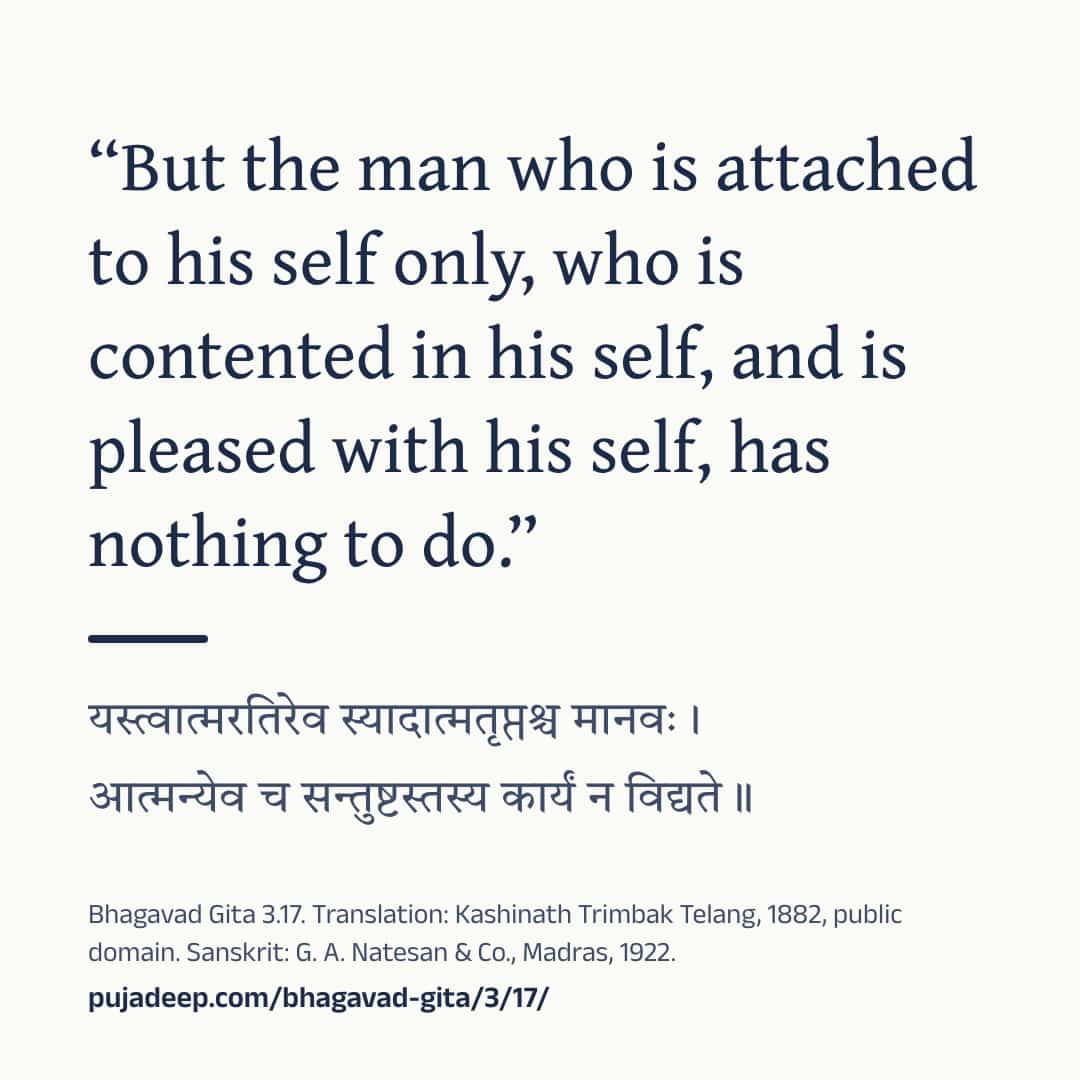
Drawing the picture
See the words
Bhagavad Gita 3.17

यस्त्वात्मरतिरेव स्यादात्मतृप्तश्च मानवः ।
आत्मन्येव च सन्तुष्टस्तस्य कार्यं न विद्यते ॥

“But the man who is attached to his self only, who is contented in his self, and is pleased with his self, has nothing to do.”
(K. T. Telang, The Bhagavadgîtâ (The Sacred Books of the East, vol. VIII, Oxford: Clarendon Press, 1882), p. 54, public domain)

“But the man verily who rejoiceth in the SELF, with the SELF is satisfied, and is content in the SELF, for him there is nothing to do;”
(Annie Besant, The Bhagavad Gîtâ, or The Lord's Song (London: Theosophical Publishing Society, 1895), p. 43, public domain)
This sentence goes on in 3.18.

“But the man who is devoted to the Self, and is satisfied with the Self, and content in the Self alone, he has no obligatory duty.”
(Swami Swarupananda, Srimad-Bhagavad-Gita (Mayavati: Prabuddha Bharata Press, 1909; first printed in Prabuddha Bharata, 1907–1909), p. 71, public domain)

Sanskrit: G. A. Natesan & Co., Madras, 1922.
https://pujadeep.com/bhagavad-gita/3/17/ Nothing is sent from this site. Your own app sends it, to the chat you choose. The picture quotes the translation you chose on this page, with its name and year.
Sanskrit text: The Bhagavad-Gita, or The Lord's Song, with the text in Devanagari and an English translation, 1922. Meanings: written for Pujadeep and checked against the cited edition. Source and changes
Questions families ask
Who speaks Bhagavad Gita 3.17?
Krishna speaks this verse, in chapter 3 (Karma Yoga).
Where does the Sanskrit text come from?
Sanskrit text: The Bhagavad-Gita, or The Lord's Song, with the text in Devanagari and an English translation, 1922. Meanings: written for Pujadeep and checked against the cited edition. See the source
Is the meaning on this page a translation?
Explanation written for this site from the sources listed here, and checked against the cited edition. It is not a translation and not the only way to read the text. Free to quote with credit.
Source and licence
- Sanskrit text
- The Bhagavad-Gita, or The Lord's Song, with the text in Devanagari and an English translation (Annie Besant, G. A. Natesan & Co., Madras, 1922). Public domain. The Sanskrit on these pages was read from this printing’s page images.
- Translation
- The Bhagavadgîtâ with the Sanatsugâtîya and the Anugîtâ, translated by Kâshinâth Trimbak Telang (The Sacred Books of the East, vol. VIII, ed. F. Max Müller) (Kashinath Trimbak Telang, F. Max Müller, Clarendon Press, Oxford, 1882). Public domain. Shown verbatim, as printed.
- Translation
- The Bhagavad Gîtâ, or The Lord's Song, translated by Annie Besant (Annie Besant, Theosophical Publishing Society, London, 1895). Public domain. Shown verbatim, as printed.
- Translation
- Srimad-Bhagavad-Gita, with Sanskrit Text; Paraphrase with Word-by-word Literal Translation; English Rendering and Comments, Index, &c., by the Swami Swarupananda (Himalayan Series, No. XX) (Swami Swarupananda, The Editors and Publishers, Advaita Ashrama, Mayavati, Prabuddha Bharata Press, Mayavati, Almora, Himalayas, 1909). Public domain. Shown verbatim, as printed.
- Commentary
- The Bhagavad-Gita, with the commentary of Sri Sankaracharya, translated by A. Mahadeva Sastri (2nd ed., Mysore: G. T. A. Printing Works, 1901) (Public-domain scan, University of California Libraries). Summarised in our own words; none of its text is reproduced.
- Commentary
- Sri Bhagavad-Gita with Sri Ramanujacharya's Visishtadvaita commentary, translated by A. Govindacharya (Madras, 1898) (Scan uploaded to archive.org (folkscanomy collection)). Summarised in our own words; none of its text is reproduced.
- Common wording
- In this text, 32 words follow today's common wording, checked against sanskritdocuments.org; Sanskrit Wikisource; Gita Press, Gorakhpur; GRETIL, Göttingen and Bhaktivedanta Book Trust.
- Our explanation
- Explanation written for this site from the sources listed here, and checked against the cited edition. It is not a translation and not the only way to read the text. Free to quote with credit.
- Checked
- Checked against the cited edition, October 27, 2026.