Bhagavad Gita 3.20: meaning and translation
Chapter 3: Karma Yoga. Krishna says
Janaka and others reached perfection (saṃsiddhi) through action alone, Krishna says.
Click or tap a word for its meaning and its dictionary page.
Text and layers
Text and layers
These choices stay in this browser.
Bhagavad Gita 3.20
कर्मणैव हि संसिद्धिमास्थिता जनकादयः ।लोकसङ्ग्रहमेवापि सम्पश्यन्कर्तुमर्हसि ॥
Karmanaiva hi sansiddhimasthita janakadayahLokasangrahamevapi sampashyankartumarhasi
karmaṇaiva hi saṃsiddhimāsthitā janakādayaḥ |lokasaṅgrahamevāpi sampaśyankartumarhasi ||
Our explanation Janaka and others reached perfection (saṃsiddhi) through action alone, Krishna says. Janaka was a king known in the Upanishads for his wisdom. Arjuna too should act, with an eye to holding the world together (loka-saṅgraha): Telang renders this as keeping people to their duties, Besant as the protection of the masses.
हिंदी अर्थ कृष्ण कहते हैं कि जनक आदि ने कर्म के द्वारा ही सिद्धि (संसिद्धि) पाई। जनक एक राजा थे, जो उपनिषदों में अपने ज्ञान के लिए प्रसिद्ध हैं। अर्जुन को भी लोकसंग्रह (लोगों को साथ और व्यवस्था में बनाए रखना) को ध्यान में रखकर कर्म करना चाहिए। तेलंग इसका अनुवाद “लोगों को उनके कर्तव्यों में बनाए रखना” करते हैं, बेसेंट “जनसाधारण की रक्षा”।
Word by word
Every word, with its dictionary page
Word by word
- कर्मणा karmaṇā · by action (noun (neuter), instrumental singular) Dictionary: karman, Monier-Williams 1899, p. 258, col. 2 “act, action, performance, business”
- एव eva · alone (indeclinable) Dictionary: 1. eva, Monier-Williams 1899, p. 232, col. 2 “just, exactly, very, same, only, even, alone, merely”
- हि hi · indeed (indeclinable) Dictionary: 2. hi, Monier-Williams 1899, p. 1297, col. 3 “for, because, on account of”
- संसिद्धिम् saṃsiddhim · perfection (noun (feminine), accusative singular) Dictionary: saṃ-siddhi, Monier-Williams 1899, p. 1119, col. 2 “complete accomplishment or fulfilment, perfection, success”
- आस्थिताः āsthitāḥ · reached (past participle (masculine), nominative plural) Dictionary: ā-sthita, Monier-Williams 1899, p. 161, col. 2 “come or fallen into; one who has undertaken or performed”
- जनकादयः janakādayaḥ · Janaka and others (compound (masculine), nominative plural) Dictionary: janaka, Monier-Williams 1899, p. 410, col. 3 “N. of a king of Videha or Mithilā”; 1. ādi, Monier-Williams 1899, p. 136, col. 3 “ifc. beginning with, et cætera, and so on”
- लोकसङ्ग्रहम् lokasaṅgraham · holding the world together (compound (masculine), accusative singular) Dictionary: loka, Monier-Williams 1899, p. 906, col. 1 “the wide space or world”; saṃ-graha, Monier-Williams 1899, p. 1129, col. 2 “drawing together”
- एव eva · just (indeclinable) Dictionary: 1. eva, Monier-Williams 1899, p. 232, col. 2 “just, exactly, very, same, only, even, alone, merely”
- अपि api · also (indeclinable) Dictionary: api, Monier-Williams 1899, p. 55, col. 1 “even, also, very”
- सम्पश्यन् sampaśyan · having in view (present participle (masculine), nominative singular) Dictionary: sam-paś, Monier-Williams 1899, p. 1172, col. 3 “to attend to, ponder, consider”
- कर्तुम् kartum · to act (infinitive (to do)) Dictionary: 1. kṛ, Monier-Williams 1899, p. 301, col. 1 “to do, make, perform, accomplish, cause, effect, prepare”
- अर्हसि arhasi · you ought (present, 2nd person singular) Dictionary: arh, Monier-Williams 1899, p. 93, col. 3 “to be obliged or required to do anything”
Old translations
Kashinath Trimbak Telang, 1882. Public domain. Page 54.
By action alone, did Ganaka and the rest work for perfection1. And having regard also to the keeping of people (to their duties) you should perform action.
Footnotes (the translator’s own) - I. e. final emancipation; cf. p. 59 infra, and Îsopanishad, p. 6. ↩
Compare 3 translations
Kashinath Trimbak Telang, 1882. Public domain. Page 54.
By action alone, did Ganaka and the rest work for perfection1. And having regard also to the keeping of people (to their duties) you should perform action.
Footnotes (the translator’s own) - I. e. final emancipation; cf. p. 59 infra, and Îsopanishad, p. 6. ↩
You are reading this one
Annie Besant, 1895. Public domain. Page 44.
Janaka and others indeed attained to perfection by action; then having an eye to the protection of the masses also, thou shouldst perform action.
You are reading this one
Swami Swarupananda, 1909 (first printed 1907). Public domain. Page 72.
Verily by action alone, Janaka and others attained perfection;—also, simply with the view for the guidance of men, thou shouldst perform action.
You are reading this one
Cite this verse
The translation: K. T. Telang, The Bhagavadgîtâ (The Sacred Books of the East, vol. VIII, Oxford: Clarendon Press, 1882), p. 54. Bhagavad Gita 3.20.
The translation: Annie Besant, The Bhagavad Gîtâ, or The Lord's Song (London: Theosophical Publishing Society, 1895), p. 44. Bhagavad Gita 3.20.
The translation: Swami Swarupananda, Srimad-Bhagavad-Gita (Mayavati: Prabuddha Bharata Press, 1909; first printed in Prabuddha Bharata, 1907–1909), p. 72. Bhagavad Gita 3.20.
Our explanation: “Bhagavad Gita 3.20: meaning and translation.” Pujadeep. Updated October 27, 2026. https://pujadeep.com/bhagavad-gita/3/20/
Pujadeep’s explanations are free to quote with credit: name Pujadeep and link to the page. How to credit
Classical readings, by school
Each reading is named by its school. None is presented as the only meaning.
What Advaita, Vishishtadvaita and Dvaita teach, in short
Shankara Advaita
Shankara says that Janaka and other wise kings sought liberation through action. If they already had right knowledge, they kept working to set an example for the world; if not, they worked to purify the mind. Either way, Arjuna, born a kshatriya, should act for the good of the people.
Source: The Bhagavad-Gita, with the commentary of Sri Sankaracharya, translated by A. Mahadeva Sastri (2nd ed., Mysore: G. T. A. Printing Works, 1901), commentary on 3.20, pp. 92–93. Summarised in our own words; none of its text is reproduced.
Ramanuja Vishishtadvaita
Ramanuja says that royal sages like Janaka, leaders of the wise, reached the realisation of the self through works alone. A person of standing has a further reason to act: others copy such a person, so the duties of one's own station should be done as an example.
Source: Sri Bhagavad-Gita with Sri Ramanujacharya's Visishtadvaita commentary, translated by A. Govindacharya (Madras, 1898), commentary on 3.20–21 (numbered 19½–21 in this translation), pp. 106–107. Summarised in our own words; none of its text is reproduced.
Share
Show the ways to share
Send one picture or the text to one chat. The picture names its source and the address of this page.
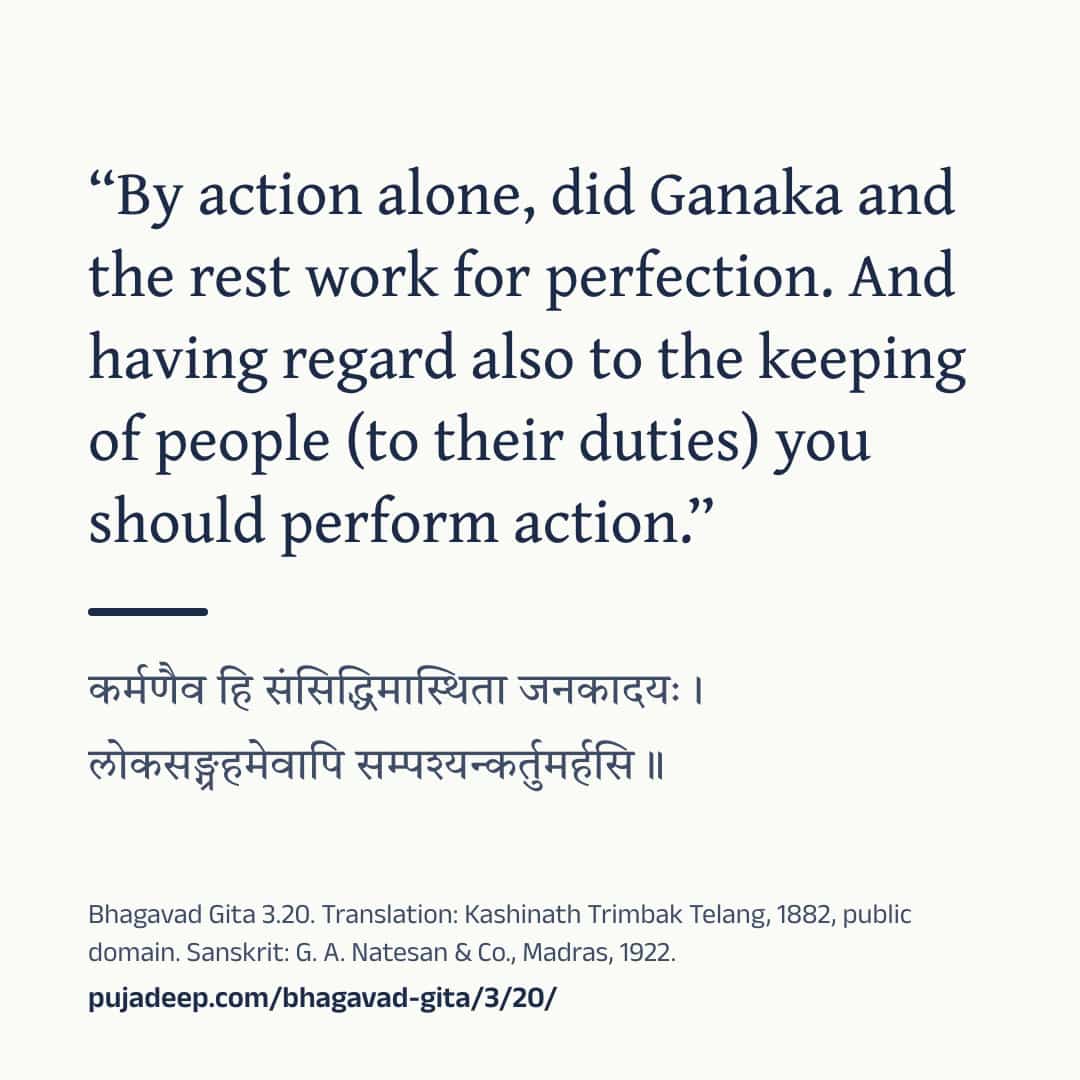
Drawing the picture
See the words
Bhagavad Gita 3.20

कर्मणैव हि संसिद्धिमास्थिता जनकादयः ।
लोकसङ्ग्रहमेवापि सम्पश्यन्कर्तुमर्हसि ॥

“By action alone, did Ganaka and the rest work for perfection. And having regard also to the keeping of people (to their duties) you should perform action.”
(K. T. Telang, The Bhagavadgîtâ (The Sacred Books of the East, vol. VIII, Oxford: Clarendon Press, 1882), p. 54, public domain)

“Janaka and others indeed attained to perfection by action; then having an eye to the protection of the masses also, thou shouldst perform action.”
(Annie Besant, The Bhagavad Gîtâ, or The Lord's Song (London: Theosophical Publishing Society, 1895), p. 44, public domain)

“Verily by action alone, Janaka and others attained perfection;—also, simply with the view for the guidance of men, thou shouldst perform action.”
(Swami Swarupananda, Srimad-Bhagavad-Gita (Mayavati: Prabuddha Bharata Press, 1909; first printed in Prabuddha Bharata, 1907–1909), p. 72, public domain)

Sanskrit: G. A. Natesan & Co., Madras, 1922.
https://pujadeep.com/bhagavad-gita/3/20/ Nothing is sent from this site. Your own app sends it, to the chat you choose. The picture quotes the translation you chose on this page, with its name and year.
Sanskrit text: The Bhagavad-Gita, or The Lord's Song, with the text in Devanagari and an English translation, 1922. Meanings: written for Pujadeep and checked against the cited edition. Source and changes
Questions families ask
Who speaks Bhagavad Gita 3.20?
Krishna speaks this verse, in chapter 3 (Karma Yoga).
Where does the Sanskrit text come from?
Sanskrit text: The Bhagavad-Gita, or The Lord's Song, with the text in Devanagari and an English translation, 1922. Meanings: written for Pujadeep and checked against the cited edition. See the source
Is the meaning on this page a translation?
Explanation written for this site from the sources listed here, and checked against the cited edition. It is not a translation and not the only way to read the text. Free to quote with credit.
Source and licence
- Sanskrit text
- The Bhagavad-Gita, or The Lord's Song, with the text in Devanagari and an English translation (Annie Besant, G. A. Natesan & Co., Madras, 1922). Public domain. The Sanskrit on these pages was read from this printing’s page images.
- Translation
- The Bhagavadgîtâ with the Sanatsugâtîya and the Anugîtâ, translated by Kâshinâth Trimbak Telang (The Sacred Books of the East, vol. VIII, ed. F. Max Müller) (Kashinath Trimbak Telang, F. Max Müller, Clarendon Press, Oxford, 1882). Public domain. Shown verbatim, as printed.
- Translation
- The Bhagavad Gîtâ, or The Lord's Song, translated by Annie Besant (Annie Besant, Theosophical Publishing Society, London, 1895). Public domain. Shown verbatim, as printed.
- Translation
- Srimad-Bhagavad-Gita, with Sanskrit Text; Paraphrase with Word-by-word Literal Translation; English Rendering and Comments, Index, &c., by the Swami Swarupananda (Himalayan Series, No. XX) (Swami Swarupananda, The Editors and Publishers, Advaita Ashrama, Mayavati, Prabuddha Bharata Press, Mayavati, Almora, Himalayas, 1909). Public domain. Shown verbatim, as printed.
- Commentary
- The Bhagavad-Gita, with the commentary of Sri Sankaracharya, translated by A. Mahadeva Sastri (2nd ed., Mysore: G. T. A. Printing Works, 1901) (Public-domain scan, University of California Libraries). Summarised in our own words; none of its text is reproduced.
- Commentary
- Sri Bhagavad-Gita with Sri Ramanujacharya's Visishtadvaita commentary, translated by A. Govindacharya (Madras, 1898) (Scan uploaded to archive.org (folkscanomy collection)). Summarised in our own words; none of its text is reproduced.
- Common wording
- In this text, 32 words follow today's common wording, checked against sanskritdocuments.org; Sanskrit Wikisource; Gita Press, Gorakhpur; GRETIL, Göttingen and Bhaktivedanta Book Trust.
- Our explanation
- Explanation written for this site from the sources listed here, and checked against the cited edition. It is not a translation and not the only way to read the text. Free to quote with credit.
- Checked
- Checked against the cited edition, October 27, 2026.