Bhagavad Gita 3.31: meaning and translation
Chapter 3: Karma Yoga. Krishna says
People who always follow this teaching (mata) of his with faith and without finding fault, Krishna says, are also freed from the bonds of action.
Click or tap a word for its meaning and its dictionary page.
Text and layers
Text and layers
These choices stay in this browser.
Bhagavad Gita 3.31
ये मे मतमिदं नित्यमनुतिष्ठन्ति मानवाः ।श्रद्धावन्तोऽनसूयन्तो मुच्यन्ते तेऽपि कर्मभिः ॥
Ye me matamidam nityamanutishthanti manavahShraddhavantonasuyanto muchyante tepi karmabhih
ye me matamidaṃ nityamanutiṣṭhanti mānavāḥ |śraddhāvanto’nasūyanto mucyante te’pi karmabhiḥ ||
Our explanation People who always follow this teaching (mata) of his with faith and without finding fault, Krishna says, are also freed from the bonds of action.
हिंदी अर्थ कृष्ण कहते हैं कि जो लोग श्रद्धा के साथ और दोष निकाले बिना उनके इस मत (उपदेश) का सदा पालन करते हैं, वे भी कर्मों के बंधन से छूट जाते हैं।
Word by word
Every word, with its dictionary page
Word by word
- ये ye · who (pronoun (masculine), nominative plural) Dictionary: yad, Monier-Williams 1899, p. 844, col. 2 “who, which, what, whichever, whatever, that”
- मे me · "my" (pronoun, genitive singular) Dictionary: 1. mad, Monier-Williams 1899, p. 777, col. 2 “base of the first pers. pron. in the sg. number”
- मतम् matam · teaching (noun (neuter), accusative singular) Dictionary: mata, Monier-Williams 1899, p. 783, col. 1 “a thought, idea, opinion, sentiment, view, belief, doctrine”
- इदम् idam · this (pronoun (neuter), accusative singular) Dictionary: 1. idam, Monier-Williams 1899, p. 165, col. 2
- नित्यम् nityam · always (indeclinable) Dictionary: nitya, Monier-Williams 1899, p. 547, col. 2 “continual, perpetual, eternal”
- अनुतिष्ठन्ति anutiṣṭhanti · follow (present, 3rd person plural) Dictionary: anu-ṣṭhā, Monier-Williams 1899, p. 40, col. 1 “to carry out, attend to; to perform, do, practise”
- मानवाः mānavāḥ · people (noun (masculine), nominative plural) Dictionary: mānava, Monier-Williams 1899, p. 809, col. 3 “a human being, man”
- श्रद्धावन्तः śraddhāvantaḥ · with faith (adjective (masculine), nominative plural) Dictionary: śraddhā-vat, Monier-Williams 1899, p. 1095, col. 3; śraddhā, Monier-Williams 1899, p. 1095, col. 3 “faith, trust, confidence”
- अनसूयन्तः anasūyantaḥ · not finding fault (present participle (masculine), nominative plural) Dictionary: an-asūya, Monier-Williams 1899, p. 27, col. 2 “not spiteful, not envious”; 1. asūya, Monier-Williams 1899, p. 121, col. 3 “to murmur at, be displeased or discontented with”
- मुच्यन्ते mucyante · are freed (present passive, 3rd person plural) Dictionary: 2. muc, Monier-Williams 1899, p. 820, col. 3 “to be loosed, to be set free or released”
- ते te · they (pronoun (masculine), nominative plural) Dictionary: tad, Monier-Williams 1899, p. 434, col. 1 “m. he, f. she, n. it, that, this”
- अपि api · also (indeclinable) Dictionary: api, Monier-Williams 1899, p. 55, col. 1 “even, also, very”
- कर्मभिः karmabhiḥ · from actions (noun (neuter), instrumental plural) Dictionary: karman, Monier-Williams 1899, p. 258, col. 2 “act, action, performance, business”
Old translations
Kashinath Trimbak Telang, 1882. Public domain. Page 56.
Even those men who always act on this opinion of mine, full of faith, and without carping, are released from all actions.
Compare 3 translations
Kashinath Trimbak Telang, 1882. Public domain. Page 56.
Even those men who always act on this opinion of mine, full of faith, and without carping, are released from all actions.
You are reading this one
Annie Besant, 1895. Public domain. Page 46.
Who abide ever in this teaching of Mine, full of faith and free from cavilling, they too are released from actions.
You are reading this one
Swami Swarupananda, 1909 (first printed 1907). Public domain. Page 77.
Those men who constantly practise this teaching of mine, full of Shraddhâ and without cavilling, they too, are freed from work.
You are reading this one
Cite this verse
The translation: K. T. Telang, The Bhagavadgîtâ (The Sacred Books of the East, vol. VIII, Oxford: Clarendon Press, 1882), p. 56. Bhagavad Gita 3.31.
The translation: Annie Besant, The Bhagavad Gîtâ, or The Lord's Song (London: Theosophical Publishing Society, 1895), p. 46. Bhagavad Gita 3.31.
The translation: Swami Swarupananda, Srimad-Bhagavad-Gita (Mayavati: Prabuddha Bharata Press, 1909; first printed in Prabuddha Bharata, 1907–1909), p. 77. Bhagavad Gita 3.31.
Our explanation: “Bhagavad Gita 3.31: meaning and translation.” Pujadeep. Updated October 27, 2026. https://pujadeep.com/bhagavad-gita/3/31/
Pujadeep’s explanations are free to quote with credit: name Pujadeep and link to the page. How to credit
Classical readings, by school
No readings by school on this verse yet.
Share
Show the ways to share
Send one picture or the text to one chat. The picture names its source and the address of this page.
Drawing the picture
See the words
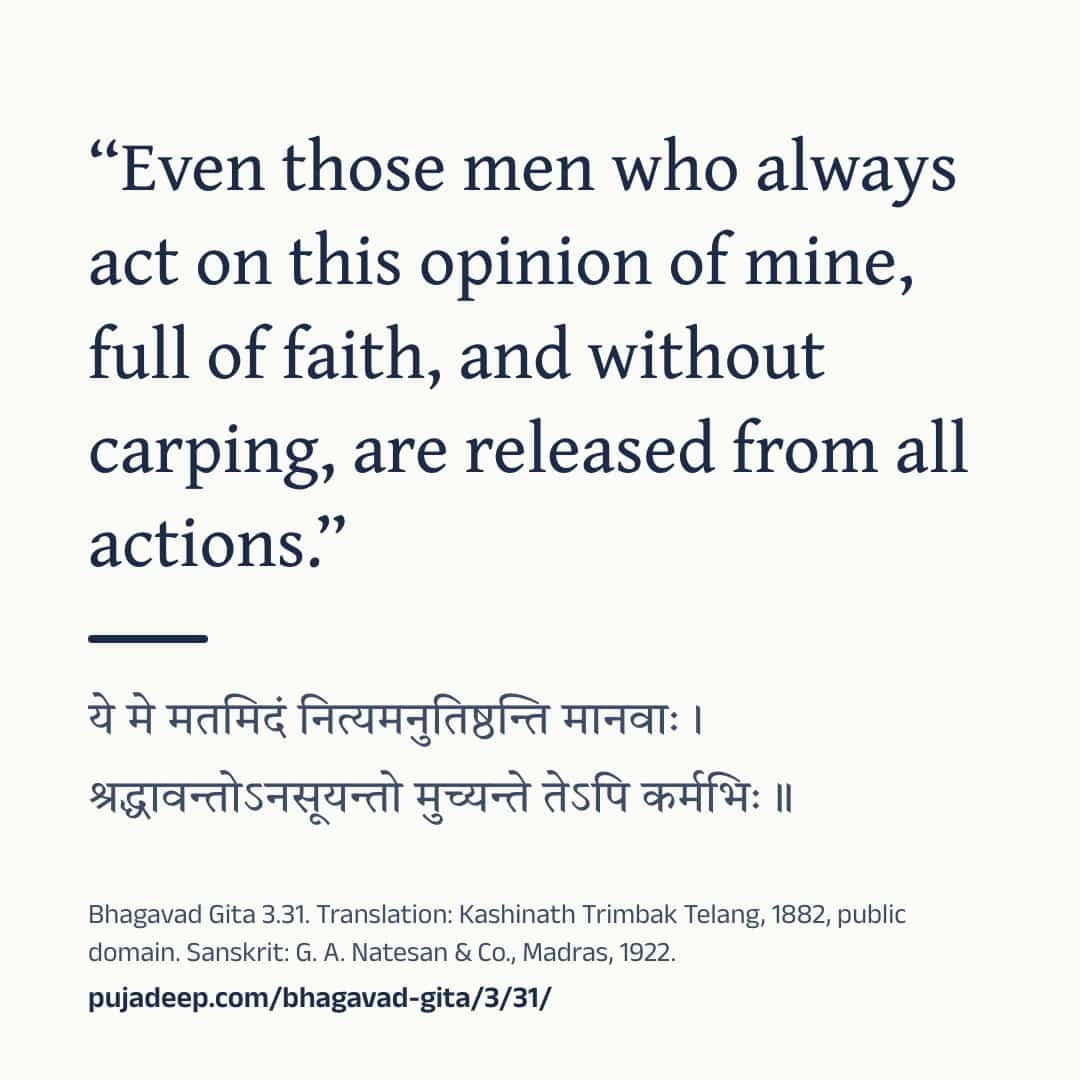
Bhagavad Gita 3.31

ये मे मतमिदं नित्यमनुतिष्ठन्ति मानवाः ।
श्रद्धावन्तोऽनसूयन्तो मुच्यन्ते तेऽपि कर्मभिः ॥

“Even those men who always act on this opinion of mine, full of faith, and without carping, are released from all actions.”
(K. T. Telang, The Bhagavadgîtâ (The Sacred Books of the East, vol. VIII, Oxford: Clarendon Press, 1882), p. 56, public domain)

“Who abide ever in this teaching of Mine, full of faith and free from cavilling, they too are released from actions.”
(Annie Besant, The Bhagavad Gîtâ, or The Lord's Song (London: Theosophical Publishing Society, 1895), p. 46, public domain)

“Those men who constantly practise this teaching of mine, full of Shraddhâ and without cavilling, they too, are freed from work.”
(Swami Swarupananda, Srimad-Bhagavad-Gita (Mayavati: Prabuddha Bharata Press, 1909; first printed in Prabuddha Bharata, 1907–1909), p. 77, public domain)

Sanskrit: G. A. Natesan & Co., Madras, 1922.
https://pujadeep.com/bhagavad-gita/3/31/ Nothing is sent from this site. Your own app sends it, to the chat you choose. The picture quotes the translation you chose on this page, with its name and year.
Sanskrit text: The Bhagavad-Gita, or The Lord's Song, with the text in Devanagari and an English translation, 1922. Meanings: written for Pujadeep and checked against the cited edition. Source and changes
Questions families ask
Who speaks Bhagavad Gita 3.31?
Krishna speaks this verse, in chapter 3 (Karma Yoga).
Where does the Sanskrit text come from?
Sanskrit text: The Bhagavad-Gita, or The Lord's Song, with the text in Devanagari and an English translation, 1922. Meanings: written for Pujadeep and checked against the cited edition. See the source
Is the meaning on this page a translation?
Explanation written for this site from the sources listed here, and checked against the cited edition. It is not a translation and not the only way to read the text. Free to quote with credit.
Source and licence
- Sanskrit text
- The Bhagavad-Gita, or The Lord's Song, with the text in Devanagari and an English translation (Annie Besant, G. A. Natesan & Co., Madras, 1922). Public domain. The Sanskrit on these pages was read from this printing’s page images.
- Translation
- The Bhagavadgîtâ with the Sanatsugâtîya and the Anugîtâ, translated by Kâshinâth Trimbak Telang (The Sacred Books of the East, vol. VIII, ed. F. Max Müller) (Kashinath Trimbak Telang, F. Max Müller, Clarendon Press, Oxford, 1882). Public domain. Shown verbatim, as printed.
- Translation
- The Bhagavad Gîtâ, or The Lord's Song, translated by Annie Besant (Annie Besant, Theosophical Publishing Society, London, 1895). Public domain. Shown verbatim, as printed.
- Translation
- Srimad-Bhagavad-Gita, with Sanskrit Text; Paraphrase with Word-by-word Literal Translation; English Rendering and Comments, Index, &c., by the Swami Swarupananda (Himalayan Series, No. XX) (Swami Swarupananda, The Editors and Publishers, Advaita Ashrama, Mayavati, Prabuddha Bharata Press, Mayavati, Almora, Himalayas, 1909). Public domain. Shown verbatim, as printed.
- Common wording
- In this text, 32 words follow today's common wording, checked against sanskritdocuments.org; Sanskrit Wikisource; Gita Press, Gorakhpur; GRETIL, Göttingen and Bhaktivedanta Book Trust.
- Our explanation
- Explanation written for this site from the sources listed here, and checked against the cited edition. It is not a translation and not the only way to read the text. Free to quote with credit.
- Checked
- Checked against the cited edition, October 27, 2026.