Bhagavad Gita 3.41: meaning and translation
Chapter 3: Karma Yoga. Krishna says
So, Krishna tells Arjuna, best of the Bharatas, first control the senses, and then strike down this sinful thing, which destroys knowledge (jñāna) and realisation (vijñāna).
Click or tap a word for its meaning and its dictionary page.
Text and layers
Text and layers
These choices stay in this browser.
Bhagavad Gita 3.41
तस्मात्त्वमिन्द्रियाण्यादौ नियम्य भरतर्षभ ।पाप्मानं प्रजहि ह्येनं ज्ञानविज्ञाननाशनम् ॥
Tasmattvamindriyanyadau niyamya bharatarshabhaPapmanam prajahi hyenam jnanavijnananashanam
tasmāttvamindriyāṇyādau niyamya bharatarṣabha |pāpmānaṃ prajahi hyenaṃ jñānavijñānanāśanam ||
Our explanation So, Krishna tells Arjuna, best of the Bharatas, first control the senses, and then strike down this sinful thing, which destroys knowledge (jñāna) and realisation (vijñāna). Telang's note explains: knowledge comes from books or teachers, experience from one's own perception.
हिंदी अर्थ इसलिए कृष्ण अर्जुन से, जिन्हें वे भरतर्षभ (भरतवंशियों में श्रेष्ठ) कहते हैं, कहते हैं कि पहले इंद्रियों को वश में करें, फिर ज्ञान और विज्ञान का नाश करने वाली इस पापी कामना को नष्ट करें। तेलंग की टिप्पणी के अनुसार ज्ञान पुस्तकों या गुरुओं से आता है, और विज्ञान (अनुभव) अपने प्रत्यक्ष अनुभव से।
Word by word
Every word, with its dictionary page
Word by word
- तस्मात् tasmāt · therefore (indeclinable) Dictionary: tasmāt, Monier-Williams 1899, p. 441, col. 2 “from that, on that account, therefore”
- त्वम् tvam · you (pronoun, nominative singular) Dictionary: 2. tva, Monier-Williams 1899, p. 463, col. 2 “base of the 2nd personal pron.”
- इन्द्रियाणि indriyāṇi · the senses (noun (neuter), accusative plural) Dictionary: indriya, Monier-Williams 1899, p. 167, col. 2 “faculty of sense, sense, organ of sense”
- आदौ ādau · first (noun (masculine), locative singular) Dictionary: 1. ādi, Monier-Williams 1899, p. 136, col. 3 “beginning, commencement”
- नियम्य niyamya · having controlled (absolutive (having done)) Dictionary: ni-yam, Monier-Williams 1899, p. 552, col. 1 “to hold in, keep down, restrain, control, govern, regulate”
- भरतर्षभ bharatarṣabha · O best of the Bharatas (compound (masculine), vocative singular) Dictionary: bharata, Monier-Williams 1899, p. 747, col. 2 “a celebrated hero and monarch of India”; ṛṣabha, Monier-Williams 1899, p. 226, col. 3 “a bull”
- पाप्मानम् pāpmānam · this sinful one (noun (masculine), accusative singular) Dictionary: pāpman, Monier-Williams 1899, p. 619, col. 1 “evil, unhappiness, misfortune, calamity, crime, sin, wickedness”
- प्रजहि prajahi · strike down, cast off (imperative, 2nd person singular) Dictionary: 1. han, Monier-Williams 1899, p. 1287, col. 2 “to smite, slay, hit, kill, mar, destroy”; pra-hā, Monier-Williams 1899, p. 700, col. 3
- हि hi · surely (indeclinable) Dictionary: 2. hi, Monier-Williams 1899, p. 1297, col. 3 “for, because, on account of”
- एनम् enam · this (pronoun (masculine), accusative singular) Dictionary: 1. ena, Monier-Williams 1899, p. 232, col. 1 “he, she, it; this, that”
- ज्ञानविज्ञाननाशनम् jñānavijñānanāśanam · destroying knowledge and realisation (compound (masculine), accusative singular) Dictionary: jñāna, Monier-Williams 1899, p. 426, col. 1 “knowing, becoming acquainted with, knowledge”; vi-jñāna, Monier-Williams 1899, p. 961, col. 2 “the act of distinguishing or discerning, understanding, comprehending, recognizing, intelligence, knowledge”; nāśana, Monier-Williams 1899, p. 538, col. 1 “destroying &c. = prec. (with gen. or ifc.), VS.; MBh. &c.; n. destruction, removal”
Old translations
Kashinath Trimbak Telang, 1882. Public domain. Page 57.
Therefore, O chief of the descendants of Bharata! first restrain your senses, then cast off this sinful thing which destroys knowledge and experience1.
Footnotes (the translator’s own) - Knowledge is from books or teachers, experience is the result of personal perception. ↩
Compare 3 translations
Kashinath Trimbak Telang, 1882. Public domain. Page 57.
Therefore, O chief of the descendants of Bharata! first restrain your senses, then cast off this sinful thing which destroys knowledge and experience1.
Footnotes (the translator’s own) - Knowledge is from books or teachers, experience is the result of personal perception. ↩
You are reading this one
Annie Besant, 1895. Public domain. Page 48.
Therefore, O best of the Bhâratas, from the first, mastering the senses, do thou cast off this thing of sin, destructive of wisdom and knowledge!
You are reading this one
Swami Swarupananda, 1909 (first printed 1907). Public domain. Page 82.
Therefore, O Bull of the Bharata race, controlling the senses at the outset, kill it,—the sinful, the destroyer of knowledge and realisation.
You are reading this one
Cite this verse
The translation: K. T. Telang, The Bhagavadgîtâ (The Sacred Books of the East, vol. VIII, Oxford: Clarendon Press, 1882), p. 57. Bhagavad Gita 3.41.
The translation: Annie Besant, The Bhagavad Gîtâ, or The Lord's Song (London: Theosophical Publishing Society, 1895), p. 48. Bhagavad Gita 3.41.
The translation: Swami Swarupananda, Srimad-Bhagavad-Gita (Mayavati: Prabuddha Bharata Press, 1909; first printed in Prabuddha Bharata, 1907–1909), p. 82. Bhagavad Gita 3.41.
Our explanation: “Bhagavad Gita 3.41: meaning and translation.” Pujadeep. Updated October 27, 2026. https://pujadeep.com/bhagavad-gita/3/41/
Pujadeep’s explanations are free to quote with credit: name Pujadeep and link to the page. How to credit
Classical readings, by school
No readings by school on this verse yet.
Share
Show the ways to share
Send one picture or the text to one chat. The picture names its source and the address of this page.
Drawing the picture
See the words
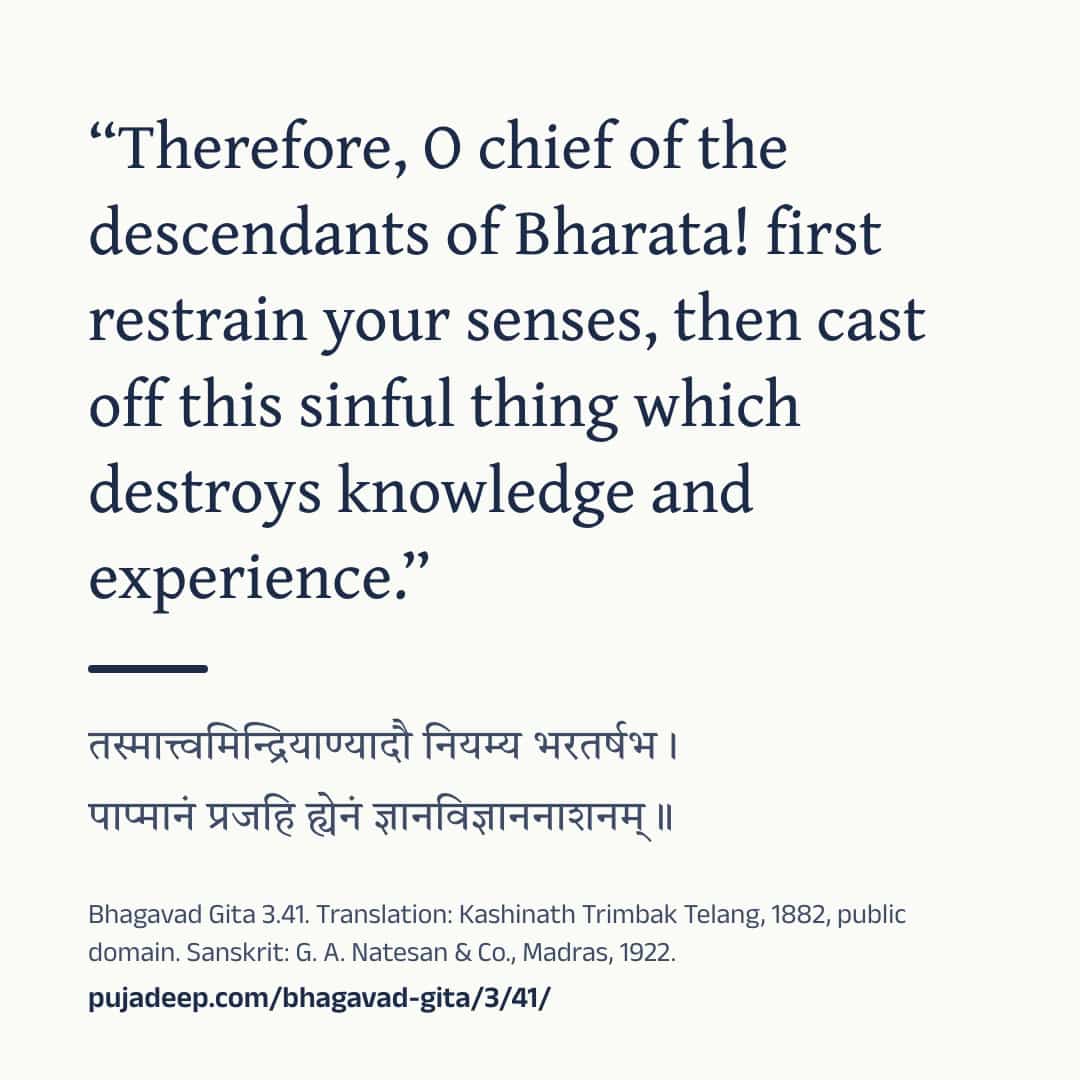
Bhagavad Gita 3.41

तस्मात्त्वमिन्द्रियाण्यादौ नियम्य भरतर्षभ ।
पाप्मानं प्रजहि ह्येनं ज्ञानविज्ञाननाशनम् ॥

“Therefore, O chief of the descendants of Bharata! first restrain your senses, then cast off this sinful thing which destroys knowledge and experience.”
(K. T. Telang, The Bhagavadgîtâ (The Sacred Books of the East, vol. VIII, Oxford: Clarendon Press, 1882), p. 57, public domain)

“Therefore, O best of the Bhâratas, from the first, mastering the senses, do thou cast off this thing of sin, destructive of wisdom and knowledge!”
(Annie Besant, The Bhagavad Gîtâ, or The Lord's Song (London: Theosophical Publishing Society, 1895), p. 48, public domain)

“Therefore, O Bull of the Bharata race, controlling the senses at the outset, kill it,—the sinful, the destroyer of knowledge and realisation.”
(Swami Swarupananda, Srimad-Bhagavad-Gita (Mayavati: Prabuddha Bharata Press, 1909; first printed in Prabuddha Bharata, 1907–1909), p. 82, public domain)

Sanskrit: G. A. Natesan & Co., Madras, 1922.
https://pujadeep.com/bhagavad-gita/3/41/ Nothing is sent from this site. Your own app sends it, to the chat you choose. The picture quotes the translation you chose on this page, with its name and year.
Sanskrit text: The Bhagavad-Gita, or The Lord's Song, with the text in Devanagari and an English translation, 1922. Meanings: written for Pujadeep and checked against the cited edition. Source and changes
Questions families ask
Who speaks Bhagavad Gita 3.41?
Krishna speaks this verse, in chapter 3 (Karma Yoga).
Where does the Sanskrit text come from?
Sanskrit text: The Bhagavad-Gita, or The Lord's Song, with the text in Devanagari and an English translation, 1922. Meanings: written for Pujadeep and checked against the cited edition. See the source
Is the meaning on this page a translation?
Explanation written for this site from the sources listed here, and checked against the cited edition. It is not a translation and not the only way to read the text. Free to quote with credit.
Source and licence
- Sanskrit text
- The Bhagavad-Gita, or The Lord's Song, with the text in Devanagari and an English translation (Annie Besant, G. A. Natesan & Co., Madras, 1922). Public domain. The Sanskrit on these pages was read from this printing’s page images.
- Translation
- The Bhagavadgîtâ with the Sanatsugâtîya and the Anugîtâ, translated by Kâshinâth Trimbak Telang (The Sacred Books of the East, vol. VIII, ed. F. Max Müller) (Kashinath Trimbak Telang, F. Max Müller, Clarendon Press, Oxford, 1882). Public domain. Shown verbatim, as printed.
- Translation
- The Bhagavad Gîtâ, or The Lord's Song, translated by Annie Besant (Annie Besant, Theosophical Publishing Society, London, 1895). Public domain. Shown verbatim, as printed.
- Translation
- Srimad-Bhagavad-Gita, with Sanskrit Text; Paraphrase with Word-by-word Literal Translation; English Rendering and Comments, Index, &c., by the Swami Swarupananda (Himalayan Series, No. XX) (Swami Swarupananda, The Editors and Publishers, Advaita Ashrama, Mayavati, Prabuddha Bharata Press, Mayavati, Almora, Himalayas, 1909). Public domain. Shown verbatim, as printed.
- Common wording
- In this text, 32 words follow today's common wording, checked against sanskritdocuments.org; Sanskrit Wikisource; Gita Press, Gorakhpur; GRETIL, Göttingen and Bhaktivedanta Book Trust.
- Our explanation
- Explanation written for this site from the sources listed here, and checked against the cited edition. It is not a translation and not the only way to read the text. Free to quote with credit.
- Checked
- Checked against the cited edition, October 27, 2026.