Bhagavad Gita 3.38: meaning and translation
Chapter 3: Karma Yoga. Krishna says
As fire is covered by smoke, a mirror by dust, and an embryo by its membrane (ulba), Krishna says, so “this” is covered by desire.
Click or tap a word for its meaning and its dictionary page.
Text and layers
Text and layers
These choices stay in this browser.
Bhagavad Gita 3.38
धूमेनाऽव्रियते वह्निर्यथाऽऽदर्शो मलेन च ।यथोल्बेनावृतो गर्भस्तथा तेनेदमावृतम् ॥
Dhumenavriyate vahniryathadarsho malena chaYatholbenavrito garbhastatha tenedamavritam
dhūmenā’vriyate vahniryathā’’darśo malena ca |yatholbenāvṛto garbhastathā tenedamāvṛtam ||
Our explanation As fire is covered by smoke, a mirror by dust, and an embryo by its membrane (ulba), Krishna says, so “this” is covered by desire. The schools differ on what “this” is (see the views); Telang's note takes it as knowledge, and Besant's note as the universe, adding that some take it as knowledge.
हिंदी अर्थ कृष्ण कहते हैं कि जैसे आग धुएँ से, दर्पण मैल से और गर्भ झिल्ली (उल्ब) से ढका रहता है, वैसे ही “यह” कामना से ढका है। “यह” क्या है, इस पर मत अलग हैं: तेलंग की टिप्पणी इसे ज्ञान मानती है, और बेसेंट की टिप्पणी संसार, यह जोड़ते हुए कि कुछ लोग इसे ज्ञान मानते हैं।
Word by word
Every word, with its dictionary page
Word by word
- धूमेन dhūmena · by smoke (noun (masculine), instrumental singular) Dictionary: dhūma, Monier-Williams 1899, p. 518, col. 1 “smoke, vapour, mist”
- आव्रियते āvriyate · is covered (present passive, 3rd person singular) Dictionary: 1. ā-vṛ, Monier-Williams 1899, p. 156, col. 1 “to cover, hide, conceal”
- वह्निः vahniḥ · fire (noun (masculine), nominative singular) Dictionary: vahni, Monier-Williams 1899, p. 933, col. 3 “the conveyer or bearer of oblations to the gods”
- यथा yathā · as (indeclinable) Dictionary: yathā, Monier-Williams 1899, p. 841, col. 2 “in which manner or way, according as, as, like”
- आदर्शः ādarśaḥ · a mirror (noun (masculine), nominative singular) Dictionary: ā-darśa, Monier-Williams 1899, p. 138, col. 1 “a looking-glass, mirror”
- मलेन malena · by dust, by dirt (noun (masculine), instrumental singular) Dictionary: mala, Monier-Williams 1899, p. 792, col. 1 “dirt, filth, dust, impurity (physical and moral)”
- च ca · and (indeclinable) Dictionary: 2. ca, Monier-Williams 1899, p. 380, col. 1 “and, both, also, moreover, as well as”
- यथा yathā · as (indeclinable) Dictionary: yathā, Monier-Williams 1899, p. 841, col. 2 “in which manner or way, according as, as, like”
- उल्बेन ulbena · by the membrane (ulba) (noun (neuter), instrumental singular) Dictionary: ulba, Monier-Williams 1899, p. 219, col. 1 “a cover, envelope, esp. the membrane surrounding the embryo”
- आवृतः āvṛtaḥ · covered (past participle (masculine), nominative singular) Dictionary: ā-vṛta, Monier-Williams 1899, p. 156, col. 1 “covered, concealed, hid”
- गर्भः garbhaḥ · an embryo (noun (masculine), nominative singular) Dictionary: garbha, Monier-Williams 1899, p. 349, col. 2 “the womb”
- तथा tathā · so (indeclinable) Dictionary: tathā, Monier-Williams 1899, p. 433, col. 3 “in that manner, so, thus”
- तेन tena · by it (pronoun (masculine), instrumental singular) Dictionary: tad, Monier-Williams 1899, p. 434, col. 1 “m. he, f. she, n. it, that, this”
- इदम् idam · this (pronoun (neuter), nominative singular) Dictionary: 1. idam, Monier-Williams 1899, p. 165, col. 2
- आवृतम् āvṛtam · covered (past participle (neuter), nominative singular) Dictionary: ā-vṛta, Monier-Williams 1899, p. 156, col. 1 “covered, concealed, hid”
1 printing differs
Edition differences. Another printing or text reads this place differently.
- Spelling A digital text reads Same words. The 1922 edition marks the merged vowels with avagrahas (धूमेनाऽव्रियते, यथाऽऽदर्शो); this e-text does not.
Old translations
Kashinath Trimbak Telang, 1882. Public domain. Page 57.
As fire is enveloped by smoke, a mirror by dust, the fœtus by the womb, so is this1 enveloped by desire.
Footnotes (the translator’s own) - I. e. knowledge, mentioned in the next sentence, for which construction p. 71 and p. 98 may be compared. ↩
Compare 3 translations
Kashinath Trimbak Telang, 1882. Public domain. Page 57.
As fire is enveloped by smoke, a mirror by dust, the fœtus by the womb, so is this1 enveloped by desire.
Footnotes (the translator’s own) - I. e. knowledge, mentioned in the next sentence, for which construction p. 71 and p. 98 may be compared. ↩
You are reading this one
Annie Besant, 1895. Public domain. Page 47.
As a flame is enveloped by smoke, as a mirror by rust, as an embryo is wrapped by the womb, so This1 is enveloped by it.
Footnotes (the translator’s own) - The universe: "This" as opposed to "THAT," he Eternal. Some say "This" stands for knowledge." ↩
You are reading this one
Swami Swarupananda, 1909 (first printed 1907). Public domain. Page 160.
As fire is enveloped by smoke, as a mirror by dust, as an embryo by the womb, so is it covered by that.
You are reading this one
Cite this verse
The translation: K. T. Telang, The Bhagavadgîtâ (The Sacred Books of the East, vol. VIII, Oxford: Clarendon Press, 1882), p. 57. Bhagavad Gita 3.38.
The translation: Annie Besant, The Bhagavad Gîtâ, or The Lord's Song (London: Theosophical Publishing Society, 1895), p. 47. Bhagavad Gita 3.38.
The translation: Swami Swarupananda, Srimad-Bhagavad-Gita (Mayavati: Prabuddha Bharata Press, 1909; first printed in Prabuddha Bharata, 1907–1909), p. 160. Bhagavad Gita 3.38.
Our explanation: “Bhagavad Gita 3.38: meaning and translation.” Pujadeep. Updated October 27, 2026. https://pujadeep.com/bhagavad-gita/3/38/
Pujadeep’s explanations are free to quote with credit: name Pujadeep and link to the page. How to credit
Classical readings, by school
Each reading is named by its school. None is presented as the only meaning.
What Advaita, Vishishtadvaita and Dvaita teach, in short
Shankara Advaita
Shankara asks what “this” is and answers from the next verse: it is knowledge (jñāna), covered by desire as a bright fire is covered by dark smoke.
Source: The Bhagavad-Gita, with the commentary of Sri Sankaracharya, translated by A. Mahadeva Sastri (2nd ed., Mysore: G. T. A. Printing Works, 1901), commentary on 3.38–39, p. 101. Summarised in our own words; none of its text is reproduced.
Ramanuja Vishishtadvaita
Ramanuja takes “this” to be all creatures, the world, wrapped in desire as fire is in smoke, a mirror in a stain and an embryo in its membrane.
Source: Sri Bhagavad-Gita with Sri Ramanujacharya's Visishtadvaita commentary, translated by A. Govindacharya (Madras, 1898), commentary on 3.38, p. 122. Summarised in our own words; none of its text is reproduced.
Share
Show the ways to share
Send one picture or the text to one chat. The picture names its source and the address of this page.
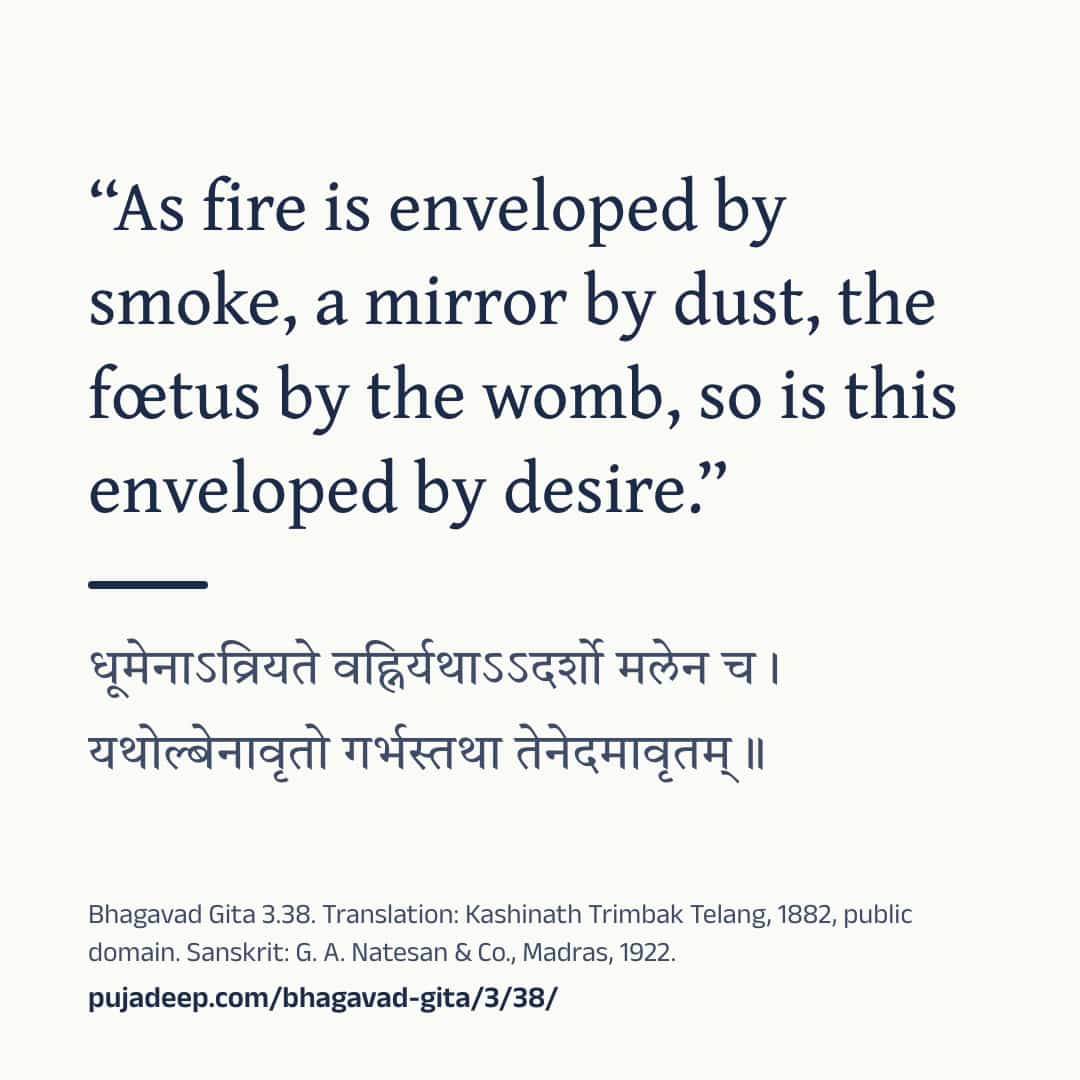
Drawing the picture
See the words
Bhagavad Gita 3.38

धूमेनाऽव्रियते वह्निर्यथाऽऽदर्शो मलेन च ।
यथोल्बेनावृतो गर्भस्तथा तेनेदमावृतम् ॥

“As fire is enveloped by smoke, a mirror by dust, the fœtus by the womb, so is this enveloped by desire.”
(K. T. Telang, The Bhagavadgîtâ (The Sacred Books of the East, vol. VIII, Oxford: Clarendon Press, 1882), p. 57, public domain)

“As a flame is enveloped by smoke, as a mirror by rust, as an embryo is wrapped by the womb, so This is enveloped by it.”
(Annie Besant, The Bhagavad Gîtâ, or The Lord's Song (London: Theosophical Publishing Society, 1895), p. 47, public domain)

“As fire is enveloped by smoke, as a mirror by dust, as an embryo by the womb, so is it covered by that.”
(Swami Swarupananda, Srimad-Bhagavad-Gita (Mayavati: Prabuddha Bharata Press, 1909; first printed in Prabuddha Bharata, 1907–1909), p. 160, public domain)

Sanskrit: G. A. Natesan & Co., Madras, 1922.
https://pujadeep.com/bhagavad-gita/3/38/ Nothing is sent from this site. Your own app sends it, to the chat you choose. The picture quotes the translation you chose on this page, with its name and year.
Sanskrit text: The Bhagavad-Gita, or The Lord's Song, with the text in Devanagari and an English translation, 1922. Meanings: written for Pujadeep and checked against the cited edition. Source and changes
Questions families ask
Who speaks Bhagavad Gita 3.38?
Krishna speaks this verse, in chapter 3 (Karma Yoga).
Where does the Sanskrit text come from?
Sanskrit text: The Bhagavad-Gita, or The Lord's Song, with the text in Devanagari and an English translation, 1922. Meanings: written for Pujadeep and checked against the cited edition. See the source
Is the meaning on this page a translation?
Explanation written for this site from the sources listed here, and checked against the cited edition. It is not a translation and not the only way to read the text. Free to quote with credit.
Source and licence
- Sanskrit text
- The Bhagavad-Gita, or The Lord's Song, with the text in Devanagari and an English translation (Annie Besant, G. A. Natesan & Co., Madras, 1922). Public domain. The Sanskrit on these pages was read from this printing’s page images.
- Translation
- The Bhagavadgîtâ with the Sanatsugâtîya and the Anugîtâ, translated by Kâshinâth Trimbak Telang (The Sacred Books of the East, vol. VIII, ed. F. Max Müller) (Kashinath Trimbak Telang, F. Max Müller, Clarendon Press, Oxford, 1882). Public domain. Shown verbatim, as printed.
- Translation
- The Bhagavad Gîtâ, or The Lord's Song, translated by Annie Besant (Annie Besant, Theosophical Publishing Society, London, 1895). Public domain. Shown verbatim, as printed.
- Translation
- Srimad-Bhagavad-Gita, with Sanskrit Text; Paraphrase with Word-by-word Literal Translation; English Rendering and Comments, Index, &c., by the Swami Swarupananda (Himalayan Series, No. XX) (Swami Swarupananda, The Editors and Publishers, Advaita Ashrama, Mayavati, Prabuddha Bharata Press, Mayavati, Almora, Himalayas, 1909). Public domain. Shown verbatim, as printed.
- Commentary
- The Bhagavad-Gita, with the commentary of Sri Sankaracharya, translated by A. Mahadeva Sastri (2nd ed., Mysore: G. T. A. Printing Works, 1901) (Public-domain scan, University of California Libraries). Summarised in our own words; none of its text is reproduced.
- Commentary
- Sri Bhagavad-Gita with Sri Ramanujacharya's Visishtadvaita commentary, translated by A. Govindacharya (Madras, 1898) (Scan uploaded to archive.org (folkscanomy collection)). Summarised in our own words; none of its text is reproduced.
- Common wording
- In this text, 32 words follow today's common wording, checked against sanskritdocuments.org; Sanskrit Wikisource; Gita Press, Gorakhpur; GRETIL, Göttingen and Bhaktivedanta Book Trust.
- Our explanation
- Explanation written for this site from the sources listed here, and checked against the cited edition. It is not a translation and not the only way to read the text. Free to quote with credit.
- Checked
- Checked against the cited edition, October 27, 2026.