Bhagavad Gita 3.28: meaning and translation
Chapter 3: Karma Yoga. Krishna says
But the one who knows the truth about how the qualities and their actions are divided, Krishna says, holds that “the qualities move among the qualities”, and is not attached.
Click or tap a word for its meaning and its dictionary page.
Text and layers
Text and layers
These choices stay in this browser.
Bhagavad Gita 3.28
तत्त्ववित्तु महाबाहो गुणकर्मविभागयोः ।गुणा गुणेषु वर्तन्त इति मत्वा न सज्जते ॥
Tattvavittu mahabaho gunakarmavibhagayohGuna guneshu vartanta iti matva na sajjate
tattvavittu mahābāho guṇakarmavibhāgayoḥ |guṇā guṇeṣu vartanta iti matvā na sajjate ||
Our explanation But the one who knows the truth about how the qualities and their actions are divided, Krishna says, holds that “the qualities move among the qualities”, and is not attached. Besant's footnote explains: the qualities as organs of sense move among the qualities as objects of sense. He calls Arjuna mighty-armed.
हिंदी अर्थ कृष्ण कहते हैं कि जो गुणों और कर्मों के विभाग का तत्त्व जानता है, वह मानता है कि “गुण ही गुणों में बरत रहे हैं”, और आसक्त नहीं होता। बेसेंट की टिप्पणी के अनुसार इंद्रियों के रूप में गुण, विषयों के रूप में गुणों में बरतते हैं। वे अर्जुन को महाबाहो (बलवान भुजाओं वाले) कहकर पुकारते हैं।
Word by word
Every word, with its dictionary page
Word by word
- तत्त्ववित् tattvavit · knower of the truth (compound (masculine), nominative singular) Dictionary: tat-tva-vid, Monier-Williams 1899, p. 433, col. 1 “knowing the true nature of (gen.)”
- तु tu · but (indeclinable) Dictionary: 2. tu, Monier-Williams 1899, p. 449, col. 3 “but”
- महाबाहो mahābāho · O mighty-armed (noun (masculine), vocative singular) Dictionary: mahā-bāhu, Monier-Williams 1899, p. 798, col. 1 “long-armed”
- गुणकर्मविभागयोः guṇakarmavibhāgayoḥ · of the divisions of qualities and actions (compound (masculine), genitive dual) Dictionary: guṇa, Monier-Williams 1899, p. 357, col. 1 “a quality, peculiarity, attribute or property”; karman, Monier-Williams 1899, p. 258, col. 2 “act, action, performance, business”; vi-bhāga, Monier-Williams 1899, p. 977, col. 2 “division, separation, distinction, difference”
- गुणाः guṇāḥ · the qualities (noun (masculine), nominative plural) Dictionary: guṇa, Monier-Williams 1899, p. 357, col. 1 “a quality, peculiarity, attribute or property”
- गुणेषु guṇeṣu · among the qualities (noun (masculine), locative plural) Dictionary: guṇa, Monier-Williams 1899, p. 357, col. 1 “a quality, peculiarity, attribute or property”
- वर्तन्ते vartante · move, act (present, 3rd person plural) Dictionary: 1. vṛt, Monier-Williams 1899, p. 1009, col. 1 “to move or go on, get along, advance, proceed”
- इति iti · thus (ends the quotation) (indeclinable) Dictionary: 2. iti, Monier-Williams 1899, p. 165, col. 1 “in this manner, thus”
- मत्वा matvā · having understood (absolutive (having done)) Dictionary: man, Monier-Williams 1899, p. 783, col. 1 “to think, believe, imagine, suppose, conjecture”
- न na · not (indeclinable) Dictionary: 2. na, Monier-Williams 1899, p. 523, col. 1 “not, no, nor, neither”
- सज्जते sajjate · is attached (present passive, 3rd person singular) Dictionary: 2. sañj, Monier-Williams 1899, p. 1132, col. 3 “to be attached or fastened, adhere, cling, stick”
Old translations
Kashinath Trimbak Telang, 1882. Public domain. Page 55.
But he, O you of mighty arms! who knows the truth about the difference from qualities and the difference from actions1, forms no attachments, believing that qualities deal with qualities2.
Footnotes (the translator’s own) Compare 3 translations
Kashinath Trimbak Telang, 1882. Public domain. Page 55.
But he, O you of mighty arms! who knows the truth about the difference from qualities and the difference from actions1, forms no attachments, believing that qualities deal with qualities2.
Footnotes (the translator’s own) You are reading this one
Annie Besant, 1895. Public domain. Page 45.
But he who knoweth the Essence, O mighty-armed, the divisions of the energies and functions, holding that "the energies move amid the energies"1 is not bound.
Footnotes (the translator’s own) - The energies as sense-organs move amid the energies as sense-objects. A suggested reading is "The functions dwell in the propensities." ↩
You are reading this one
Swami Swarupananda, 1909 (first printed 1907). Public domain. Page 75.
But, one, with true insight into the domains of Guna and Karma, knowing that it is the senses which run after the objects, does not become attached.
You are reading this one
Cite this verse
The translation: K. T. Telang, The Bhagavadgîtâ (The Sacred Books of the East, vol. VIII, Oxford: Clarendon Press, 1882), p. 55. Bhagavad Gita 3.28.
The translation: Annie Besant, The Bhagavad Gîtâ, or The Lord's Song (London: Theosophical Publishing Society, 1895), p. 45. Bhagavad Gita 3.28.
The translation: Swami Swarupananda, Srimad-Bhagavad-Gita (Mayavati: Prabuddha Bharata Press, 1909; first printed in Prabuddha Bharata, 1907–1909), p. 75. Bhagavad Gita 3.28.
Our explanation: “Bhagavad Gita 3.28: meaning and translation.” Pujadeep. Updated October 27, 2026. https://pujadeep.com/bhagavad-gita/3/28/
Pujadeep’s explanations are free to quote with credit: name Pujadeep and link to the page. How to credit
Classical readings, by school
No readings by school on this verse yet.
Share
Show the ways to share
Send one picture or the text to one chat. The picture names its source and the address of this page.
Drawing the picture
See the words
Bhagavad Gita 3.28

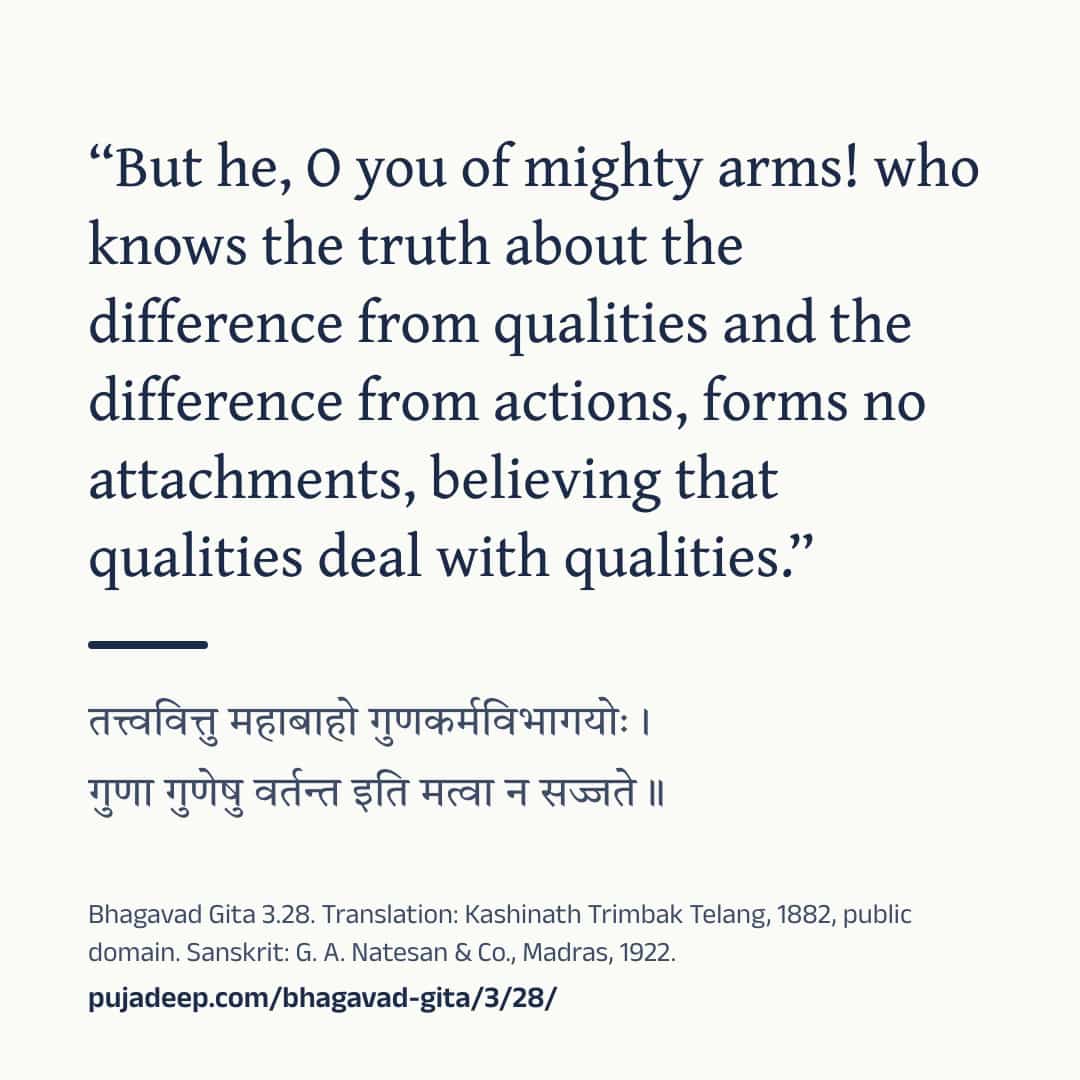
तत्त्ववित्तु महाबाहो गुणकर्मविभागयोः ।
गुणा गुणेषु वर्तन्त इति मत्वा न सज्जते ॥

“But he, O you of mighty arms! who knows the truth about the difference from qualities and the difference from actions, forms no attachments, believing that qualities deal with qualities.”
(K. T. Telang, The Bhagavadgîtâ (The Sacred Books of the East, vol. VIII, Oxford: Clarendon Press, 1882), p. 55, public domain)

“But he who knoweth the Essence, O mighty-armed, the divisions of the energies and functions, holding that "the energies move amid the energies" is not bound.”
(Annie Besant, The Bhagavad Gîtâ, or The Lord's Song (London: Theosophical Publishing Society, 1895), p. 45, public domain)

“But, one, with true insight into the domains of Guna and Karma, knowing that it is the senses which run after the objects, does not become attached.”
(Swami Swarupananda, Srimad-Bhagavad-Gita (Mayavati: Prabuddha Bharata Press, 1909; first printed in Prabuddha Bharata, 1907–1909), p. 75, public domain)

Sanskrit: G. A. Natesan & Co., Madras, 1922.
https://pujadeep.com/bhagavad-gita/3/28/ Nothing is sent from this site. Your own app sends it, to the chat you choose. The picture quotes the translation you chose on this page, with its name and year.
Sanskrit text: The Bhagavad-Gita, or The Lord's Song, with the text in Devanagari and an English translation, 1922. Meanings: written for Pujadeep and checked against the cited edition. Source and changes
Questions families ask
Who speaks Bhagavad Gita 3.28?
Krishna speaks this verse, in chapter 3 (Karma Yoga).
Where does the Sanskrit text come from?
Sanskrit text: The Bhagavad-Gita, or The Lord's Song, with the text in Devanagari and an English translation, 1922. Meanings: written for Pujadeep and checked against the cited edition. See the source
Is the meaning on this page a translation?
Explanation written for this site from the sources listed here, and checked against the cited edition. It is not a translation and not the only way to read the text. Free to quote with credit.
Source and licence
- Sanskrit text
- The Bhagavad-Gita, or The Lord's Song, with the text in Devanagari and an English translation (Annie Besant, G. A. Natesan & Co., Madras, 1922). Public domain. The Sanskrit on these pages was read from this printing’s page images.
- Translation
- The Bhagavadgîtâ with the Sanatsugâtîya and the Anugîtâ, translated by Kâshinâth Trimbak Telang (The Sacred Books of the East, vol. VIII, ed. F. Max Müller) (Kashinath Trimbak Telang, F. Max Müller, Clarendon Press, Oxford, 1882). Public domain. Shown verbatim, as printed.
- Translation
- The Bhagavad Gîtâ, or The Lord's Song, translated by Annie Besant (Annie Besant, Theosophical Publishing Society, London, 1895). Public domain. Shown verbatim, as printed.
- Translation
- Srimad-Bhagavad-Gita, with Sanskrit Text; Paraphrase with Word-by-word Literal Translation; English Rendering and Comments, Index, &c., by the Swami Swarupananda (Himalayan Series, No. XX) (Swami Swarupananda, The Editors and Publishers, Advaita Ashrama, Mayavati, Prabuddha Bharata Press, Mayavati, Almora, Himalayas, 1909). Public domain. Shown verbatim, as printed.
- Common wording
- In this text, 32 words follow today's common wording, checked against sanskritdocuments.org; Sanskrit Wikisource; Gita Press, Gorakhpur; GRETIL, Göttingen and Bhaktivedanta Book Trust.
- Our explanation
- Explanation written for this site from the sources listed here, and checked against the cited edition. It is not a translation and not the only way to read the text. Free to quote with credit.
- Checked
- Checked against the cited edition, October 27, 2026.