Bhagavad Gita 3.27: meaning and translation
Chapter 3: Karma Yoga. Krishna says
All actions are done by the qualities (guṇas) of nature (prakṛti), Krishna says.
Click or tap a word for its meaning and its dictionary page.
Text and layers
Text and layers
These choices stay in this browser.
Bhagavad Gita 3.27
प्रकृतेः क्रियमाणानि गुणैः कर्माणि सर्वशः ।अहङ्कारविमूढात्मा कर्ताऽहमिति मन्यते ॥
Prakriteh kriyamanani gunaih karmani sarvashahAhankaravimudhatma kartahamiti manyate
prakṛteḥ kriyamāṇāni guṇaiḥ karmāṇi sarvaśaḥ |ahaṅkāravimūḍhātmā kartā’hamiti manyate ||
Our explanation All actions are done by the qualities (guṇas) of nature (prakṛti), Krishna says. But a person whose mind is deluded by ego (ahaṅkāra) thinks, “I am the doer.”
हिंदी अर्थ कृष्ण कहते हैं कि सब कर्म प्रकृति के गुणों द्वारा होते हैं। पर अहंकार से मोहित मन वाला व्यक्ति सोचता है, “मैं कर्ता हूँ।”
Word by word
Every word, with its dictionary page
Word by word
- प्रकृतेः prakṛteḥ · of nature (prakṛti) (noun (feminine), genitive singular) Dictionary: pra-kṛti, Monier-Williams 1899, p. 654, col. 1 “the original producer of (or rather passive power of creating) the material world”
- क्रियमाणानि kriyamāṇāni · being done (present passive participle (neuter), nominative plural) Dictionary: 1. kṛ, Monier-Williams 1899, p. 301, col. 1 “to do, make, perform, accomplish, cause, effect”
- गुणैः guṇaiḥ · by the qualities (guṇas) (noun (masculine), instrumental plural) Dictionary: guṇa, Monier-Williams 1899, p. 357, col. 1 “a quality, peculiarity, attribute or property”
- कर्माणि karmāṇi · actions (noun (neuter), nominative plural) Dictionary: karman, Monier-Williams 1899, p. 258, col. 2 “act, action, performance, business”
- सर्वशः sarvaśaḥ · all, in every way (indeclinable) Dictionary: sarvaśas, Monier-Williams 1899, p. 1189, col. 2 “wholly, completely, entirely, thoroughly, collectively, altogether”
- अहङ्कारविमूढात्मा ahaṅkāravimūḍhātmā · deluded in mind by ego (compound (masculine), nominative singular) Dictionary: ahaṃ-kāra, Monier-Williams 1899, p. 124, col. 2 “conception of one's individuality, self-consciousness”; vi-mūḍha, Monier-Williams 1899, p. 980, col. 3; vi-mugdha, Monier-Williams 1899, p. 980, col. 3 “confused, bewildered, infatuated”; vi-mūḍhātman, Monier-Williams 1899, p. 980, col. 3 “foolish-minded, perplexed in mind, senseless”; ātman, Monier-Williams 1899, p. 135, col. 1 “the understanding, intellect, mind”
- कर्ता kartā · the doer (noun (masculine), nominative singular) Dictionary: kartṛ, Monier-Williams 1899, p. 257, col. 3 “one who makes or does or acts or effects, a doer, maker, agent, author”
- अहम् aham · "I" (pronoun, nominative singular) Dictionary: aham, Monier-Williams 1899, p. 124, col. 2 “nom. sg. ‘I,’”
- इति iti · thus (ends the quotation) (indeclinable) Dictionary: 2. iti, Monier-Williams 1899, p. 165, col. 1 “in this manner, thus”
- मन्यते manyate · thinks (present, 3rd person singular) Dictionary: man, Monier-Williams 1899, p. 783, col. 1 “to think, believe, imagine, suppose, conjecture”
1 printing differs
Edition differences. Another printing or text reads this place differently.
- Spelling A digital text reads Same words. The 1922 edition marks the merged vowel with an avagraha (कर्ताऽहम्); this e-text does not.
Old translations
Kashinath Trimbak Telang, 1882. Public domain. Page 55.
He whose mind is deluded by egoism thinks himself the doer of the actions, which, in every way, are done by the qualities of nature1.
Footnotes (the translator’s own) - The active principle is nature, the aggregate of the three qualities; the soul is only the looker-on; cf. inter alia, p. 104 infra. ↩
Compare 3 translations
Kashinath Trimbak Telang, 1882. Public domain. Page 55.
He whose mind is deluded by egoism thinks himself the doer of the actions, which, in every way, are done by the qualities of nature1.
Footnotes (the translator’s own) - The active principle is nature, the aggregate of the three qualities; the soul is only the looker-on; cf. inter alia, p. 104 infra. ↩
You are reading this one
Annie Besant, 1895. Public domain. Page 45.
Actions are wrought by the energies of Nature only. The self, deluded by egoism,1 thinketh: "I am the doer."
Footnotes (the translator’s own) - Ahankâra, the separate "I am." ↩
You are reading this one
Swami Swarupananda, 1909 (first printed 1907). Public domain. Page 75.
The Gunas of Prakriti, perform all action. With the understanding deluded by egoism, one regards oneself, as "I am the doer."
You are reading this one
Cite this verse
The translation: K. T. Telang, The Bhagavadgîtâ (The Sacred Books of the East, vol. VIII, Oxford: Clarendon Press, 1882), p. 55. Bhagavad Gita 3.27.
The translation: Annie Besant, The Bhagavad Gîtâ, or The Lord's Song (London: Theosophical Publishing Society, 1895), p. 45. Bhagavad Gita 3.27.
The translation: Swami Swarupananda, Srimad-Bhagavad-Gita (Mayavati: Prabuddha Bharata Press, 1909; first printed in Prabuddha Bharata, 1907–1909), p. 75. Bhagavad Gita 3.27.
Our explanation: “Bhagavad Gita 3.27: meaning and translation.” Pujadeep. Updated October 27, 2026. https://pujadeep.com/bhagavad-gita/3/27/
Pujadeep’s explanations are free to quote with credit: name Pujadeep and link to the page. How to credit
Classical readings, by school
No readings by school on this verse yet.
Share
Show the ways to share
Send one picture or the text to one chat. The picture names its source and the address of this page.
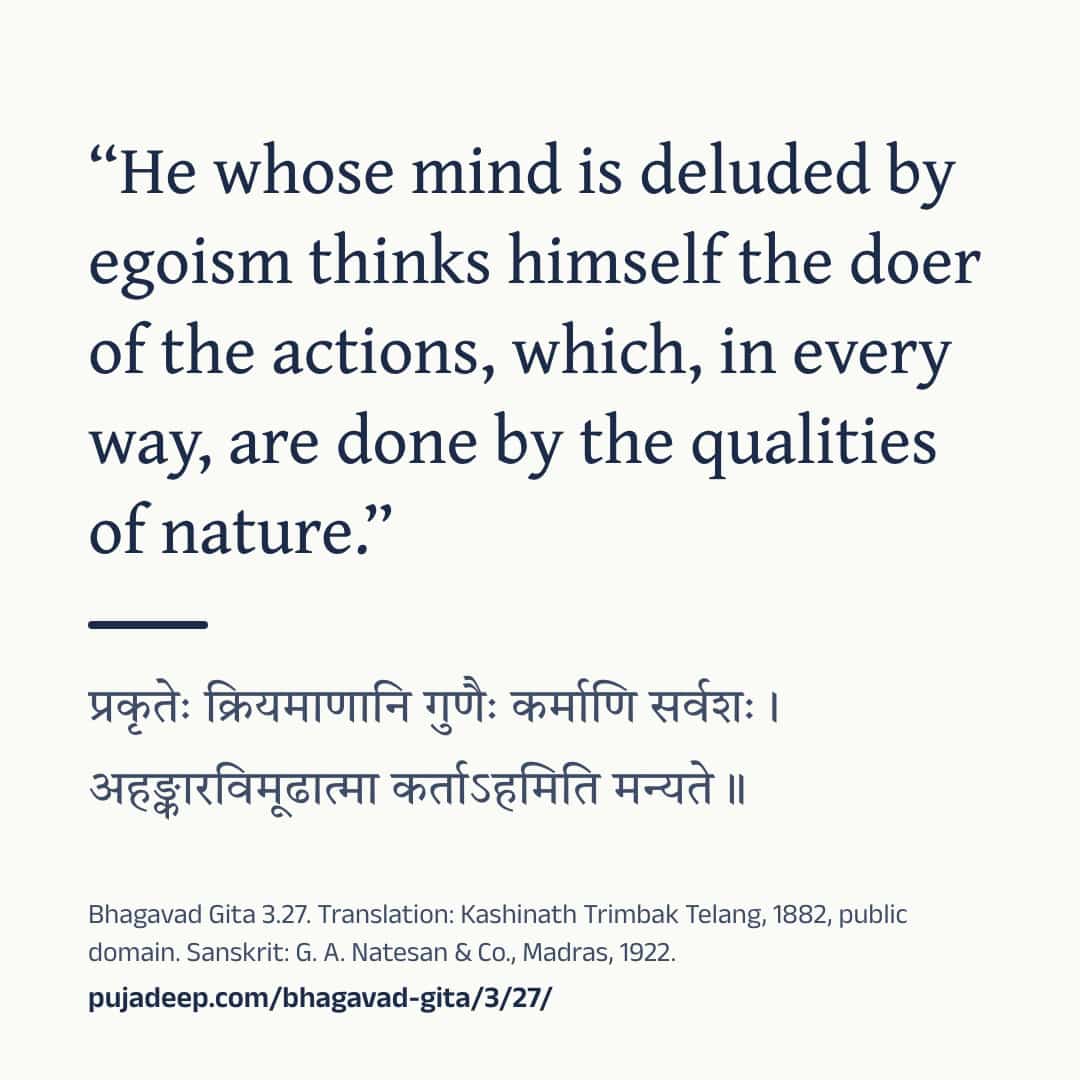
Drawing the picture
See the words
Bhagavad Gita 3.27

प्रकृतेः क्रियमाणानि गुणैः कर्माणि सर्वशः ।
अहङ्कारविमूढात्मा कर्ताऽहमिति मन्यते ॥

“He whose mind is deluded by egoism thinks himself the doer of the actions, which, in every way, are done by the qualities of nature.”
(K. T. Telang, The Bhagavadgîtâ (The Sacred Books of the East, vol. VIII, Oxford: Clarendon Press, 1882), p. 55, public domain)

“Actions are wrought by the energies of Nature only. The self, deluded by egoism, thinketh: "I am the doer."”
(Annie Besant, The Bhagavad Gîtâ, or The Lord's Song (London: Theosophical Publishing Society, 1895), p. 45, public domain)

“The Gunas of Prakriti, perform all action. With the understanding deluded by egoism, one regards oneself, as "I am the doer."”
(Swami Swarupananda, Srimad-Bhagavad-Gita (Mayavati: Prabuddha Bharata Press, 1909; first printed in Prabuddha Bharata, 1907–1909), p. 75, public domain)

Sanskrit: G. A. Natesan & Co., Madras, 1922.
https://pujadeep.com/bhagavad-gita/3/27/ Nothing is sent from this site. Your own app sends it, to the chat you choose. The picture quotes the translation you chose on this page, with its name and year.
Sanskrit text: The Bhagavad-Gita, or The Lord's Song, with the text in Devanagari and an English translation, 1922. Meanings: written for Pujadeep and checked against the cited edition. Source and changes
Questions families ask
Who speaks Bhagavad Gita 3.27?
Krishna speaks this verse, in chapter 3 (Karma Yoga).
Where does the Sanskrit text come from?
Sanskrit text: The Bhagavad-Gita, or The Lord's Song, with the text in Devanagari and an English translation, 1922. Meanings: written for Pujadeep and checked against the cited edition. See the source
Is the meaning on this page a translation?
Explanation written for this site from the sources listed here, and checked against the cited edition. It is not a translation and not the only way to read the text. Free to quote with credit.
Source and licence
- Sanskrit text
- The Bhagavad-Gita, or The Lord's Song, with the text in Devanagari and an English translation (Annie Besant, G. A. Natesan & Co., Madras, 1922). Public domain. The Sanskrit on these pages was read from this printing’s page images.
- Translation
- The Bhagavadgîtâ with the Sanatsugâtîya and the Anugîtâ, translated by Kâshinâth Trimbak Telang (The Sacred Books of the East, vol. VIII, ed. F. Max Müller) (Kashinath Trimbak Telang, F. Max Müller, Clarendon Press, Oxford, 1882). Public domain. Shown verbatim, as printed.
- Translation
- The Bhagavad Gîtâ, or The Lord's Song, translated by Annie Besant (Annie Besant, Theosophical Publishing Society, London, 1895). Public domain. Shown verbatim, as printed.
- Translation
- Srimad-Bhagavad-Gita, with Sanskrit Text; Paraphrase with Word-by-word Literal Translation; English Rendering and Comments, Index, &c., by the Swami Swarupananda (Himalayan Series, No. XX) (Swami Swarupananda, The Editors and Publishers, Advaita Ashrama, Mayavati, Prabuddha Bharata Press, Mayavati, Almora, Himalayas, 1909). Public domain. Shown verbatim, as printed.
- Common wording
- In this text, 32 words follow today's common wording, checked against sanskritdocuments.org; Sanskrit Wikisource; Gita Press, Gorakhpur; GRETIL, Göttingen and Bhaktivedanta Book Trust.
- Our explanation
- Explanation written for this site from the sources listed here, and checked against the cited edition. It is not a translation and not the only way to read the text. Free to quote with credit.
- Checked
- Checked against the cited edition, October 27, 2026.