Bhagavad Gita 3.37: meaning and translation
Chapter 3: Karma Yoga. Krishna says
Krishna answers that it is desire (kāma), it is anger (krodha), born of the quality of rajas (restless activity).
Click or tap a word for its meaning and its dictionary page.
Text and layers
Text and layers
These choices stay in this browser.
Bhagavad Gita 3.37
श्रीभगवानुवाच ।
काम एष क्रोध एष रजोगुणसमुद्भवः ।महाशनो महापाप्मा विद्ध्येनमिह वैरिणम् ॥
Kama esha krodha esha rajogunasamudbhavahMahashano mahapapma viddhyenamiha vairinam
kāma eṣa krodha eṣa rajoguṇasamudbhavaḥ |mahāśano mahāpāpmā viddhyenamiha vairiṇam ||
Our explanation Krishna answers that it is desire (kāma), it is anger (krodha), born of the quality of rajas (restless activity). It is all-devouring and very sinful; Arjuna should know it as the enemy here. Both Shankara and Ramanuja explain that anger is desire that has been blocked.
हिंदी अर्थ कृष्ण उत्तर देते हैं कि यह काम (कामना) है, यह क्रोध है, जो रजोगुण (बेचैन सक्रियता) से उत्पन्न होता है। यह सब कुछ खा जाने वाला और महापापी है; अर्जुन इसे यहाँ का शत्रु जानें। शंकराचार्य और रामानुजाचार्य दोनों समझाते हैं कि रुकावट पड़ने पर कामना ही क्रोध बन जाती है।
Word by word
Every word, with its dictionary page
Word by word
- कामः kāmaḥ · desire (noun (masculine), nominative singular) Dictionary: kāma, Monier-Williams 1899, p. 271, col. 3 “wish, desire, longing”
- एषः eṣaḥ · this (pronoun (masculine), nominative singular) Dictionary: etad, Monier-Williams 1899, p. 231, col. 2 “this, this here, here”
- क्रोधः krodhaḥ · anger (noun (masculine), nominative singular) Dictionary: krodha, Monier-Williams 1899, p. 322, col. 1 “anger, wrath, passion”
- एषः eṣaḥ · this (pronoun (masculine), nominative singular) Dictionary: etad, Monier-Williams 1899, p. 231, col. 2 “this, this here, here”
- रजोगुणसमुद्भवः rajoguṇasamudbhavaḥ · born of the quality of rajas (compound (masculine), nominative singular) Dictionary: rajas, Monier-Williams 1899, p. 863, col. 2 “the 'darkening' quality, passion, emotion, affection”; guṇa, Monier-Williams 1899, p. 357, col. 1 “a quality, peculiarity, attribute or property”; sam-udbhava, Monier-Williams 1899, p. 1168, col. 2 “existence, production, origin”
- महाशनः mahāśanaḥ · all-devouring (compound (masculine), nominative singular) Dictionary: mahāśana, Monier-Williams 1899, p. 801, col. 1 “eating much, voracious, a great eater”
- महापाप्मा mahāpāpmā · very sinful (compound (masculine), nominative singular) Dictionary: mahā, Monier-Williams 1899, p. 794, col. 3 “in comp. for mahat”; pāpman, Monier-Williams 1899, p. 619, col. 1 “evil, unhappiness, misfortune, calamity, crime, sin, wickedness”
- विद्धि viddhi · know (imperative, 2nd person singular) Dictionary: 1. vid, Monier-Williams 1899, p. 963, col. 2 “to know, understand, perceive, learn”
- एनम् enam · it, this (pronoun (masculine), accusative singular) Dictionary: 1. ena, Monier-Williams 1899, p. 232, col. 1 “he, she, it; this, that”
- इह iha · here (indeclinable) Dictionary: iha, Monier-Williams 1899, p. 169, col. 3 “in this place, here”
- वैरिणम् vairiṇam · the enemy (noun (masculine), accusative singular) Dictionary: vairin, Monier-Williams 1899, p. 1025, col. 1 “hostile, inimical; m. an enemy”
Old translations
Kashinath Trimbak Telang, 1882. Public domain. Page 57.
The Deity said:
It is desire, it is wrath1, born from the quality of passion; it is very ravenous, very sinful. Know that that is the foe in this world.
Footnotes (the translator’s own) - Vide p. 50 supra. ↩
Compare 3 translations
Kashinath Trimbak Telang, 1882. Public domain. Page 57.
The Deity said:
It is desire, it is wrath1, born from the quality of passion; it is very ravenous, very sinful. Know that that is the foe in this world.
Footnotes (the translator’s own) - Vide p. 50 supra. ↩
You are reading this one
Annie Besant, 1895. Public domain. Page 47.
The Blessed Lord said:
It is desire, it is wrath, begotten by the Rajas-energy; all-consuming, all-polluting, know thou this as our foe here on earth.
You are reading this one
Swami Swarupananda, 1909 (first printed 1907). Public domain. Page 160.
The Blessed Lord said:
It is desire—it is anger, born of the Raja-guna: of great craving, and of great sin; know this as the foe here (in this world).
You are reading this one
Cite this verse
The translation: K. T. Telang, The Bhagavadgîtâ (The Sacred Books of the East, vol. VIII, Oxford: Clarendon Press, 1882), p. 57. Bhagavad Gita 3.37.
The translation: Annie Besant, The Bhagavad Gîtâ, or The Lord's Song (London: Theosophical Publishing Society, 1895), p. 47. Bhagavad Gita 3.37.
The translation: Swami Swarupananda, Srimad-Bhagavad-Gita (Mayavati: Prabuddha Bharata Press, 1909; first printed in Prabuddha Bharata, 1907–1909), p. 160. Bhagavad Gita 3.37.
Our explanation: “Bhagavad Gita 3.37: meaning and translation.” Pujadeep. Updated October 27, 2026. https://pujadeep.com/bhagavad-gita/3/37/
Pujadeep’s explanations are free to quote with credit: name Pujadeep and link to the page. How to credit
Classical readings, by school
No readings by school on this verse yet.
Share
Show the ways to share
Send one picture or the text to one chat. The picture names its source and the address of this page.
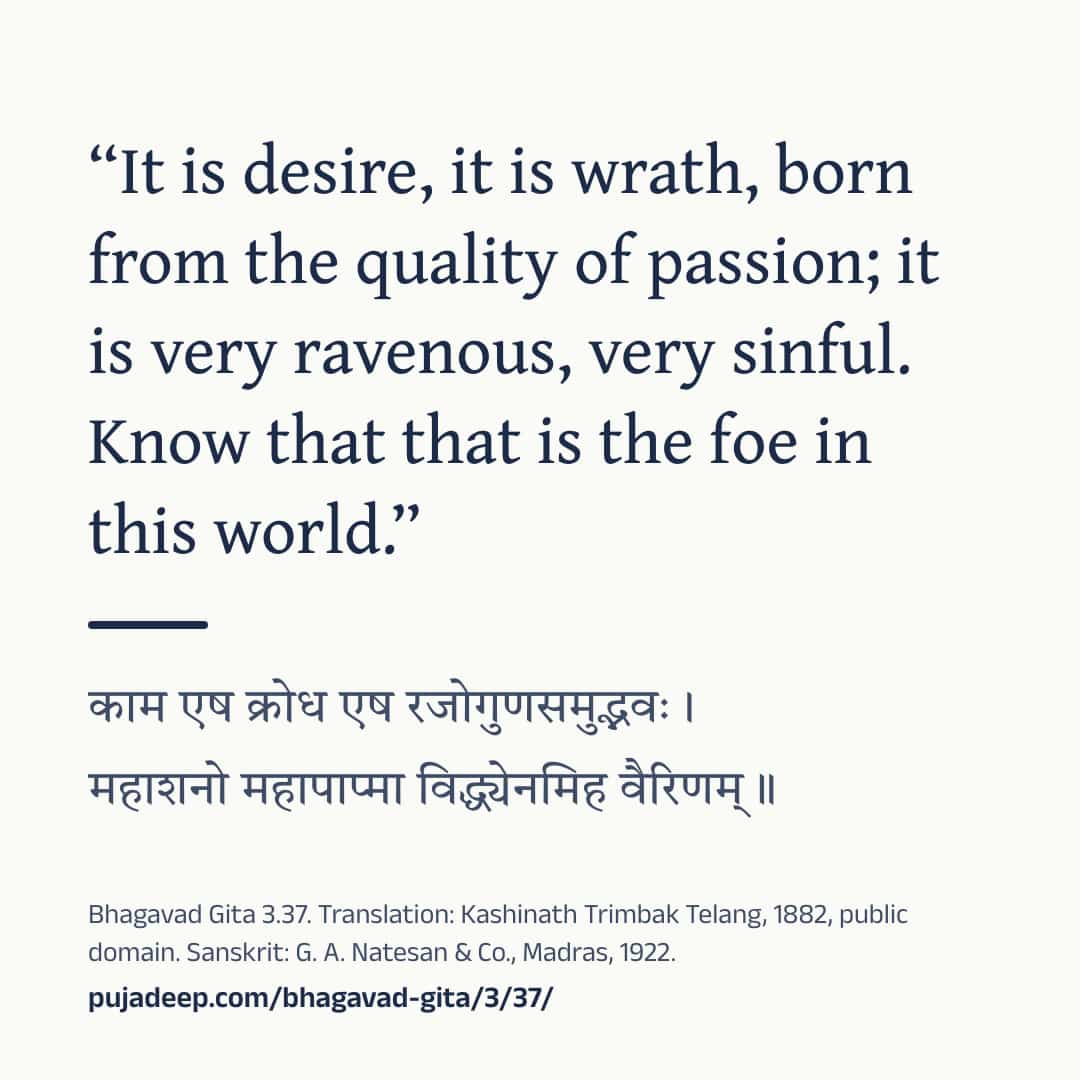
Drawing the picture
See the words
Bhagavad Gita 3.37

काम एष क्रोध एष रजोगुणसमुद्भवः ।
महाशनो महापाप्मा विद्ध्येनमिह वैरिणम् ॥

“It is desire, it is wrath, born from the quality of passion; it is very ravenous, very sinful. Know that that is the foe in this world.”
(K. T. Telang, The Bhagavadgîtâ (The Sacred Books of the East, vol. VIII, Oxford: Clarendon Press, 1882), p. 57, public domain)

“It is desire, it is wrath, begotten by the Rajas-energy; all-consuming, all-polluting, know thou this as our foe here on earth.”
(Annie Besant, The Bhagavad Gîtâ, or The Lord's Song (London: Theosophical Publishing Society, 1895), p. 47, public domain)

“It is desire—it is anger, born of the Raja-guna: of great craving, and of great sin; know this as the foe here (in this world).”
(Swami Swarupananda, Srimad-Bhagavad-Gita (Mayavati: Prabuddha Bharata Press, 1909; first printed in Prabuddha Bharata, 1907–1909), p. 160, public domain)

Sanskrit: G. A. Natesan & Co., Madras, 1922.
https://pujadeep.com/bhagavad-gita/3/37/ Nothing is sent from this site. Your own app sends it, to the chat you choose. The picture quotes the translation you chose on this page, with its name and year.
Sanskrit text: The Bhagavad-Gita, or The Lord's Song, with the text in Devanagari and an English translation, 1922. Meanings: written for Pujadeep and checked against the cited edition. Source and changes
Questions families ask
Who speaks Bhagavad Gita 3.37?
Krishna speaks this verse, in chapter 3 (Karma Yoga).
Where does the Sanskrit text come from?
Sanskrit text: The Bhagavad-Gita, or The Lord's Song, with the text in Devanagari and an English translation, 1922. Meanings: written for Pujadeep and checked against the cited edition. See the source
Is the meaning on this page a translation?
Explanation written for this site from the sources listed here, and checked against the cited edition. It is not a translation and not the only way to read the text. Free to quote with credit.
Source and licence
- Sanskrit text
- The Bhagavad-Gita, or The Lord's Song, with the text in Devanagari and an English translation (Annie Besant, G. A. Natesan & Co., Madras, 1922). Public domain. The Sanskrit on these pages was read from this printing’s page images.
- Translation
- The Bhagavadgîtâ with the Sanatsugâtîya and the Anugîtâ, translated by Kâshinâth Trimbak Telang (The Sacred Books of the East, vol. VIII, ed. F. Max Müller) (Kashinath Trimbak Telang, F. Max Müller, Clarendon Press, Oxford, 1882). Public domain. Shown verbatim, as printed.
- Translation
- The Bhagavad Gîtâ, or The Lord's Song, translated by Annie Besant (Annie Besant, Theosophical Publishing Society, London, 1895). Public domain. Shown verbatim, as printed.
- Translation
- Srimad-Bhagavad-Gita, with Sanskrit Text; Paraphrase with Word-by-word Literal Translation; English Rendering and Comments, Index, &c., by the Swami Swarupananda (Himalayan Series, No. XX) (Swami Swarupananda, The Editors and Publishers, Advaita Ashrama, Mayavati, Prabuddha Bharata Press, Mayavati, Almora, Himalayas, 1909). Public domain. Shown verbatim, as printed.
- Common wording
- In this text, 32 words follow today's common wording, checked against sanskritdocuments.org; Sanskrit Wikisource; Gita Press, Gorakhpur; GRETIL, Göttingen and Bhaktivedanta Book Trust.
- Our explanation
- Explanation written for this site from the sources listed here, and checked against the cited edition. It is not a translation and not the only way to read the text. Free to quote with credit.
- Checked
- Checked against the cited edition, October 27, 2026.