Bhagavad Gita 3.39: meaning and translation
Chapter 3: Karma Yoga. Krishna says
Knowledge (jñāna) is covered by this constant enemy of the wise, Krishna says, in the form of desire, which is hard to fill (duṣpūra) and burns like fire (anala).
Click or tap a word for its meaning and its dictionary page.
Text and layers
Text and layers
These choices stay in this browser.
Bhagavad Gita 3.39
आवृतं ज्ञानमेतेन ज्ञानिनो नित्यवैरिणा ।कामरूपेण कौन्तेय दुष्पूरेणानलेन च ॥
Avritam jnanametena jnanino nityavairinaKamarupena kaunteya dushpurenanalena cha
āvṛtaṃ jñānametena jñānino nityavairiṇā |kāmarūpeṇa kaunteya duṣpūreṇānalena ca ||
Our explanation Knowledge (jñāna) is covered by this constant enemy of the wise, Krishna says, in the form of desire, which is hard to fill (duṣpūra) and burns like fire (anala). He calls Arjuna son of Kunti.
हिंदी अर्थ कृष्ण कहते हैं कि हे कौन्तेय, ज्ञानी के इस नित्य शत्रु ने, कामना के रूप में, ज्ञान को ढक रखा है; यह कामना कभी भरती नहीं (दुष्पूर) और आग (अनल) की तरह जलती है।
Word by word
Every word, with its dictionary page
Word by word
- आवृतम् āvṛtam · covered (past participle (neuter), nominative singular) Dictionary: ā-vṛta, Monier-Williams 1899, p. 156, col. 1 “covered, concealed, hid”
- ज्ञानम् jñānam · knowledge (noun (neuter), nominative singular) Dictionary: jñāna, Monier-Williams 1899, p. 426, col. 1 “knowing, becoming acquainted with, knowledge”
- एतेन etena · by this (pronoun (masculine), instrumental singular) Dictionary: etad, Monier-Williams 1899, p. 231, col. 2 “this, this here, here”
- ज्ञानिनः jñāninaḥ · of the wise (noun (masculine), genitive singular) Dictionary: jñānin, Monier-Williams 1899, p. 426, col. 2 “knowing, endowed with knowledge or intelligence, wise”
- नित्यवैरिणा nityavairiṇā · by the constant enemy (compound (masculine), instrumental singular) Dictionary: nitya, Monier-Williams 1899, p. 547, col. 2 “continual, perpetual, eternal”; vairin, Monier-Williams 1899, p. 1025, col. 1 “hostile, inimical; m. an enemy”
- कामरूपेण kāmarūpeṇa · in the form of desire (compound (neuter), instrumental singular) Dictionary: kāma, Monier-Williams 1899, p. 271, col. 3 “wish, desire, longing”; rūpa, Monier-Williams 1899, p. 885, col. 3 “any outward appearance or phenomenon or colour (often pl.), form, shape, figure”
- कौन्तेय kaunteya · O son of Kunti (noun (masculine), vocative singular) Dictionary: kaunteya, Monier-Williams 1899, p. 316, col. 2 “metron. fr. Kuntī”
- दुष्पूरेण duṣpūreṇa · hard to fill (adjective (masculine), instrumental singular) Dictionary: duṣ-pūra, Monier-Williams 1899, p. 488, col. 1 “difficult to be filled or satisfied”
- अनलेन analena · fire (noun (masculine), instrumental singular) Dictionary: anala, Monier-Williams 1899, p. 26, col. 2 “fire; the god of fire”
- च ca · and (indeclinable) Dictionary: 2. ca, Monier-Williams 1899, p. 380, col. 1 “and, both, also, moreover, as well as”
Old translations
Kashinath Trimbak Telang, 1882. Public domain. Page 57.
Knowledge, O son of Kuntî! is enveloped by this constant foe of the man of knowledge, in the shape of desire, which is like a fire1 and insatiable.
Footnotes (the translator’s own) - Which becomes more powerful the more it is fed. ↩
Compare 3 translations
Kashinath Trimbak Telang, 1882. Public domain. Page 57.
Knowledge, O son of Kuntî! is enveloped by this constant foe of the man of knowledge, in the shape of desire, which is like a fire1 and insatiable.
Footnotes (the translator’s own) - Which becomes more powerful the more it is fed. ↩
You are reading this one
Annie Besant, 1895. Public domain. Page 47–48.
Enveloped is wisdom by this constant enemy of the wise in the form of desire, which is insatiable and a flame.
You are reading this one
Swami Swarupananda, 1909 (first printed 1907). Public domain. Page 81.
Knowledge is covered by this, the constant foe of the wise, O son of Kunti, the unappeasable fire of desire.
You are reading this one
Cite this verse
The translation: K. T. Telang, The Bhagavadgîtâ (The Sacred Books of the East, vol. VIII, Oxford: Clarendon Press, 1882), p. 57. Bhagavad Gita 3.39.
The translation: Annie Besant, The Bhagavad Gîtâ, or The Lord's Song (London: Theosophical Publishing Society, 1895), pp. 47–48. Bhagavad Gita 3.39.
The translation: Swami Swarupananda, Srimad-Bhagavad-Gita (Mayavati: Prabuddha Bharata Press, 1909; first printed in Prabuddha Bharata, 1907–1909), p. 81. Bhagavad Gita 3.39.
Our explanation: “Bhagavad Gita 3.39: meaning and translation.” Pujadeep. Updated October 27, 2026. https://pujadeep.com/bhagavad-gita/3/39/
Pujadeep’s explanations are free to quote with credit: name Pujadeep and link to the page. How to credit
Classical readings, by school
No readings by school on this verse yet.
Share
Show the ways to share
Send one picture or the text to one chat. The picture names its source and the address of this page.
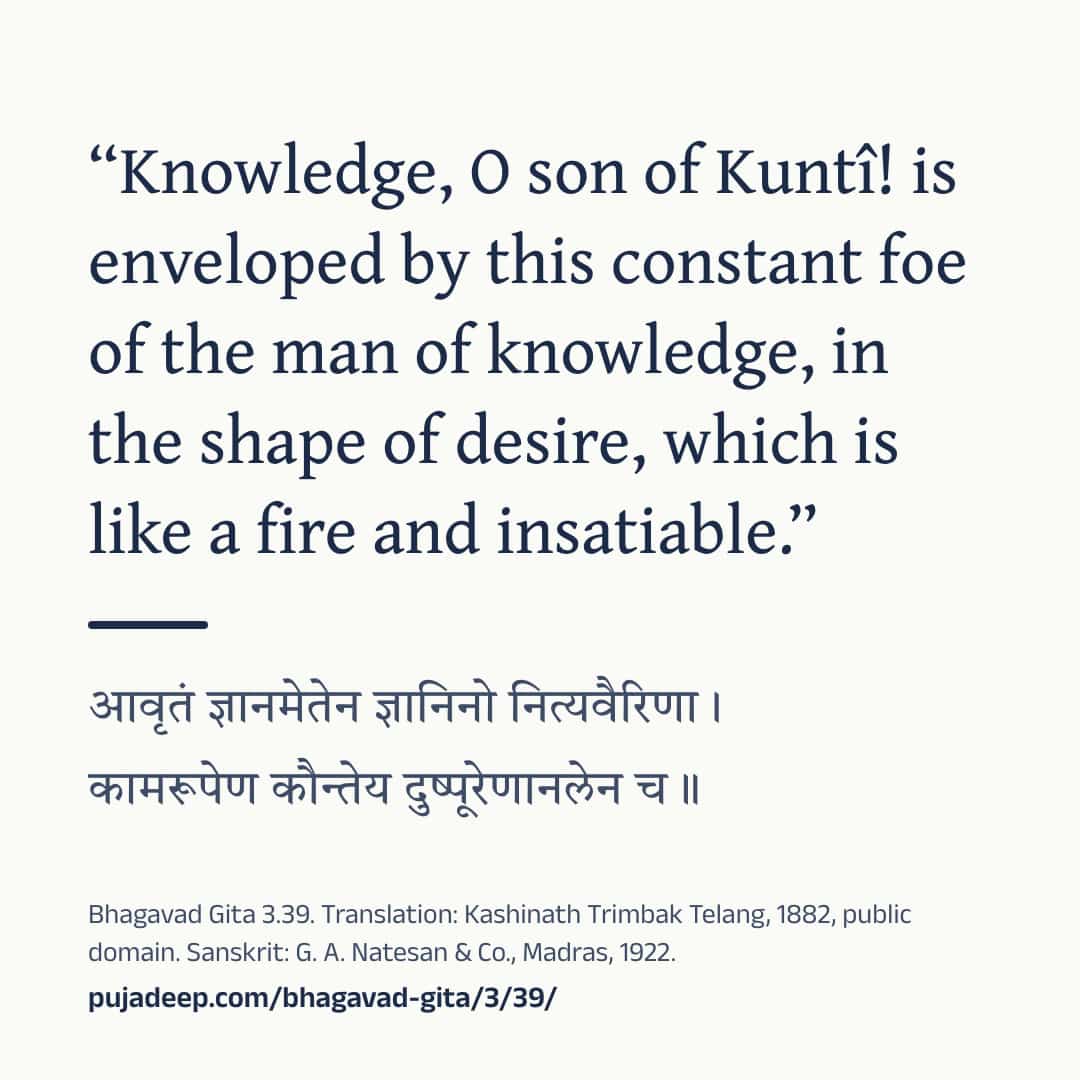
Drawing the picture
See the words
Bhagavad Gita 3.39

आवृतं ज्ञानमेतेन ज्ञानिनो नित्यवैरिणा ।
कामरूपेण कौन्तेय दुष्पूरेणानलेन च ॥

“Knowledge, O son of Kuntî! is enveloped by this constant foe of the man of knowledge, in the shape of desire, which is like a fire and insatiable.”
(K. T. Telang, The Bhagavadgîtâ (The Sacred Books of the East, vol. VIII, Oxford: Clarendon Press, 1882), p. 57, public domain)

“Enveloped is wisdom by this constant enemy of the wise in the form of desire, which is insatiable and a flame.”
(Annie Besant, The Bhagavad Gîtâ, or The Lord's Song (London: Theosophical Publishing Society, 1895), pp. 47–48, public domain)

“Knowledge is covered by this, the constant foe of the wise, O son of Kunti, the unappeasable fire of desire.”
(Swami Swarupananda, Srimad-Bhagavad-Gita (Mayavati: Prabuddha Bharata Press, 1909; first printed in Prabuddha Bharata, 1907–1909), p. 81, public domain)

Sanskrit: G. A. Natesan & Co., Madras, 1922.
https://pujadeep.com/bhagavad-gita/3/39/ Nothing is sent from this site. Your own app sends it, to the chat you choose. The picture quotes the translation you chose on this page, with its name and year.
Sanskrit text: The Bhagavad-Gita, or The Lord's Song, with the text in Devanagari and an English translation, 1922. Meanings: written for Pujadeep and checked against the cited edition. Source and changes
Questions families ask
Who speaks Bhagavad Gita 3.39?
Krishna speaks this verse, in chapter 3 (Karma Yoga).
Where does the Sanskrit text come from?
Sanskrit text: The Bhagavad-Gita, or The Lord's Song, with the text in Devanagari and an English translation, 1922. Meanings: written for Pujadeep and checked against the cited edition. See the source
Is the meaning on this page a translation?
Explanation written for this site from the sources listed here, and checked against the cited edition. It is not a translation and not the only way to read the text. Free to quote with credit.
Source and licence
- Sanskrit text
- The Bhagavad-Gita, or The Lord's Song, with the text in Devanagari and an English translation (Annie Besant, G. A. Natesan & Co., Madras, 1922). Public domain. The Sanskrit on these pages was read from this printing’s page images.
- Translation
- The Bhagavadgîtâ with the Sanatsugâtîya and the Anugîtâ, translated by Kâshinâth Trimbak Telang (The Sacred Books of the East, vol. VIII, ed. F. Max Müller) (Kashinath Trimbak Telang, F. Max Müller, Clarendon Press, Oxford, 1882). Public domain. Shown verbatim, as printed.
- Translation
- The Bhagavad Gîtâ, or The Lord's Song, translated by Annie Besant (Annie Besant, Theosophical Publishing Society, London, 1895). Public domain. Shown verbatim, as printed.
- Translation
- Srimad-Bhagavad-Gita, with Sanskrit Text; Paraphrase with Word-by-word Literal Translation; English Rendering and Comments, Index, &c., by the Swami Swarupananda (Himalayan Series, No. XX) (Swami Swarupananda, The Editors and Publishers, Advaita Ashrama, Mayavati, Prabuddha Bharata Press, Mayavati, Almora, Himalayas, 1909). Public domain. Shown verbatim, as printed.
- Common wording
- In this text, 32 words follow today's common wording, checked against sanskritdocuments.org; Sanskrit Wikisource; Gita Press, Gorakhpur; GRETIL, Göttingen and Bhaktivedanta Book Trust.
- Our explanation
- Explanation written for this site from the sources listed here, and checked against the cited edition. It is not a translation and not the only way to read the text. Free to quote with credit.
- Checked
- Checked against the cited edition, October 27, 2026.