Bhagavad Gita 3.30: meaning and translation
Chapter 3: Karma Yoga. Krishna says
Krishna tells Arjuna to give up all actions to him (saṃnyasya), with his thought on the self (adhyātma), free from hope and from the sense of “mine”, and to fight with his fever (jvara), his anguish, gone.
Click or tap a word for its meaning and its dictionary page.
Text and layers
Text and layers
These choices stay in this browser.
Bhagavad Gita 3.30
मयि सर्वाणि कर्माणि संन्यस्याऽध्यात्मचेतसा ।निराशीर्निर्ममो भूत्वा युध्यस्व विगतज्वरः ॥
Mayi sarvani karmani sannyasyadhyatmachetasaNirashirnirmamo bhutva yudhyasva vigatajvarah
mayi sarvāṇi karmāṇi saṃnyasyā’dhyātmacetasā |nirāśīrnirmamo bhūtvā yudhyasva vigatajvaraḥ ||
Our explanation Krishna tells Arjuna to give up all actions to him (saṃnyasya), with his thought on the self (adhyātma), free from hope and from the sense of “mine”, and to fight with his fever (jvara), his anguish, gone. The schools explain this giving up in different ways (see the views).
हिंदी अर्थ कृष्ण अर्जुन से कहते हैं कि वे अपने सब कर्म उन्हें अर्पित करके, चित्त को आत्मा (अध्यात्म) में लगाकर, आशा और ममता (“मेरा” के भाव) से मुक्त होकर, और ज्वर (मन का संताप) छोड़कर युद्ध करें। अलग-अलग परंपराएँ इस अर्पण को अलग ढंग से समझाती हैं।
Word by word
Every word, with its dictionary page
Word by word
- मयि mayi · "in me" (pronoun, locative singular) Dictionary: 1. mad, Monier-Williams 1899, p. 777, col. 2 “base of the first pers. pron. in the sg. number (esp. in comp.)”
- सर्वाणि sarvāṇi · all (adjective (neuter), accusative plural) Dictionary: sarva, Monier-Williams 1899, p. 1184, col. 3 “whole, entire, all, every”
- कर्माणि karmāṇi · actions (noun (neuter), accusative plural) Dictionary: karman, Monier-Williams 1899, p. 258, col. 2 “act, action, performance, business”
- संन्यस्य saṃnyasya · giving up, entrusting (absolutive (having done)) Dictionary: saṃ-ny-as, Monier-Williams 1899, p. 1148, col. 1 “to lay aside, give up, abandon, resign”
- अध्यात्मचेतसा adhyātmacetasā · with thought on the self (compound (neuter), instrumental singular) Dictionary: adhy-ātma, Monier-Williams 1899, p. 23, col. 2 “the Supreme Spirit”; cetas, Monier-Williams 1899, p. 398, col. 1 “consciousness, intelligence, thinking soul, heart, mind”
- निराशीः nirāśīḥ · free from hope (adjective (masculine), nominative singular) Dictionary: nir-āśis, Monier-Williams 1899, p. 540, col. 2 “free from desire, indifferent”
- निर्ममः nirmamaḥ · free from possessiveness (adjective (masculine), nominative singular) Dictionary: nir-mama, Monier-Williams 1899, p. 541, col. 3 “unselfish, disinterested, (esp.) free from all worldly connections”
- भूत्वा bhūtvā · having become (absolutive (having done)) Dictionary: 1. bhū, Monier-Williams 1899, p. 760, col. 2 “to become, be”
- युध्यस्व yudhyasva · fight (imperative, 2nd person singular) Dictionary: 1. yudh, Monier-Williams 1899, p. 854, col. 3 “to fight, wage war”
- विगतज्वरः vigatajvaraḥ · with anguish gone (compound (masculine), nominative singular) Dictionary: 2. vi-gata, Monier-Williams 1899, p. 956, col. 3 “gone away, departed, disappeared, ceased”; jvara, Monier-Williams 1899, p. 428, col. 1 “fever of the soul, mental pain, affliction, grief”
1 printing differs
Edition differences. Another printing or text reads this place differently.
- Spelling A digital text reads Same words. The 1922 edition marks the merged vowel with an avagraha (संन्यस्याऽध्यात्म…); this e-text does not.
Old translations
Kashinath Trimbak Telang, 1882. Public domain. Page 55–56.
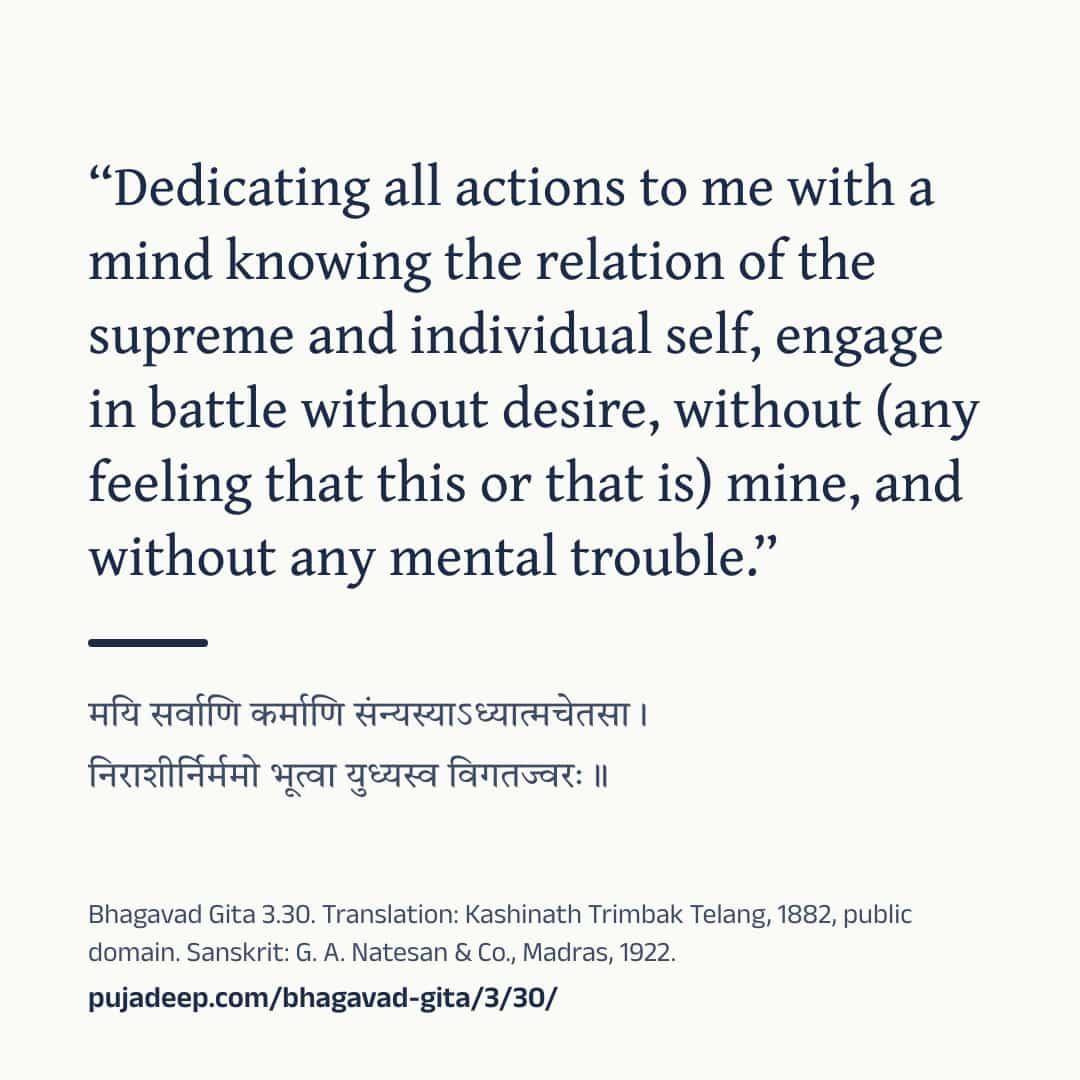
Dedicating all actions to me with a mind knowing the relation of the supreme and individual self, engage in battle without desire, without (any feeling that this or that is) mine, and without any mental trouble1.
Footnotes (the translator’s own) - About the consequences of your actions. ↩
Compare 3 translations
Kashinath Trimbak Telang, 1882. Public domain. Page 55–56.
Dedicating all actions to me with a mind knowing the relation of the supreme and individual self, engage in battle without desire, without (any feeling that this or that is) mine, and without any mental trouble1.
Footnotes (the translator’s own) - About the consequences of your actions. ↩
You are reading this one
Annie Besant, 1895. Public domain. Page 46.
Surrendering all actions to Me, with thy thoughts (resting) on the Supreme SELF, from hope and egoism freed, and of mental fever cured, engage in battle.
You are reading this one
Swami Swarupananda, 1909 (first printed 1907). Public domain. Page 76.
Renouncing all actions to Me, with mind centred on the Self, getting rid of hope and selfishness, fight,—free from (mental) fever.
You are reading this one
Cite this verse
The translation: K. T. Telang, The Bhagavadgîtâ (The Sacred Books of the East, vol. VIII, Oxford: Clarendon Press, 1882), pp. 55–56. Bhagavad Gita 3.30.
The translation: Annie Besant, The Bhagavad Gîtâ, or The Lord's Song (London: Theosophical Publishing Society, 1895), p. 46. Bhagavad Gita 3.30.
The translation: Swami Swarupananda, Srimad-Bhagavad-Gita (Mayavati: Prabuddha Bharata Press, 1909; first printed in Prabuddha Bharata, 1907–1909), p. 76. Bhagavad Gita 3.30.
Our explanation: “Bhagavad Gita 3.30: meaning and translation.” Pujadeep. Updated October 27, 2026. https://pujadeep.com/bhagavad-gita/3/30/
Pujadeep’s explanations are free to quote with credit: name Pujadeep and link to the page. How to credit
Classical readings, by school
Each reading is named by its school. None is presented as the only meaning.
What Advaita, Vishishtadvaita and Dvaita teach, in short
Shankara Advaita
Shankara says Arjuna is to surrender all actions to Vasudeva, the Supreme Lord, with the discerning thought: “The doer does this for the Lord's sake, as His servant.” The “fever” is anguish or grief.
Source: The Bhagavad-Gita, with the commentary of Sri Sankaracharya, translated by A. Mahadeva Sastri (2nd ed., Mysore: G. T. A. Printing Works, 1901), commentary on 3.30, p. 97. Summarised in our own words; none of its text is reproduced.
Ramanuja Vishishtadvaita
Ramanuja reads the verse through his view that every self is the body of the Lord, who lives within it as its inner ruler (antaryāmin). Arjuna should see that his acts are done by the Lord through him, give up the sense of owning them, and do them as worship. The “fever” is the anxiety about how to escape the burden of past deeds.
Source: Sri Bhagavad-Gita with Sri Ramanujacharya's Visishtadvaita commentary, translated by A. Govindacharya (Madras, 1898), commentary on 3.30, pp. 114–116. Summarised in our own words; none of its text is reproduced.
Share
Show the ways to share
Send one picture or the text to one chat. The picture names its source and the address of this page.
Drawing the picture
See the words
Bhagavad Gita 3.30

मयि सर्वाणि कर्माणि संन्यस्याऽध्यात्मचेतसा ।
निराशीर्निर्ममो भूत्वा युध्यस्व विगतज्वरः ॥

“Dedicating all actions to me with a mind knowing the relation of the supreme and individual self, engage in battle without desire, without (any feeling that this or that is) mine, and without any mental trouble.”
(K. T. Telang, The Bhagavadgîtâ (The Sacred Books of the East, vol. VIII, Oxford: Clarendon Press, 1882), pp. 55–56, public domain)

“Surrendering all actions to Me, with thy thoughts (resting) on the Supreme SELF, from hope and egoism freed, and of mental fever cured, engage in battle.”
(Annie Besant, The Bhagavad Gîtâ, or The Lord's Song (London: Theosophical Publishing Society, 1895), p. 46, public domain)

“Renouncing all actions to Me, with mind centred on the Self, getting rid of hope and selfishness, fight,—free from (mental) fever.”
(Swami Swarupananda, Srimad-Bhagavad-Gita (Mayavati: Prabuddha Bharata Press, 1909; first printed in Prabuddha Bharata, 1907–1909), p. 76, public domain)

Sanskrit: G. A. Natesan & Co., Madras, 1922.
https://pujadeep.com/bhagavad-gita/3/30/ Nothing is sent from this site. Your own app sends it, to the chat you choose. The picture quotes the translation you chose on this page, with its name and year.
Sanskrit text: The Bhagavad-Gita, or The Lord's Song, with the text in Devanagari and an English translation, 1922. Meanings: written for Pujadeep and checked against the cited edition. Source and changes
Questions families ask
Who speaks Bhagavad Gita 3.30?
Krishna speaks this verse, in chapter 3 (Karma Yoga).
Where does the Sanskrit text come from?
Sanskrit text: The Bhagavad-Gita, or The Lord's Song, with the text in Devanagari and an English translation, 1922. Meanings: written for Pujadeep and checked against the cited edition. See the source
Is the meaning on this page a translation?
Explanation written for this site from the sources listed here, and checked against the cited edition. It is not a translation and not the only way to read the text. Free to quote with credit.
Source and licence
- Sanskrit text
- The Bhagavad-Gita, or The Lord's Song, with the text in Devanagari and an English translation (Annie Besant, G. A. Natesan & Co., Madras, 1922). Public domain. The Sanskrit on these pages was read from this printing’s page images.
- Translation
- The Bhagavadgîtâ with the Sanatsugâtîya and the Anugîtâ, translated by Kâshinâth Trimbak Telang (The Sacred Books of the East, vol. VIII, ed. F. Max Müller) (Kashinath Trimbak Telang, F. Max Müller, Clarendon Press, Oxford, 1882). Public domain. Shown verbatim, as printed.
- Translation
- The Bhagavad Gîtâ, or The Lord's Song, translated by Annie Besant (Annie Besant, Theosophical Publishing Society, London, 1895). Public domain. Shown verbatim, as printed.
- Translation
- Srimad-Bhagavad-Gita, with Sanskrit Text; Paraphrase with Word-by-word Literal Translation; English Rendering and Comments, Index, &c., by the Swami Swarupananda (Himalayan Series, No. XX) (Swami Swarupananda, The Editors and Publishers, Advaita Ashrama, Mayavati, Prabuddha Bharata Press, Mayavati, Almora, Himalayas, 1909). Public domain. Shown verbatim, as printed.
- Commentary
- The Bhagavad-Gita, with the commentary of Sri Sankaracharya, translated by A. Mahadeva Sastri (2nd ed., Mysore: G. T. A. Printing Works, 1901) (Public-domain scan, University of California Libraries). Summarised in our own words; none of its text is reproduced.
- Commentary
- Sri Bhagavad-Gita with Sri Ramanujacharya's Visishtadvaita commentary, translated by A. Govindacharya (Madras, 1898) (Scan uploaded to archive.org (folkscanomy collection)). Summarised in our own words; none of its text is reproduced.
- Common wording
- In this text, 32 words follow today's common wording, checked against sanskritdocuments.org; Sanskrit Wikisource; Gita Press, Gorakhpur; GRETIL, Göttingen and Bhaktivedanta Book Trust.
- Our explanation
- Explanation written for this site from the sources listed here, and checked against the cited edition. It is not a translation and not the only way to read the text. Free to quote with credit.
- Checked
- Checked against the cited edition, October 27, 2026.