Bhagavad Gita 3.22: meaning and translation
Chapter 3: Karma Yoga. Krishna says
Krishna speaks of himself.
Click or tap a word for its meaning and its dictionary page.
Text and layers
Text and layers
These choices stay in this browser.
Bhagavad Gita 3.22
न मे पार्थास्ति कर्तव्यं त्रिषु लोकेषु किञ्चन ।नानवाप्तमवाप्तव्यं वर्त एव च कर्मणि ॥
Na me parthasti kartavyam trishu lokeshu kinchanaNanavaptamavaptavyam varta eva cha karmani
na me pārthāsti kartavyaṃ triṣu lokeṣu kiñcana |nānavāptamavāptavyaṃ varta eva ca karmaṇi ||
Our explanation Krishna speaks of himself. There is nothing in the three worlds, he says, that he has to do, and nothing he lacks or still needs to gain; yet he goes on acting. He calls Arjuna Partha.
हिंदी अर्थ कृष्ण अपने बारे में कहते हैं। वे कहते हैं कि तीनों लोकों में उनके लिए कोई कर्तव्य नहीं है, और न कुछ ऐसा है जो उन्हें न मिला हो या पाना बाकी हो; फिर भी वे कर्म में लगे रहते हैं। वे अर्जुन को पार्थ कहकर पुकारते हैं।
Word by word
Every word, with its dictionary page
Word by word
- न na · not (indeclinable) Dictionary: 2. na, Monier-Williams 1899, p. 523, col. 1 “not, no, nor, neither”
- मे me · "for me" (pronoun, genitive singular) Dictionary: 1. mad, Monier-Williams 1899, p. 777, col. 2 “base of the first pers. pron. in the sg. number”
- पार्थ pārtha · O Partha (noun (masculine), vocative singular) Dictionary: 2. pārtha, Monier-Williams 1899, p. 621, col. 3
- अस्ति asti · is (present, 3rd person singular) Dictionary: 1. as, Monier-Williams 1899, p. 117, col. 2 “to be, live, exist, be present”
- कर्तव्यम् kartavyam · to be done (gerundive (to be done) (neuter), nominative singular) Dictionary: kartavya, Monier-Williams 1899, p. 257, col. 3 “to be done or made or accomplished”
- त्रिषु triṣu · in the three (numeral (masculine), locative plural) Dictionary: tri, Monier-Williams 1899, p. 457, col. 3
- लोकेषु lokeṣu · worlds (noun (masculine), locative plural) Dictionary: loka, Monier-Williams 1899, p. 906, col. 1 “the wide space or world”
- किञ्चन kiñcana · anything (pronoun (neuter), nominative singular) Dictionary: kim, Monier-Williams 1899, p. 282, col. 2 “what? how? whence? wherefore? why?”; cana, Monier-Williams 1899, p. 386, col. 2
- न na · not (indeclinable) Dictionary: 2. na, Monier-Williams 1899, p. 523, col. 1 “not, no, nor, neither”
- अनवाप्तम् anavāptam · not gained (past participle (neuter), nominative singular) Dictionary: an-avāpta, Monier-Williams 1899, p. 27, col. 1 “not obtained”
- अवाप्तव्यम् avāptavyam · to be gained (gerundive (to be done) (neuter), nominative singular) Dictionary: avāptavya, Monier-Williams 1899, p. 107, col. 1 “to be obtained”
- वर्ते varte · "I go on" (present, 1st person singular) Dictionary: 1. vṛt, Monier-Williams 1899, p. 1009, col. 1 “be engaged in or occupied with”
- एव eva · still (indeclinable) Dictionary: 1. eva, Monier-Williams 1899, p. 232, col. 2 “just, exactly, very, same, only, even, alone, merely”
- च ca · yet (indeclinable) Dictionary: 2. ca, Monier-Williams 1899, p. 380, col. 1 “and, both, also, moreover, as well as”
- कर्मणि karmaṇi · in action (noun (neuter), locative singular) Dictionary: karman, Monier-Williams 1899, p. 258, col. 2 “act, action, performance, business”
Old translations
Kashinath Trimbak Telang, 1882. Public domain. Page 54–55.
There is nothing, O son of Prithâ! for me to do in (all) the three worlds, nothing to acquire which has not been acquired. Still I do engage in action.
Compare 3 translations
Kashinath Trimbak Telang, 1882. Public domain. Page 54–55.
There is nothing, O son of Prithâ! for me to do in (all) the three worlds, nothing to acquire which has not been acquired. Still I do engage in action.
You are reading this one
Annie Besant, 1895. Public domain. Page 44.
There is nothing in the three worlds, O Pârtha, that should be done by Me, nor anything unattained that might be attained; yet I mingle in action.
You are reading this one
Swami Swarupananda, 1909 (first printed 1907). Public domain. Page 73.
I have, O son of Prithâ, no duty, nothing that I have not gained, and nothing that I have to gain, in the three worlds; yet, I continue in action.
You are reading this one
Cite this verse
The translation: K. T. Telang, The Bhagavadgîtâ (The Sacred Books of the East, vol. VIII, Oxford: Clarendon Press, 1882), pp. 54–55. Bhagavad Gita 3.22.
The translation: Annie Besant, The Bhagavad Gîtâ, or The Lord's Song (London: Theosophical Publishing Society, 1895), p. 44. Bhagavad Gita 3.22.
The translation: Swami Swarupananda, Srimad-Bhagavad-Gita (Mayavati: Prabuddha Bharata Press, 1909; first printed in Prabuddha Bharata, 1907–1909), p. 73. Bhagavad Gita 3.22.
Our explanation: “Bhagavad Gita 3.22: meaning and translation.” Pujadeep. Updated October 27, 2026. https://pujadeep.com/bhagavad-gita/3/22/
Pujadeep’s explanations are free to quote with credit: name Pujadeep and link to the page. How to credit
Classical readings, by school
No readings by school on this verse yet.
Share
Show the ways to share
Send one picture or the text to one chat. The picture names its source and the address of this page.
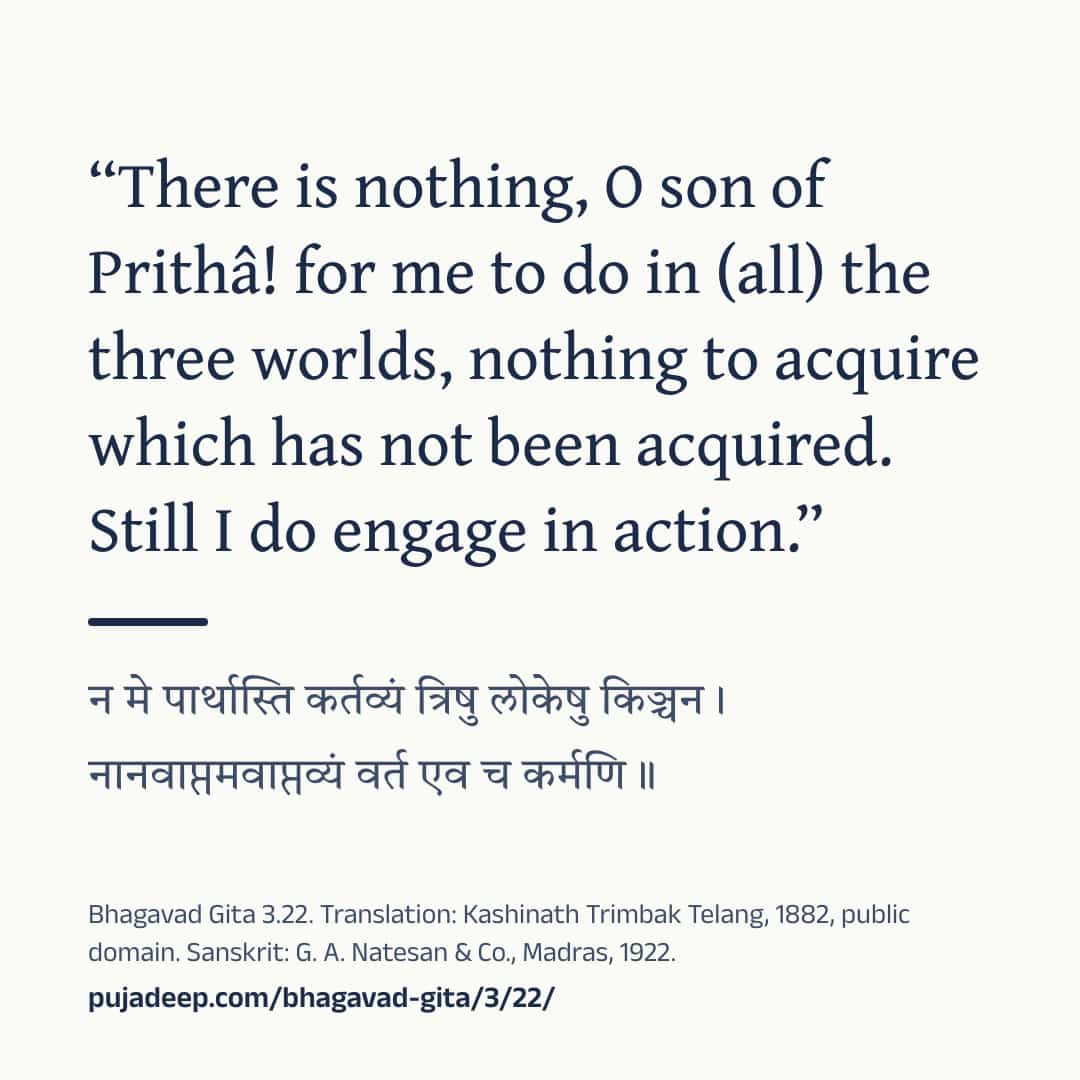
Drawing the picture
See the words
Bhagavad Gita 3.22

न मे पार्थास्ति कर्तव्यं त्रिषु लोकेषु किञ्चन ।
नानवाप्तमवाप्तव्यं वर्त एव च कर्मणि ॥

“There is nothing, O son of Prithâ! for me to do in (all) the three worlds, nothing to acquire which has not been acquired. Still I do engage in action.”
(K. T. Telang, The Bhagavadgîtâ (The Sacred Books of the East, vol. VIII, Oxford: Clarendon Press, 1882), pp. 54–55, public domain)

“There is nothing in the three worlds, O Pârtha, that should be done by Me, nor anything unattained that might be attained; yet I mingle in action.”
(Annie Besant, The Bhagavad Gîtâ, or The Lord's Song (London: Theosophical Publishing Society, 1895), p. 44, public domain)

“I have, O son of Prithâ, no duty, nothing that I have not gained, and nothing that I have to gain, in the three worlds; yet, I continue in action.”
(Swami Swarupananda, Srimad-Bhagavad-Gita (Mayavati: Prabuddha Bharata Press, 1909; first printed in Prabuddha Bharata, 1907–1909), p. 73, public domain)

Sanskrit: G. A. Natesan & Co., Madras, 1922.
https://pujadeep.com/bhagavad-gita/3/22/ Nothing is sent from this site. Your own app sends it, to the chat you choose. The picture quotes the translation you chose on this page, with its name and year.
Sanskrit text: The Bhagavad-Gita, or The Lord's Song, with the text in Devanagari and an English translation, 1922. Meanings: written for Pujadeep and checked against the cited edition. Source and changes
Questions families ask
Who speaks Bhagavad Gita 3.22?
Krishna speaks this verse, in chapter 3 (Karma Yoga).
Where does the Sanskrit text come from?
Sanskrit text: The Bhagavad-Gita, or The Lord's Song, with the text in Devanagari and an English translation, 1922. Meanings: written for Pujadeep and checked against the cited edition. See the source
Is the meaning on this page a translation?
Explanation written for this site from the sources listed here, and checked against the cited edition. It is not a translation and not the only way to read the text. Free to quote with credit.
Source and licence
- Sanskrit text
- The Bhagavad-Gita, or The Lord's Song, with the text in Devanagari and an English translation (Annie Besant, G. A. Natesan & Co., Madras, 1922). Public domain. The Sanskrit on these pages was read from this printing’s page images.
- Translation
- The Bhagavadgîtâ with the Sanatsugâtîya and the Anugîtâ, translated by Kâshinâth Trimbak Telang (The Sacred Books of the East, vol. VIII, ed. F. Max Müller) (Kashinath Trimbak Telang, F. Max Müller, Clarendon Press, Oxford, 1882). Public domain. Shown verbatim, as printed.
- Translation
- The Bhagavad Gîtâ, or The Lord's Song, translated by Annie Besant (Annie Besant, Theosophical Publishing Society, London, 1895). Public domain. Shown verbatim, as printed.
- Translation
- Srimad-Bhagavad-Gita, with Sanskrit Text; Paraphrase with Word-by-word Literal Translation; English Rendering and Comments, Index, &c., by the Swami Swarupananda (Himalayan Series, No. XX) (Swami Swarupananda, The Editors and Publishers, Advaita Ashrama, Mayavati, Prabuddha Bharata Press, Mayavati, Almora, Himalayas, 1909). Public domain. Shown verbatim, as printed.
- Common wording
- In this text, 32 words follow today's common wording, checked against sanskritdocuments.org; Sanskrit Wikisource; Gita Press, Gorakhpur; GRETIL, Göttingen and Bhaktivedanta Book Trust.
- Our explanation
- Explanation written for this site from the sources listed here, and checked against the cited edition. It is not a translation and not the only way to read the text. Free to quote with credit.
- Checked
- Checked against the cited edition, October 27, 2026.