Bhagavad Gita 3.14: meaning and translation
Chapter 3: Karma Yoga. Krishna says
Krishna describes a cycle.
Click or tap a word for its meaning and its dictionary page.
Text and layers
Text and layers
These choices stay in this browser.
Bhagavad Gita 3.14
अन्नाद्भवन्ति भूतानि पर्जन्यादन्नसंभवः ।यज्ञाद्भवति पर्जन्यो यज्ञः कर्मसमुद्भवः ॥
Annadbhavanti bhutani parjanyadannasambhavahYajnadbhavati parjanyo yajnah karmasamudbhavah
annādbhavanti bhūtāni parjanyādannasaṃbhavaḥ |yajñādbhavati parjanyo yajñaḥ karmasamudbhavaḥ ||
Our explanation Krishna describes a cycle. Beings come from food, food comes from rain (parjanya), rain comes from sacrifice, and sacrifice comes from action. The sentence continues in the next verse.
हिंदी अर्थ कृष्ण एक चक्र का वर्णन करते हैं। अन्न से प्राणी उत्पन्न होते हैं, वर्षा (पर्जन्य) से अन्न होता है, यज्ञ से वर्षा होती है, और यज्ञ कर्म से उत्पन्न होता है। यह वाक्य अगले श्लोक में आगे बढ़ता है।
Word by word
Every word, with its dictionary page
Word by word
- अन्नात् annāt · from food (noun (neuter), ablative singular) Dictionary: anna, Monier-Williams 1899, p. 45, col. 1 “food or victuals, especially boiled rice”
- भवन्ति bhavanti · come into being (present, 3rd person plural) Dictionary: 1. bhū, Monier-Williams 1899, p. 760, col. 2 “arise, come into being, exist”
- भूतानि bhūtāni · beings (noun (neuter), nominative plural) Dictionary: bhūta, Monier-Williams 1899, p. 761, col. 3 “that which is or exists, any living being”
- पर्जन्यात् parjanyāt · from rain (noun (masculine), ablative singular) Dictionary: parjanya, Monier-Williams 1899, p. 606, col. 2 “rain, Bhag. iii, 14; rain personified or the god of rain (often identified with Indra)”
- अन्नसंभवः annasaṃbhavaḥ · the birth of food (compound (masculine), nominative singular) Dictionary: anna, Monier-Williams 1899, p. 45, col. 1 “food or victuals, especially boiled rice”; sam-bhava, Monier-Williams 1899, p. 1179, col. 1 “birth, production, origin, source”
- यज्ञात् yajñāt · from sacrifice (noun (masculine), ablative singular) Dictionary: yajña, Monier-Williams 1899, p. 839, col. 2 “act of worship or devotion, offering, oblation, sacrifice”
- भवति bhavati · comes (present, 3rd person singular) Dictionary: 1. bhū, Monier-Williams 1899, p. 760, col. 2 “arise, come into being, exist”
- पर्जन्यः parjanyaḥ · rain (noun (masculine), nominative singular) Dictionary: parjanya, Monier-Williams 1899, p. 606, col. 2 “rain, Bhag. iii, 14; rain personified or the god of rain (often identified with Indra)”
- यज्ञः yajñaḥ · sacrifice (noun (masculine), nominative singular) Dictionary: yajña, Monier-Williams 1899, p. 839, col. 2 “act of worship or devotion, offering, oblation, sacrifice”
- कर्मसमुद्भवः karmasamudbhavaḥ · born of action (compound (masculine), nominative singular) Dictionary: karman, Monier-Williams 1899, p. 258, col. 2 “act, action, performance, business”; sam-udbhava, Monier-Williams 1899, p. 1168, col. 2 “existence, production, origin”
1 printing differs
Edition differences. Another printing or text reads this place differently.
- Spelling A digital text reads Same word. The e-text writes the class nasal (अन्नसम्भवः); the 1922 edition writes anusvara (अन्नसंभवः), as another digital text does (annasaṃbhavaḥ).
Old translations
Kashinath Trimbak Telang, 1882. Public domain. Page 54.
From food are born (all) creatures; from rain is the production of food; rain is produced by sacrifices; sacrifices are the result of action;
This sentence goes on in 3.15.
Compare 3 translations
Kashinath Trimbak Telang, 1882. Public domain. Page 54.
From food are born (all) creatures; from rain is the production of food; rain is produced by sacrifices; sacrifices are the result of action;
This sentence goes on in 3.15.
You are reading this one
Annie Besant, 1895. Public domain. Page 43.
From food creatures become; from rain is the production of food; rain proceedeth from sacrifice; sacrifice ariseth out of action;
This sentence goes on in 3.15.
You are reading this one
Swami Swarupananda, 1909 (first printed 1907). Public domain. Page 69.
From food come forth beings: from rain food is produced: from Yajna arises rain and Yajna is born of Karma.
You are reading this one
Cite this verse
The translation: K. T. Telang, The Bhagavadgîtâ (The Sacred Books of the East, vol. VIII, Oxford: Clarendon Press, 1882), p. 54. Bhagavad Gita 3.14.
The translation: Annie Besant, The Bhagavad Gîtâ, or The Lord's Song (London: Theosophical Publishing Society, 1895), p. 43. Bhagavad Gita 3.14.
The translation: Swami Swarupananda, Srimad-Bhagavad-Gita (Mayavati: Prabuddha Bharata Press, 1909; first printed in Prabuddha Bharata, 1907–1909), p. 69. Bhagavad Gita 3.14.
Our explanation: “Bhagavad Gita 3.14: meaning and translation.” Pujadeep. Updated October 27, 2026. https://pujadeep.com/bhagavad-gita/3/14/
Pujadeep’s explanations are free to quote with credit: name Pujadeep and link to the page. How to credit
Classical readings, by school
No readings by school on this verse yet.
Share
Show the ways to share
Send one picture or the text to one chat. The picture names its source and the address of this page.
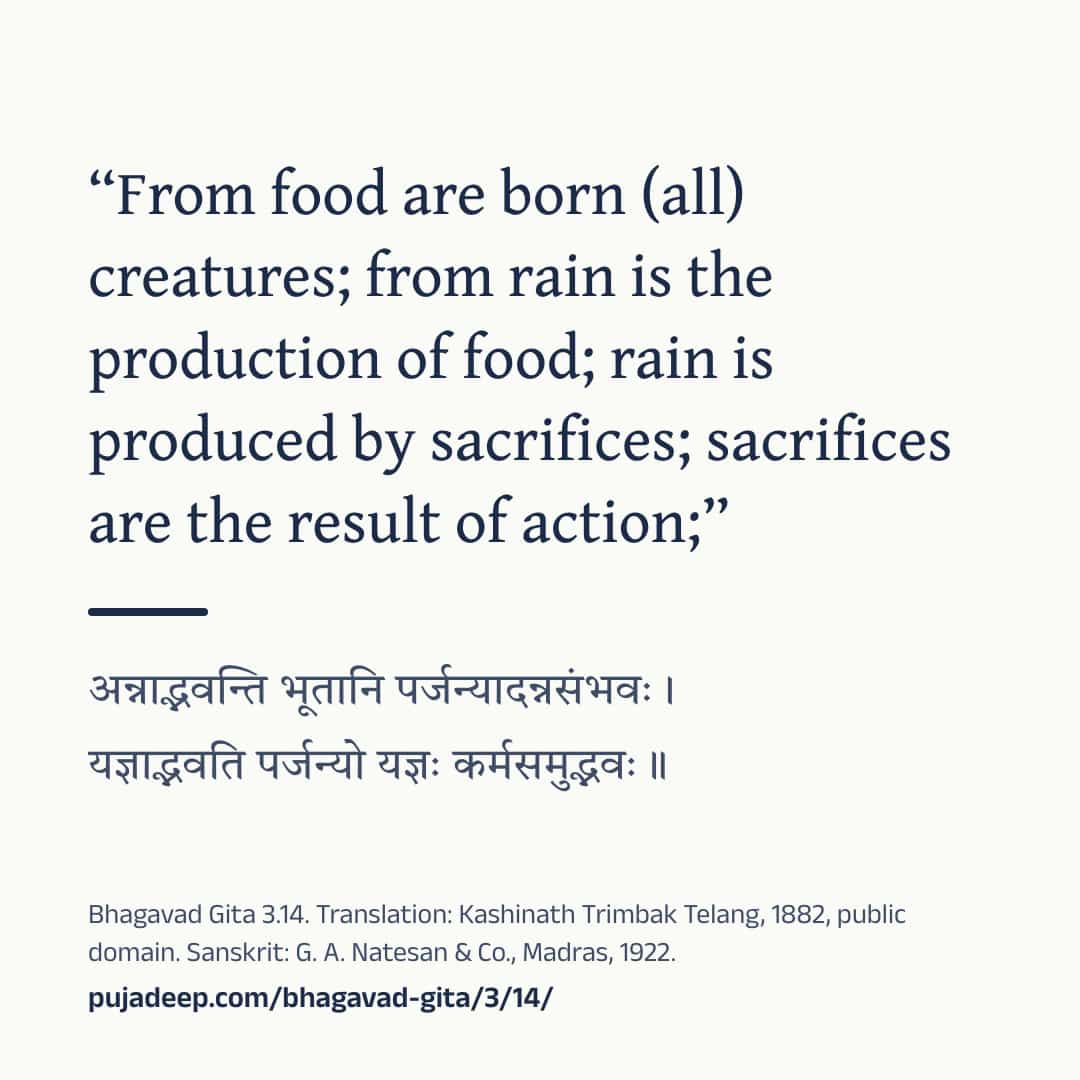
Drawing the picture
See the words
Bhagavad Gita 3.14

अन्नाद्भवन्ति भूतानि पर्जन्यादन्नसंभवः ।
यज्ञाद्भवति पर्जन्यो यज्ञः कर्मसमुद्भवः ॥

“From food are born (all) creatures; from rain is the production of food; rain is produced by sacrifices; sacrifices are the result of action;”
(K. T. Telang, The Bhagavadgîtâ (The Sacred Books of the East, vol. VIII, Oxford: Clarendon Press, 1882), p. 54, public domain)
This sentence goes on in 3.15.

“From food creatures become; from rain is the production of food; rain proceedeth from sacrifice; sacrifice ariseth out of action;”
(Annie Besant, The Bhagavad Gîtâ, or The Lord's Song (London: Theosophical Publishing Society, 1895), p. 43, public domain)
This sentence goes on in 3.15.

“From food come forth beings: from rain food is produced: from Yajna arises rain and Yajna is born of Karma.”
(Swami Swarupananda, Srimad-Bhagavad-Gita (Mayavati: Prabuddha Bharata Press, 1909; first printed in Prabuddha Bharata, 1907–1909), p. 69, public domain)

Sanskrit: G. A. Natesan & Co., Madras, 1922.
https://pujadeep.com/bhagavad-gita/3/14/ Nothing is sent from this site. Your own app sends it, to the chat you choose. The picture quotes the translation you chose on this page, with its name and year.
Sanskrit text: The Bhagavad-Gita, or The Lord's Song, with the text in Devanagari and an English translation, 1922. Meanings: written for Pujadeep and checked against the cited edition. Source and changes
Questions families ask
Who speaks Bhagavad Gita 3.14?
Krishna speaks this verse, in chapter 3 (Karma Yoga).
Where does the Sanskrit text come from?
Sanskrit text: The Bhagavad-Gita, or The Lord's Song, with the text in Devanagari and an English translation, 1922. Meanings: written for Pujadeep and checked against the cited edition. See the source
Is the meaning on this page a translation?
Explanation written for this site from the sources listed here, and checked against the cited edition. It is not a translation and not the only way to read the text. Free to quote with credit.
Source and licence
- Sanskrit text
- The Bhagavad-Gita, or The Lord's Song, with the text in Devanagari and an English translation (Annie Besant, G. A. Natesan & Co., Madras, 1922). Public domain. The Sanskrit on these pages was read from this printing’s page images.
- Translation
- The Bhagavadgîtâ with the Sanatsugâtîya and the Anugîtâ, translated by Kâshinâth Trimbak Telang (The Sacred Books of the East, vol. VIII, ed. F. Max Müller) (Kashinath Trimbak Telang, F. Max Müller, Clarendon Press, Oxford, 1882). Public domain. Shown verbatim, as printed.
- Translation
- The Bhagavad Gîtâ, or The Lord's Song, translated by Annie Besant (Annie Besant, Theosophical Publishing Society, London, 1895). Public domain. Shown verbatim, as printed.
- Translation
- Srimad-Bhagavad-Gita, with Sanskrit Text; Paraphrase with Word-by-word Literal Translation; English Rendering and Comments, Index, &c., by the Swami Swarupananda (Himalayan Series, No. XX) (Swami Swarupananda, The Editors and Publishers, Advaita Ashrama, Mayavati, Prabuddha Bharata Press, Mayavati, Almora, Himalayas, 1909). Public domain. Shown verbatim, as printed.
- Common wording
- In this text, 32 words follow today's common wording, checked against sanskritdocuments.org; Sanskrit Wikisource; Gita Press, Gorakhpur; GRETIL, Göttingen and Bhaktivedanta Book Trust.
- Our explanation
- Explanation written for this site from the sources listed here, and checked against the cited edition. It is not a translation and not the only way to read the text. Free to quote with credit.
- Checked
- Checked against the cited edition, October 27, 2026.