Bhagavad Gita 3.6: meaning and translation
Chapter 3: Karma Yoga. Krishna says
Krishna says that a person who holds back the organs of action but keeps thinking of the objects of the senses in the mind is deluded, and is called a hypocrite (mithyācāra, one whose conduct is false).
Click or tap a word for its meaning and its dictionary page.
Text and layers
Text and layers
These choices stay in this browser.
Bhagavad Gita 3.6
कर्मेन्द्रियाणि संयम्य य आस्ते मनसा स्मरन् ।इन्द्रियार्थान्विमूढात्मा मिथ्याचारः स उच्यते ॥
Karmendriyani sanyamya ya aste manasa smaranIndriyarthanvimudhatma mithyacharah sa uchyate
karmendriyāṇi saṃyamya ya āste manasā smaran |indriyārthānvimūḍhātmā mithyācāraḥ sa ucyate ||
Our explanation Krishna says that a person who holds back the organs of action but keeps thinking of the objects of the senses in the mind is deluded, and is called a hypocrite (mithyācāra, one whose conduct is false).
हिंदी अर्थ कृष्ण कहते हैं कि जो कर्मेंद्रियों को रोककर बैठता है पर मन में इंद्रियों के विषयों का चिंतन करता रहता है, वह मूढ़ है और मिथ्याचारी (झूठा आचरण करने वाला) कहलाता है।
Word by word
Every word, with its dictionary page
Word by word
- कर्मेन्द्रियाणि karmendriyāṇi · the organs of action (compound (neuter), accusative plural) Dictionary: karmendriya, Monier-Williams 1899, p. 259, col. 2 “an organ of action”
- संयम्य saṃyamya · having held back (absolutive (having done)) Dictionary: saṃ-yam, Monier-Williams 1899, p. 1111, col. 3 “to hold together, hold in, hold fast, restrain, curb, suppress, control”
- यः yaḥ · who (pronoun (masculine), nominative singular) Dictionary: yad, Monier-Williams 1899, p. 844, col. 2 “who, which, what, whichever, whatever, that”
- आस्ते āste · sits, remains (present, 3rd person singular) Dictionary: 2. ās, Monier-Williams 1899, p. 159, col. 3 “to sit, sit down, rest, lie”
- मनसा manasā · in the mind (noun (neuter), instrumental singular) Dictionary: manas, Monier-Williams 1899, p. 783, col. 3 “mind (in its widest sense as applied to all the mental powers)”
- स्मरन् smaran · thinking of (present participle (masculine), nominative singular) Dictionary: 2. smṛ, Monier-Williams 1899, p. 1271, col. 3 “to remember, recollect, bear in mind, call to mind, think of”
- इन्द्रियार्थान् indriyārthān · the objects of the senses (compound (masculine), accusative plural) Dictionary: indriyārtha, Monier-Williams 1899, p. 167, col. 2 “an object of sense (as sound, smell, &c.)”
- विमूढात्मा vimūḍhātmā · deluded in mind (compound (masculine), nominative singular) Dictionary: vi-mūḍha, Monier-Williams 1899, p. 980, col. 3; vi-mugdha, Monier-Williams 1899, p. 980, col. 3 “confused, bewildered, infatuated”; vi-mūḍhātman, Monier-Williams 1899, p. 980, col. 3 “foolish-minded, perplexed in mind, senseless”; ātman, Monier-Williams 1899, p. 135, col. 1 “the understanding, intellect, mind”
- मिथ्याचारः mithyācāraḥ · a hypocrite, false in conduct (compound (masculine), nominative singular) Dictionary: mithyācāra, Monier-Williams 1899, p. 817, col. 1 “acting falsely or hypocritically”
- सः saḥ · he (pronoun (masculine), nominative singular) Dictionary: tad, Monier-Williams 1899, p. 434, col. 1 “m. he, f. she, n. it, that, this”
- उच्यते ucyate · is called (present passive, 3rd person singular) Dictionary: vac, Monier-Williams 1899, p. 912, col. 1 “to speak, say, tell, utter, announce”
Old translations
Kashinath Trimbak Telang, 1882. Public domain. Page 53.
The deluded man who, restraining the organs of action1, continues to think in his mind about objects of sense, is called a hypocrite.
Footnotes (the translator’s own) - Hands, feet, &c. ↩
Compare 3 translations
Kashinath Trimbak Telang, 1882. Public domain. Page 53.
The deluded man who, restraining the organs of action1, continues to think in his mind about objects of sense, is called a hypocrite.
Footnotes (the translator’s own) - Hands, feet, &c. ↩
You are reading this one
Annie Besant, 1895. Public domain. Page 41.
Who, controlling the organs of action, sitteth dwelling in his mind on the objects of the senses, that bewildered man is called a hypocrite. But who, controlling the senses by Manas, O Arjuna,
This sentence goes on in 3.7.
You are reading this one
Swami Swarupananda, 1909 (first printed 1907). Public domain. Page 66.
He, who restraining the organs of action, sits revolving in the mind, thoughts regarding objects of senses, he of deluded understanding, is called a hypocrite.
You are reading this one
Cite this verse
The translation: K. T. Telang, The Bhagavadgîtâ (The Sacred Books of the East, vol. VIII, Oxford: Clarendon Press, 1882), p. 53. Bhagavad Gita 3.6.
The translation: Annie Besant, The Bhagavad Gîtâ, or The Lord's Song (London: Theosophical Publishing Society, 1895), p. 41. Bhagavad Gita 3.6.
The translation: Swami Swarupananda, Srimad-Bhagavad-Gita (Mayavati: Prabuddha Bharata Press, 1909; first printed in Prabuddha Bharata, 1907–1909), p. 66. Bhagavad Gita 3.6.
Our explanation: “Bhagavad Gita 3.6: meaning and translation.” Pujadeep. Updated October 27, 2026. https://pujadeep.com/bhagavad-gita/3/6/
Pujadeep’s explanations are free to quote with credit: name Pujadeep and link to the page. How to credit
Classical readings, by school
No readings by school on this verse yet.
Share
Show the ways to share
Send one picture or the text to one chat. The picture names its source and the address of this page.
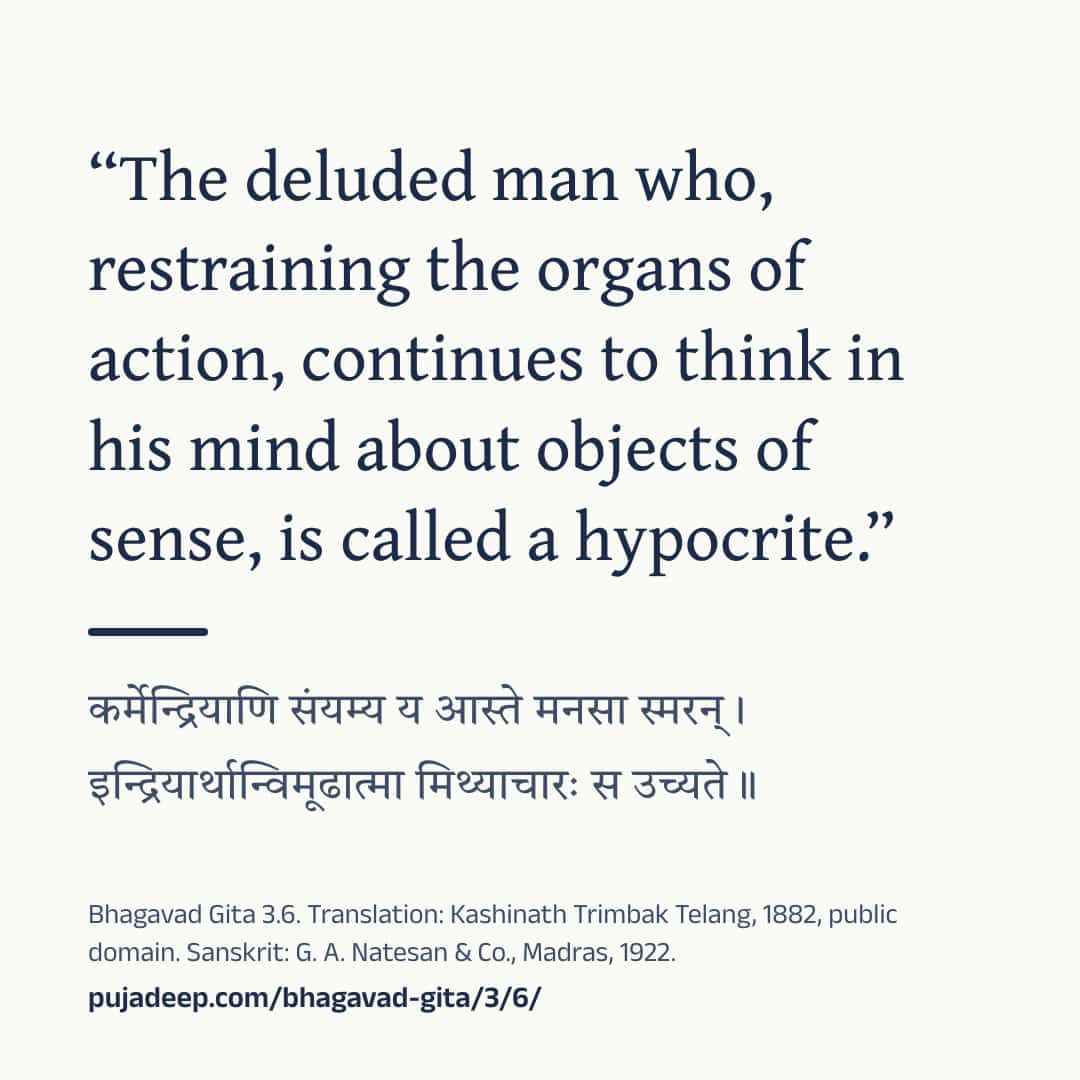
Drawing the picture
See the words
Bhagavad Gita 3.6

कर्मेन्द्रियाणि संयम्य य आस्ते मनसा स्मरन् ।
इन्द्रियार्थान्विमूढात्मा मिथ्याचारः स उच्यते ॥

“The deluded man who, restraining the organs of action, continues to think in his mind about objects of sense, is called a hypocrite.”
(K. T. Telang, The Bhagavadgîtâ (The Sacred Books of the East, vol. VIII, Oxford: Clarendon Press, 1882), p. 53, public domain)

“Who, controlling the organs of action, sitteth dwelling in his mind on the objects of the senses, that bewildered man is called a hypocrite. But who, controlling the senses by Manas, O Arjuna,”
(Annie Besant, The Bhagavad Gîtâ, or The Lord's Song (London: Theosophical Publishing Society, 1895), p. 41, public domain)
This sentence goes on in 3.7.

“He, who restraining the organs of action, sits revolving in the mind, thoughts regarding objects of senses, he of deluded understanding, is called a hypocrite.”
(Swami Swarupananda, Srimad-Bhagavad-Gita (Mayavati: Prabuddha Bharata Press, 1909; first printed in Prabuddha Bharata, 1907–1909), p. 66, public domain)

Sanskrit: G. A. Natesan & Co., Madras, 1922.
https://pujadeep.com/bhagavad-gita/3/6/ Nothing is sent from this site. Your own app sends it, to the chat you choose. The picture quotes the translation you chose on this page, with its name and year.
Sanskrit text: The Bhagavad-Gita, or The Lord's Song, with the text in Devanagari and an English translation, 1922. Meanings: written for Pujadeep and checked against the cited edition. Source and changes
Questions families ask
Who speaks Bhagavad Gita 3.6?
Krishna speaks this verse, in chapter 3 (Karma Yoga).
Where does the Sanskrit text come from?
Sanskrit text: The Bhagavad-Gita, or The Lord's Song, with the text in Devanagari and an English translation, 1922. Meanings: written for Pujadeep and checked against the cited edition. See the source
Is the meaning on this page a translation?
Explanation written for this site from the sources listed here, and checked against the cited edition. It is not a translation and not the only way to read the text. Free to quote with credit.
Source and licence
- Sanskrit text
- The Bhagavad-Gita, or The Lord's Song, with the text in Devanagari and an English translation (Annie Besant, G. A. Natesan & Co., Madras, 1922). Public domain. The Sanskrit on these pages was read from this printing’s page images.
- Translation
- The Bhagavadgîtâ with the Sanatsugâtîya and the Anugîtâ, translated by Kâshinâth Trimbak Telang (The Sacred Books of the East, vol. VIII, ed. F. Max Müller) (Kashinath Trimbak Telang, F. Max Müller, Clarendon Press, Oxford, 1882). Public domain. Shown verbatim, as printed.
- Translation
- The Bhagavad Gîtâ, or The Lord's Song, translated by Annie Besant (Annie Besant, Theosophical Publishing Society, London, 1895). Public domain. Shown verbatim, as printed.
- Translation
- Srimad-Bhagavad-Gita, with Sanskrit Text; Paraphrase with Word-by-word Literal Translation; English Rendering and Comments, Index, &c., by the Swami Swarupananda (Himalayan Series, No. XX) (Swami Swarupananda, The Editors and Publishers, Advaita Ashrama, Mayavati, Prabuddha Bharata Press, Mayavati, Almora, Himalayas, 1909). Public domain. Shown verbatim, as printed.
- Common wording
- In this text, 32 words follow today's common wording, checked against sanskritdocuments.org; Sanskrit Wikisource; Gita Press, Gorakhpur; GRETIL, Göttingen and Bhaktivedanta Book Trust.
- Our explanation
- Explanation written for this site from the sources listed here, and checked against the cited edition. It is not a translation and not the only way to read the text. Free to quote with credit.
- Checked
- Checked against the cited edition, October 27, 2026.