Bhagavad Gita 3.2: meaning and translation
Chapter 3: Karma Yoga. Arjuna says
Arjuna says that Krishna's words seem mixed and seem to confuse his understanding.
Click or tap a word for its meaning and its dictionary page.
Text and layers
Text and layers
These choices stay in this browser.
Bhagavad Gita 3.2
व्यामिश्रेणेव वाक्येन बुद्धिं मोहयसीव मे ।तदेकं वद निश्चित्य येन श्रेयोऽहमाप्नुयाम् ॥
Vyamishreneva vakyena buddhim mohayasiva meTadekam vada nishchitya yena shreyohamapnuyam
vyāmiśreṇeva vākyena buddhiṃ mohayasīva me |tadekaṃ vada niścitya yena śreyo’hamāpnuyām ||
Our explanation Arjuna says that Krishna's words seem mixed and seem to confuse his understanding. He asks Krishna to decide and to tell him the one way by which he may reach the highest good (śreyas).
हिंदी अर्थ अर्जुन कहते हैं कि कृष्ण के वचन मिले-जुले से लगते हैं और मानो उनकी बुद्धि को उलझा रहे हैं। वे कृष्ण से कहते हैं कि निश्चय करके वह एक मार्ग बताएँ जिससे उन्हें श्रेय (परम कल्याण) मिले।
Word by word
Every word, with its dictionary page
Word by word
- व्यामिश्रेण vyāmiśreṇa · mixed, confusing (adjective (neuter), instrumental singular) Dictionary: vy-ā-miśra, Monier-Williams 1899, p. 1038, col. 1 “mixed together, blended”
- इव iva · as it were, seemingly (indeclinable) Dictionary: iva, Monier-Williams 1899, p. 168, col. 3 “as it were, as if”
- वाक्येन vākyena · by speech, by words (noun (neuter), instrumental singular) Dictionary: vākya, Monier-Williams 1899, p. 936, col. 2 “speech, saying, assertion, statement, command, words”
- बुद्धिम् buddhim · understanding (noun (feminine), accusative singular) Dictionary: buddhi, Monier-Williams 1899, p. 733, col. 3 “intelligence, reason, intellect, mind”
- मोहयसि mohayasi · you confuse (causative present, 2nd person singular) Dictionary: 1. muh, Monier-Williams 1899, p. 825, col. 1 “to become stupefied or unconscious, be bewildered or perplexed”
- इव iva · as it were (indeclinable) Dictionary: iva, Monier-Williams 1899, p. 168, col. 3 “as it were, as if”
- मे me · "my" (pronoun, genitive singular) Dictionary: 1. mad, Monier-Williams 1899, p. 777, col. 2 “base of the first pers. pron. in the sg. number”
- तत् tat · that (pronoun (neuter), accusative singular) Dictionary: tad, Monier-Williams 1899, p. 434, col. 1 “m. he, f. she, n. it, that, this”
- एकम् ekam · one (adjective (neuter), accusative singular) Dictionary: eka, Monier-Williams 1899, p. 227, col. 3 “alone, solitary, single”
- वद vada · tell (imperative, 2nd person singular) Dictionary: vad, Monier-Williams 1899, p. 916, col. 1 “to speak, say, utter, tell, report”
- निश्चित्य niścitya · having decided (absolutive (having done)) Dictionary: niś-ci, Monier-Williams 1899, p. 561, col. 2 “to ascertain, investigate, decide, settle, fix upon, determine, resolve”
- येन yena · by which (pronoun (neuter), instrumental singular) Dictionary: yad, Monier-Williams 1899, p. 844, col. 2 “who, which, what, whichever, whatever, that”
- श्रेयः śreyaḥ · the highest good (noun (neuter), accusative singular) Dictionary: śreyas, Monier-Williams 1899, p. 1102, col. 2 “good (as opp. to ‘evil’), welfare, bliss, fortune, happiness”
- अहम् aham · "I" (pronoun, nominative singular) Dictionary: aham, Monier-Williams 1899, p. 124, col. 2 “nom. sg. ‘I,’”
- आप्नुयाम् āpnuyām · may reach (optative, 1st person singular) Dictionary: 1. āp, Monier-Williams 1899, p. 142, col. 1 “to reach, overtake, meet with, fall upon”
Old translations
Kashinath Trimbak Telang, 1882. Public domain. Page 52.
You seem, indeed, to confuse my mind by equivocal words. Therefore, declare one thing determinately, by which I may attain the highest good.
Compare 3 translations
Kashinath Trimbak Telang, 1882. Public domain. Page 52.
You seem, indeed, to confuse my mind by equivocal words. Therefore, declare one thing determinately, by which I may attain the highest good.
You are reading this one
Annie Besant, 1895. Public domain. Page 40.
With these perplexing words Thou only confusest my understanding1; therefore tell me with certainty the one (way) by which I may reach bliss?
Footnotes (the translator’s own) - Buddhi. ↩
You are reading this one
Swami Swarupananda, 1909 (first printed 1907). Public domain. Page 138.
With these seemingly complicating words, Thou art, as it were, bewildering my understanding;—tell me that one thing for certain, by which I can attain to the highest.
You are reading this one
Cite this verse
The translation: K. T. Telang, The Bhagavadgîtâ (The Sacred Books of the East, vol. VIII, Oxford: Clarendon Press, 1882), p. 52. Bhagavad Gita 3.2.
The translation: Annie Besant, The Bhagavad Gîtâ, or The Lord's Song (London: Theosophical Publishing Society, 1895), p. 40. Bhagavad Gita 3.2.
The translation: Swami Swarupananda, Srimad-Bhagavad-Gita (Mayavati: Prabuddha Bharata Press, 1909; first printed in Prabuddha Bharata, 1907–1909), p. 138. Bhagavad Gita 3.2.
Our explanation: “Bhagavad Gita 3.2: meaning and translation.” Pujadeep. Updated October 27, 2026. https://pujadeep.com/bhagavad-gita/3/2/
Pujadeep’s explanations are free to quote with credit: name Pujadeep and link to the page. How to credit
Classical readings, by school
Each reading is named by its school. None is presented as the only meaning.
What Advaita, Vishishtadvaita and Dvaita teach, in short
Shankara Advaita
Shankara says Krishna's words are clear, but they seem mixed to Arjuna; hence “as it were”. Arjuna asks Krishna to decide which one of the two, knowledge or action, suits his own state and capacity, and to teach him that one.
Source: The Bhagavad-Gita, with the commentary of Sri Sankaracharya, translated by A. Mahadeva Sastri (2nd ed., Mysore: G. T. A. Printing Works, 1901), commentary on 3.2, pp. 79–80. Summarised in our own words; none of its text is reproduced.
Ramanuja Vishishtadvaita
Ramanuja says the speech seems mixed because the path of knowledge stills the senses and the mind, while Krishna's words send them into action. Arjuna asks for one consistent word, so that he may know which course to follow.
Source: Sri Bhagavad-Gita with Sri Ramanujacharya's Visishtadvaita commentary, translated by A. Govindacharya (Madras, 1898), commentary on 3.1–2, p. 91. Summarised in our own words; none of its text is reproduced.
Share
Show the ways to share
Send one picture or the text to one chat. The picture names its source and the address of this page.
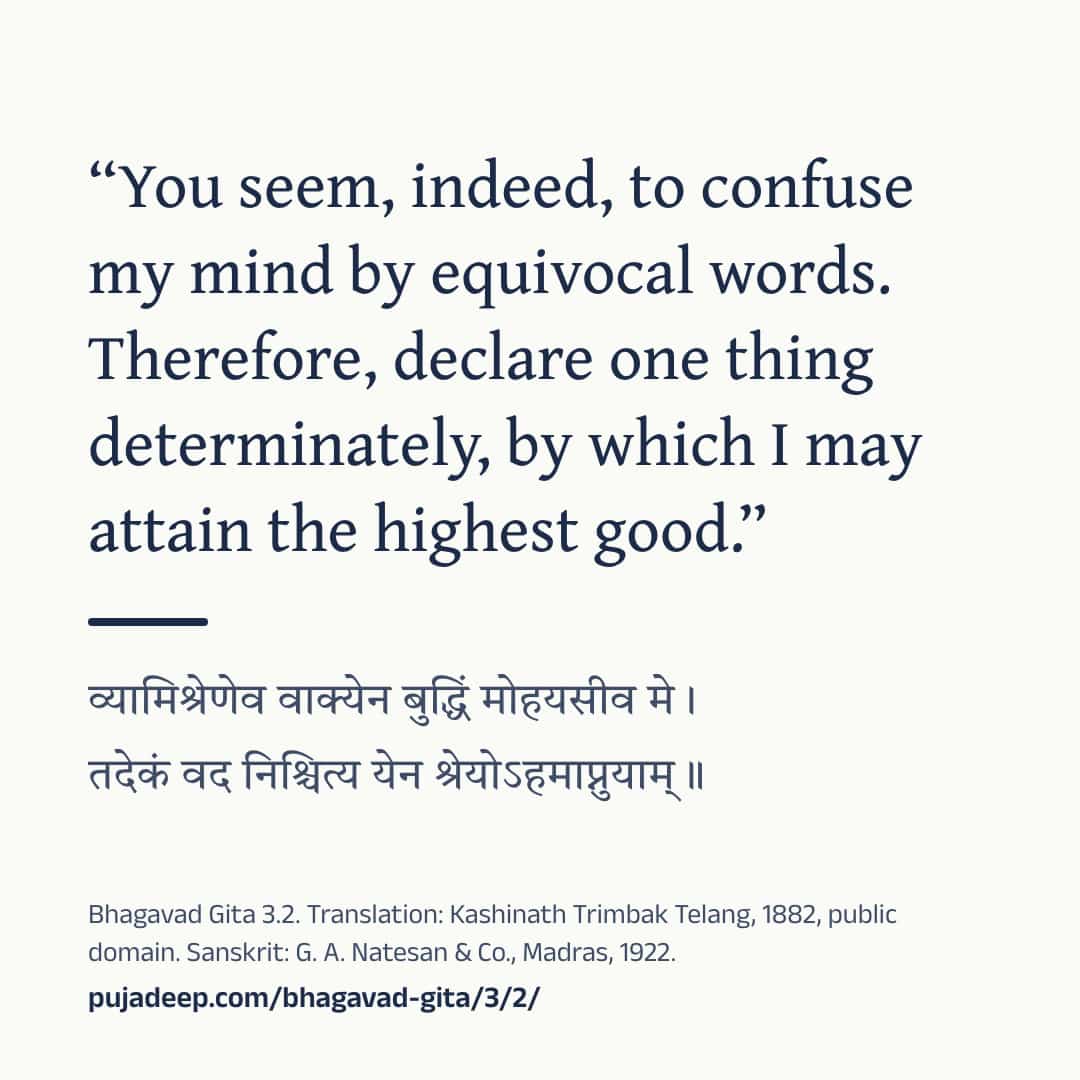
Drawing the picture
See the words
Bhagavad Gita 3.2

व्यामिश्रेणेव वाक्येन बुद्धिं मोहयसीव मे ।
तदेकं वद निश्चित्य येन श्रेयोऽहमाप्नुयाम् ॥

“You seem, indeed, to confuse my mind by equivocal words. Therefore, declare one thing determinately, by which I may attain the highest good.”
(K. T. Telang, The Bhagavadgîtâ (The Sacred Books of the East, vol. VIII, Oxford: Clarendon Press, 1882), p. 52, public domain)

“With these perplexing words Thou only confusest my understanding; therefore tell me with certainty the one (way) by which I may reach bliss?”
(Annie Besant, The Bhagavad Gîtâ, or The Lord's Song (London: Theosophical Publishing Society, 1895), p. 40, public domain)

“With these seemingly complicating words, Thou art, as it were, bewildering my understanding;—tell me that one thing for certain, by which I can attain to the highest.”
(Swami Swarupananda, Srimad-Bhagavad-Gita (Mayavati: Prabuddha Bharata Press, 1909; first printed in Prabuddha Bharata, 1907–1909), p. 138, public domain)

Sanskrit: G. A. Natesan & Co., Madras, 1922.
https://pujadeep.com/bhagavad-gita/3/2/ Nothing is sent from this site. Your own app sends it, to the chat you choose. The picture quotes the translation you chose on this page, with its name and year.
Sanskrit text: The Bhagavad-Gita, or The Lord's Song, with the text in Devanagari and an English translation, 1922. Meanings: written for Pujadeep and checked against the cited edition. Source and changes
Questions families ask
Who speaks Bhagavad Gita 3.2?
Arjuna speaks this verse, in chapter 3 (Karma Yoga).
Where does the Sanskrit text come from?
Sanskrit text: The Bhagavad-Gita, or The Lord's Song, with the text in Devanagari and an English translation, 1922. Meanings: written for Pujadeep and checked against the cited edition. See the source
Is the meaning on this page a translation?
Explanation written for this site from the sources listed here, and checked against the cited edition. It is not a translation and not the only way to read the text. Free to quote with credit.
Source and licence
- Sanskrit text
- The Bhagavad-Gita, or The Lord's Song, with the text in Devanagari and an English translation (Annie Besant, G. A. Natesan & Co., Madras, 1922). Public domain. The Sanskrit on these pages was read from this printing’s page images.
- Translation
- The Bhagavadgîtâ with the Sanatsugâtîya and the Anugîtâ, translated by Kâshinâth Trimbak Telang (The Sacred Books of the East, vol. VIII, ed. F. Max Müller) (Kashinath Trimbak Telang, F. Max Müller, Clarendon Press, Oxford, 1882). Public domain. Shown verbatim, as printed.
- Translation
- The Bhagavad Gîtâ, or The Lord's Song, translated by Annie Besant (Annie Besant, Theosophical Publishing Society, London, 1895). Public domain. Shown verbatim, as printed.
- Translation
- Srimad-Bhagavad-Gita, with Sanskrit Text; Paraphrase with Word-by-word Literal Translation; English Rendering and Comments, Index, &c., by the Swami Swarupananda (Himalayan Series, No. XX) (Swami Swarupananda, The Editors and Publishers, Advaita Ashrama, Mayavati, Prabuddha Bharata Press, Mayavati, Almora, Himalayas, 1909). Public domain. Shown verbatim, as printed.
- Commentary
- The Bhagavad-Gita, with the commentary of Sri Sankaracharya, translated by A. Mahadeva Sastri (2nd ed., Mysore: G. T. A. Printing Works, 1901) (Public-domain scan, University of California Libraries). Summarised in our own words; none of its text is reproduced.
- Commentary
- Sri Bhagavad-Gita with Sri Ramanujacharya's Visishtadvaita commentary, translated by A. Govindacharya (Madras, 1898) (Scan uploaded to archive.org (folkscanomy collection)). Summarised in our own words; none of its text is reproduced.
- Common wording
- In this text, 32 words follow today's common wording, checked against sanskritdocuments.org; Sanskrit Wikisource; Gita Press, Gorakhpur; GRETIL, Göttingen and Bhaktivedanta Book Trust.
- Our explanation
- Explanation written for this site from the sources listed here, and checked against the cited edition. It is not a translation and not the only way to read the text. Free to quote with credit.
- Checked
- Checked against the cited edition, October 27, 2026.