Bhagavad Gita 3.8: meaning and translation
Chapter 3: Karma Yoga. Krishna says
Krishna tells Arjuna to do his prescribed action (niyataṃ karma).
Click or tap a word for its meaning and its dictionary page.
Text and layers
Text and layers
These choices stay in this browser.
Bhagavad Gita 3.8
नियतं कुरु कर्म त्वं कर्म ज्यायो ह्यकर्मणः ।शरीरयात्राऽपि च ते न प्रसिध्येदकर्मणः ॥
Niyatam kuru karma tvam karma jyayo hyakarmanahSharirayatrapi cha te na prasidhyedakarmanah
niyataṃ kuru karma tvaṃ karma jyāyo hyakarmaṇaḥ |śarīrayātrā’pi ca te na prasidhyedakarmaṇaḥ ||
Our explanation Krishna tells Arjuna to do his prescribed action (niyataṃ karma). Action is better than inaction, he says, and without action even the upkeep of the body would not be possible. The commentators explain “prescribed action” and “inaction” in different ways (see the views).
हिंदी अर्थ कृष्ण अर्जुन से कहते हैं कि वे अपना नियत कर्म करें। वे कहते हैं कि कर्म न करने से कर्म करना श्रेष्ठ है, और कर्म के बिना शरीर का निर्वाह भी नहीं हो सकता। टीकाकार “नियत कर्म” और “अकर्म” को अलग-अलग ढंग से समझाते हैं।
Word by word
Every word, with its dictionary page
Word by word
- नियतम् niyatam · prescribed, set (past participle (neuter), accusative singular) Dictionary: ni-yata, Monier-Williams 1899, p. 552, col. 1 “fixed, established, settled, sure, regular, invariable”
- कुरु kuru · do (imperative, 2nd person singular) Dictionary: 1. kṛ, Monier-Williams 1899, p. 301, col. 1 “to do, make, perform, accomplish, cause, effect, prepare”
- कर्म karma · action (noun (neuter), accusative singular) Dictionary: karman, Monier-Williams 1899, p. 258, col. 2 “act, action, performance, business”
- त्वम् tvam · you (pronoun, nominative singular) Dictionary: 2. tva, Monier-Williams 1899, p. 463, col. 2 “base of the 2nd personal pron.”
- कर्म karma · action (noun (neuter), nominative singular) Dictionary: karman, Monier-Williams 1899, p. 258, col. 2 “act, action, performance, business”
- ज्यायः jyāyaḥ · better (comparative adjective (neuter), nominative singular) Dictionary: jyāyas, Monier-Williams 1899, p. 426, col. 3 “superior, more excellent, greater”
- हि hi · for (indeclinable) Dictionary: 2. hi, Monier-Williams 1899, p. 1297, col. 3 “for, because, on account of”
- अकर्मणः akarmaṇaḥ · than inaction (noun (neuter), ablative singular) Dictionary: a-karman, Monier-Williams 1899, p. 2, col. 1 “absence of work”
- शरीरयात्रा śarīrayātrā · upkeep of the body (compound (feminine), nominative singular) Dictionary: śarīra-yātrā, Monier-Williams 1899, p. 1058, col. 1 “means of bodily subsistence”
- अपि api · even (indeclinable) Dictionary: api, Monier-Williams 1899, p. 55, col. 1 “even, also, very”
- च ca · and (indeclinable) Dictionary: 2. ca, Monier-Williams 1899, p. 380, col. 1 “and, both, also, moreover, as well as”
- ते te · your (pronoun, genitive singular) Dictionary: 2. tva, Monier-Williams 1899, p. 463, col. 2 “base of the 2nd personal pron.”
- न na · not (indeclinable) Dictionary: 2. na, Monier-Williams 1899, p. 523, col. 1 “not, no, nor, neither”
- प्रसिध्येत् prasidhyet · would be possible (optative, 3rd person singular) Dictionary: pra-sidh, Monier-Williams 1899, p. 697, col. 3 “to be accomplished or effected, succeed”
- अकर्मणः akarmaṇaḥ · through inaction (noun (neuter), ablative singular) Dictionary: a-karman, Monier-Williams 1899, p. 2, col. 1 “absence of work”
1 printing differs
Edition differences. Another printing or text reads this place differently.
- Spelling A digital text reads Same words. The edition writes an avagraha (शरीरयात्राऽपि) and spells प्रसिध्येत् with one द्; this e-text writes प्रसिद्ध्येत्. Dropping one of two like consonants in a cluster is an accepted optional spelling (Pāṇini 8.4.65). Another digital text agrees with the edition (prasidhyed).
Old translations
Kashinath Trimbak Telang, 1882. Public domain. Page 53.
Do you perform prescribed action, for action is better than inaction, and the support of your body, too, cannot be accomplished with inaction.
Compare 3 translations
Kashinath Trimbak Telang, 1882. Public domain. Page 53.
Do you perform prescribed action, for action is better than inaction, and the support of your body, too, cannot be accomplished with inaction.
You are reading this one
Annie Besant, 1895. Public domain. Page 41–42.
Perform thou right action, for action is superior to inaction, and, inactive, even the maintenance of thy body would not be possible.
You are reading this one
Swami Swarupananda, 1909 (first printed 1907). Public domain. Page 66–67.
Do thou perform obligatory action; for action is superior to inaction, and even the bare maintenance of thy body would not be possible if thou art inactive.
You are reading this one
Cite this verse
The translation: K. T. Telang, The Bhagavadgîtâ (The Sacred Books of the East, vol. VIII, Oxford: Clarendon Press, 1882), p. 53. Bhagavad Gita 3.8.
The translation: Annie Besant, The Bhagavad Gîtâ, or The Lord's Song (London: Theosophical Publishing Society, 1895), pp. 41–42. Bhagavad Gita 3.8.
The translation: Swami Swarupananda, Srimad-Bhagavad-Gita (Mayavati: Prabuddha Bharata Press, 1909; first printed in Prabuddha Bharata, 1907–1909), pp. 66–67. Bhagavad Gita 3.8.
Our explanation: “Bhagavad Gita 3.8: meaning and translation.” Pujadeep. Updated October 27, 2026. https://pujadeep.com/bhagavad-gita/3/8/
Pujadeep’s explanations are free to quote with credit: name Pujadeep and link to the page. How to credit
Classical readings, by school
Each reading is named by its school. None is presented as the only meaning.
What Advaita, Vishishtadvaita and Dvaita teach, in short
Shankara Advaita
Shankara takes “prescribed action” (niyata karma) to be the obligatory daily duty (nitya karma), which is not done for any particular reward.
Source: The Bhagavad-Gita, with the commentary of Sri Sankaracharya, translated by A. Mahadeva Sastri (2nd ed., Mysore: G. T. A. Printing Works, 1901), commentary on 3.8, p. 86. Summarised in our own words; none of its text is reproduced.
Ramanuja Vishishtadvaita
Ramanuja reads niyata as “inherent”: acting comes naturally to a self joined to a body. By “inaction” he understands the path of knowledge. So he reads the verse as saying that the path of action is better even for one fit for knowledge, because it is natural, safe and itself includes knowledge of the self. And the body cannot be kept up without work.
Source: Sri Bhagavad-Gita with Sri Ramanujacharya's Visishtadvaita commentary, translated by A. Govindacharya (Madras, 1898), commentary on 3.8, pp. 95–97. Summarised in our own words; none of its text is reproduced.
Share
Show the ways to share
Send one picture or the text to one chat. The picture names its source and the address of this page.
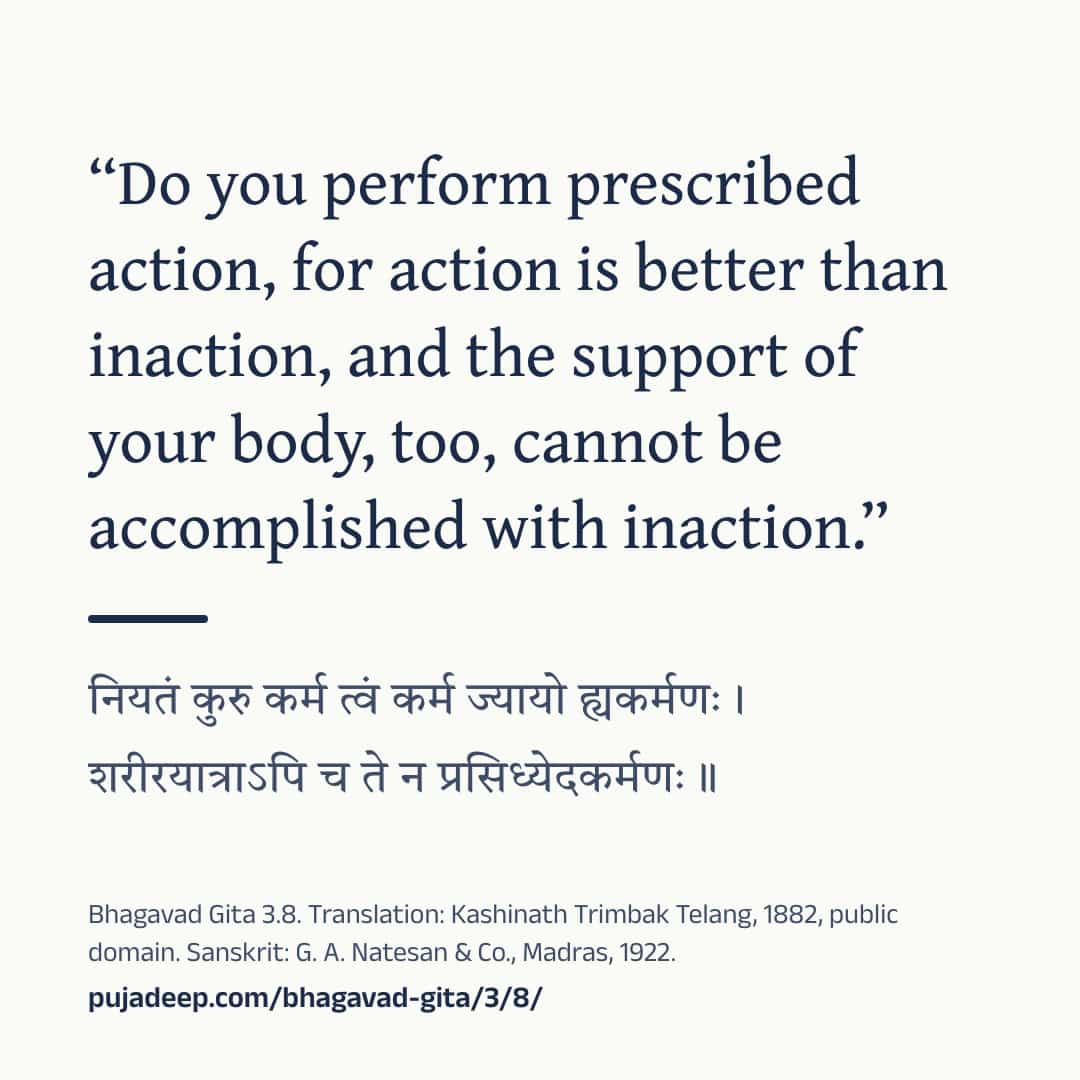
Drawing the picture
See the words
Bhagavad Gita 3.8

नियतं कुरु कर्म त्वं कर्म ज्यायो ह्यकर्मणः ।
शरीरयात्राऽपि च ते न प्रसिध्येदकर्मणः ॥

“Do you perform prescribed action, for action is better than inaction, and the support of your body, too, cannot be accomplished with inaction.”
(K. T. Telang, The Bhagavadgîtâ (The Sacred Books of the East, vol. VIII, Oxford: Clarendon Press, 1882), p. 53, public domain)

“Perform thou right action, for action is superior to inaction, and, inactive, even the maintenance of thy body would not be possible.”
(Annie Besant, The Bhagavad Gîtâ, or The Lord's Song (London: Theosophical Publishing Society, 1895), pp. 41–42, public domain)

“Do thou perform obligatory action; for action is superior to inaction, and even the bare maintenance of thy body would not be possible if thou art inactive.”
(Swami Swarupananda, Srimad-Bhagavad-Gita (Mayavati: Prabuddha Bharata Press, 1909; first printed in Prabuddha Bharata, 1907–1909), pp. 66–67, public domain)

Sanskrit: G. A. Natesan & Co., Madras, 1922.
https://pujadeep.com/bhagavad-gita/3/8/ Nothing is sent from this site. Your own app sends it, to the chat you choose. The picture quotes the translation you chose on this page, with its name and year.
Sanskrit text: The Bhagavad-Gita, or The Lord's Song, with the text in Devanagari and an English translation, 1922. Meanings: written for Pujadeep and checked against the cited edition. Source and changes
Questions families ask
Who speaks Bhagavad Gita 3.8?
Krishna speaks this verse, in chapter 3 (Karma Yoga).
Where does the Sanskrit text come from?
Sanskrit text: The Bhagavad-Gita, or The Lord's Song, with the text in Devanagari and an English translation, 1922. Meanings: written for Pujadeep and checked against the cited edition. See the source
Is the meaning on this page a translation?
Explanation written for this site from the sources listed here, and checked against the cited edition. It is not a translation and not the only way to read the text. Free to quote with credit.
Source and licence
- Sanskrit text
- The Bhagavad-Gita, or The Lord's Song, with the text in Devanagari and an English translation (Annie Besant, G. A. Natesan & Co., Madras, 1922). Public domain. The Sanskrit on these pages was read from this printing’s page images.
- Translation
- The Bhagavadgîtâ with the Sanatsugâtîya and the Anugîtâ, translated by Kâshinâth Trimbak Telang (The Sacred Books of the East, vol. VIII, ed. F. Max Müller) (Kashinath Trimbak Telang, F. Max Müller, Clarendon Press, Oxford, 1882). Public domain. Shown verbatim, as printed.
- Translation
- The Bhagavad Gîtâ, or The Lord's Song, translated by Annie Besant (Annie Besant, Theosophical Publishing Society, London, 1895). Public domain. Shown verbatim, as printed.
- Translation
- Srimad-Bhagavad-Gita, with Sanskrit Text; Paraphrase with Word-by-word Literal Translation; English Rendering and Comments, Index, &c., by the Swami Swarupananda (Himalayan Series, No. XX) (Swami Swarupananda, The Editors and Publishers, Advaita Ashrama, Mayavati, Prabuddha Bharata Press, Mayavati, Almora, Himalayas, 1909). Public domain. Shown verbatim, as printed.
- Commentary
- The Bhagavad-Gita, with the commentary of Sri Sankaracharya, translated by A. Mahadeva Sastri (2nd ed., Mysore: G. T. A. Printing Works, 1901) (Public-domain scan, University of California Libraries). Summarised in our own words; none of its text is reproduced.
- Commentary
- Sri Bhagavad-Gita with Sri Ramanujacharya's Visishtadvaita commentary, translated by A. Govindacharya (Madras, 1898) (Scan uploaded to archive.org (folkscanomy collection)). Summarised in our own words; none of its text is reproduced.
- Common wording
- In this text, 32 words follow today's common wording, checked against sanskritdocuments.org; Sanskrit Wikisource; Gita Press, Gorakhpur; GRETIL, Göttingen and Bhaktivedanta Book Trust.
- Our explanation
- Explanation written for this site from the sources listed here, and checked against the cited edition. It is not a translation and not the only way to read the text. Free to quote with credit.
- Checked
- Checked against the cited edition, October 27, 2026.