Bhagavad Gita 3.11: meaning and translation
Chapter 3: Karma Yoga. Krishna says
Krishna: Prajapati's words continue: “With this, nourish the gods (devas), and let the gods nourish you.
Click or tap a word for its meaning and its dictionary page.
Text and layers
Text and layers
These choices stay in this browser.
Bhagavad Gita 3.11
देवान्भावयतानेन ते देवा भावयन्तु वः ।परस्परं भावयन्तः श्रेयः परमवाप्स्यथ ॥
Devanbhavayatanena te deva bhavayantu vahParasparam bhavayantah shreyah paramavapsyatha
devānbhāvayatānena te devā bhāvayantu vaḥ |parasparaṃ bhāvayantaḥ śreyaḥ paramavāpsyatha ||
Our explanation Prajapati's words continue: “With this, nourish the gods (devas), and let the gods nourish you. Nourishing one another, you shall reach the highest good.”
हिंदी अर्थ प्रजापति आगे कहते हैं: “इस यज्ञ से तुम देवताओं को संतुष्ट करो, और देवता तुम्हें संतुष्ट करें। एक-दूसरे को संतुष्ट करते हुए तुम परम कल्याण पाओगे।”
Word by word
Every word, with its dictionary page
Word by word
- देवान् devān · the gods (noun (masculine), accusative plural) Dictionary: deva, Monier-Williams 1899, p. 492, col. 2 “a deity, god”
- भावयत bhāvayata · nourish (causative imperative, 2nd person plural) Dictionary: 1. bhū, Monier-Williams 1899, p. 760, col. 2 “to cherish, foster, animate, enliven, refresh, encourage, promote, further”
- अनेन anena · with this (pronoun (masculine), instrumental singular) Dictionary: 1. idam, Monier-Williams 1899, p. 165, col. 2 “this, this here, referring to something near the speaker”
- ते te · those (pronoun (masculine), nominative plural) Dictionary: tad, Monier-Williams 1899, p. 434, col. 1 “m. he, f. she, n. it, that, this”
- देवाः devāḥ · gods (noun (masculine), nominative plural) Dictionary: deva, Monier-Williams 1899, p. 492, col. 2 “a deity, god”
- भावयन्तु bhāvayantu · may nourish (causative imperative, 3rd person plural) Dictionary: 1. bhū, Monier-Williams 1899, p. 760, col. 2 “to cherish, foster, animate, enliven, refresh, encourage, promote, further”
- वः vaḥ · you (pronoun, accusative plural) Dictionary: yuṣmad, Monier-Williams 1899, p. 855, col. 3 “the base of the 2nd pers. pron. as used in comp.”
- परस्परम् parasparam · one another (indeclinable) Dictionary: paras-para, Monier-Williams 1899, p. 589, col. 1 “one another, each other”
- भावयन्तः bhāvayantaḥ · nourishing (causative present participle (masculine), nominative plural) Dictionary: 1. bhū, Monier-Williams 1899, p. 760, col. 2 “to cherish, foster, animate, enliven, refresh, encourage, promote, further”
- श्रेयः śreyaḥ · good, welfare (noun (neuter), accusative singular) Dictionary: śreyas, Monier-Williams 1899, p. 1102, col. 2 “good (as opp. to ‘evil’), welfare, bliss, fortune, happiness”
- परम् param · highest (adjective (neuter), accusative singular) Dictionary: 1. para, Monier-Williams 1899, p. 586, col. 1 “highest, supreme, chief”
- अवाप्स्यथ avāpsyatha · you will reach (future, 2nd person plural) Dictionary: avāp, Monier-Williams 1899, p. 107, col. 1 “to reach, attain, obtain, gain, get”
Old translations
Kashinath Trimbak Telang, 1882. Public domain. Page 53.
Please the gods with this, and may those gods please you. Pleasing each other, you will attain the highest good.
Compare 3 translations
Kashinath Trimbak Telang, 1882. Public domain. Page 53.
Please the gods with this, and may those gods please you. Pleasing each other, you will attain the highest good.
You are reading this one
Annie Besant, 1895. Public domain. Page 42.
"With this nourish ye the Gods, and may the Gods nourish you; thus nourishing one another, ye shall reap the supremest good.
This sentence begins in 3.10.
You are reading this one
Swami Swarupananda, 1909 (first printed 1907). Public domain. Page 68.
"Cherish the Devas with this, and may those Devas cherish you: thus cherishing one another, ye shall gain the highest good.
You are reading this one
Cite this verse
The translation: K. T. Telang, The Bhagavadgîtâ (The Sacred Books of the East, vol. VIII, Oxford: Clarendon Press, 1882), p. 53. Bhagavad Gita 3.11.
The translation: Annie Besant, The Bhagavad Gîtâ, or The Lord's Song (London: Theosophical Publishing Society, 1895), p. 42. Bhagavad Gita 3.11.
The translation: Swami Swarupananda, Srimad-Bhagavad-Gita (Mayavati: Prabuddha Bharata Press, 1909; first printed in Prabuddha Bharata, 1907–1909), p. 68. Bhagavad Gita 3.11.
Our explanation: “Bhagavad Gita 3.11: meaning and translation.” Pujadeep. Updated October 27, 2026. https://pujadeep.com/bhagavad-gita/3/11/
Pujadeep’s explanations are free to quote with credit: name Pujadeep and link to the page. How to credit
Classical readings, by school
No readings by school on this verse yet.
Share
Show the ways to share
Send one picture or the text to one chat. The picture names its source and the address of this page.
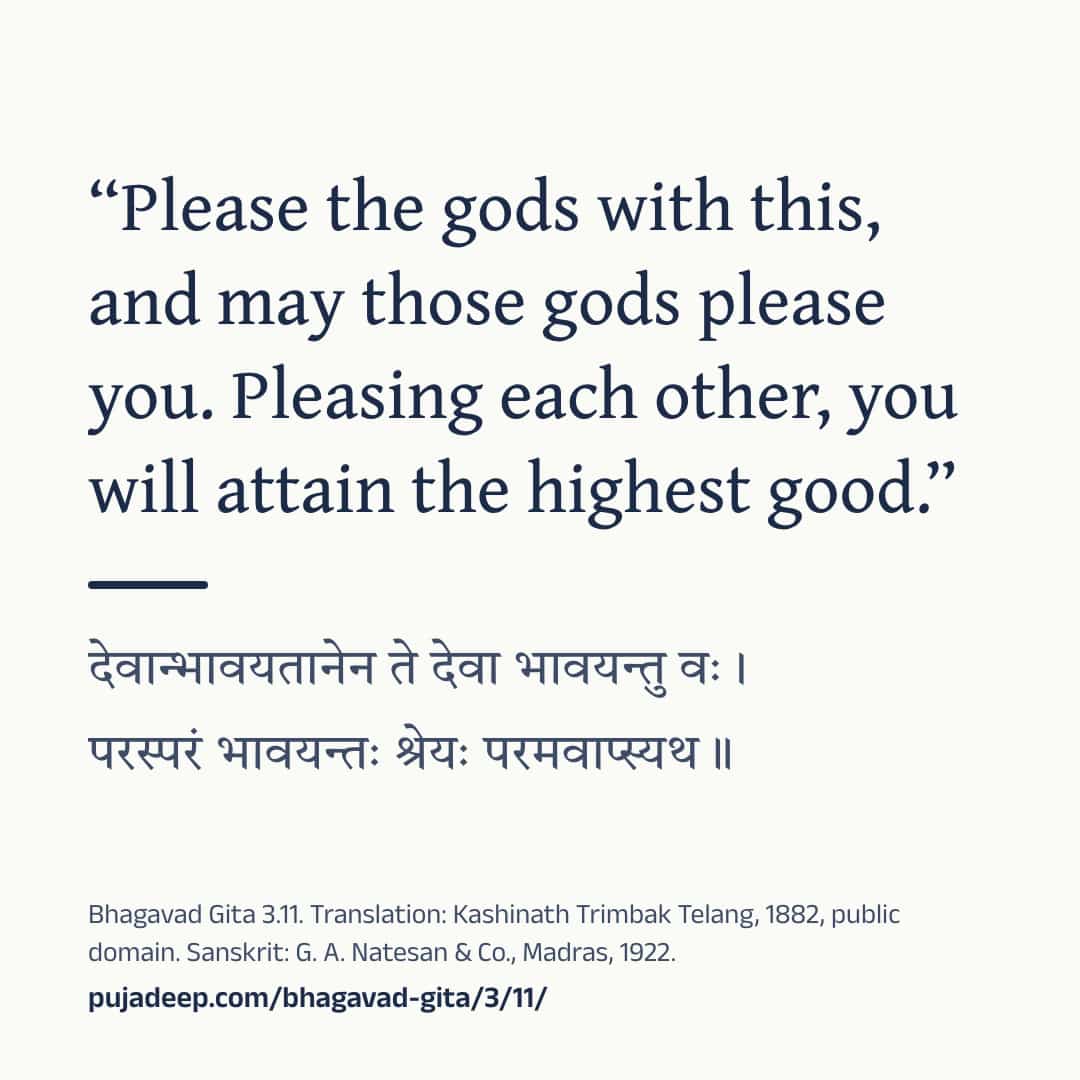
Drawing the picture
See the words
Bhagavad Gita 3.11

देवान्भावयतानेन ते देवा भावयन्तु वः ।
परस्परं भावयन्तः श्रेयः परमवाप्स्यथ ॥

“Please the gods with this, and may those gods please you. Pleasing each other, you will attain the highest good.”
(K. T. Telang, The Bhagavadgîtâ (The Sacred Books of the East, vol. VIII, Oxford: Clarendon Press, 1882), p. 53, public domain)

“"With this nourish ye the Gods, and may the Gods nourish you; thus nourishing one another, ye shall reap the supremest good.”
(Annie Besant, The Bhagavad Gîtâ, or The Lord's Song (London: Theosophical Publishing Society, 1895), p. 42, public domain)
This sentence begins in 3.10.

“"Cherish the Devas with this, and may those Devas cherish you: thus cherishing one another, ye shall gain the highest good.”
(Swami Swarupananda, Srimad-Bhagavad-Gita (Mayavati: Prabuddha Bharata Press, 1909; first printed in Prabuddha Bharata, 1907–1909), p. 68, public domain)

Sanskrit: G. A. Natesan & Co., Madras, 1922.
https://pujadeep.com/bhagavad-gita/3/11/ Nothing is sent from this site. Your own app sends it, to the chat you choose. The picture quotes the translation you chose on this page, with its name and year.
Sanskrit text: The Bhagavad-Gita, or The Lord's Song, with the text in Devanagari and an English translation, 1922. Meanings: written for Pujadeep and checked against the cited edition. Source and changes
Questions families ask
Who speaks Bhagavad Gita 3.11?
Krishna speaks this verse, in chapter 3 (Karma Yoga).
Where does the Sanskrit text come from?
Sanskrit text: The Bhagavad-Gita, or The Lord's Song, with the text in Devanagari and an English translation, 1922. Meanings: written for Pujadeep and checked against the cited edition. See the source
Is the meaning on this page a translation?
Explanation written for this site from the sources listed here, and checked against the cited edition. It is not a translation and not the only way to read the text. Free to quote with credit.
Source and licence
- Sanskrit text
- The Bhagavad-Gita, or The Lord's Song, with the text in Devanagari and an English translation (Annie Besant, G. A. Natesan & Co., Madras, 1922). Public domain. The Sanskrit on these pages was read from this printing’s page images.
- Translation
- The Bhagavadgîtâ with the Sanatsugâtîya and the Anugîtâ, translated by Kâshinâth Trimbak Telang (The Sacred Books of the East, vol. VIII, ed. F. Max Müller) (Kashinath Trimbak Telang, F. Max Müller, Clarendon Press, Oxford, 1882). Public domain. Shown verbatim, as printed.
- Translation
- The Bhagavad Gîtâ, or The Lord's Song, translated by Annie Besant (Annie Besant, Theosophical Publishing Society, London, 1895). Public domain. Shown verbatim, as printed.
- Translation
- Srimad-Bhagavad-Gita, with Sanskrit Text; Paraphrase with Word-by-word Literal Translation; English Rendering and Comments, Index, &c., by the Swami Swarupananda (Himalayan Series, No. XX) (Swami Swarupananda, The Editors and Publishers, Advaita Ashrama, Mayavati, Prabuddha Bharata Press, Mayavati, Almora, Himalayas, 1909). Public domain. Shown verbatim, as printed.
- Common wording
- In this text, 32 words follow today's common wording, checked against sanskritdocuments.org; Sanskrit Wikisource; Gita Press, Gorakhpur; GRETIL, Göttingen and Bhaktivedanta Book Trust.
- Our explanation
- Explanation written for this site from the sources listed here, and checked against the cited edition. It is not a translation and not the only way to read the text. Free to quote with credit.
- Checked
- Checked against the cited edition, October 27, 2026.