Bhagavad Gita 3.12: meaning and translation
Chapter 3: Karma Yoga. Krishna says
Krishna: Prajapati says: “The gods, nourished by sacrifice, will give you the enjoyments you desire.” The verse goes on: whoever enjoys their gifts without offering anything to them in return is a thief.
Click or tap a word for its meaning and its dictionary page.
Text and layers
Text and layers
These choices stay in this browser.
Bhagavad Gita 3.12
इष्टान्भोगान्हि वो देवा दास्यन्ते यज्ञभाविताः ।तैर्दत्तानप्रदायैभ्यो यो भुङ्क्ते स्तेन एव सः ॥
Ishtanbhoganhi vo deva dasyante yajnabhavitahTairdattanapradayaibhyo yo bhunkte stena eva sah
iṣṭānbhogānhi vo devā dāsyante yajñabhāvitāḥ |tairdattānapradāyaibhyo yo bhuṅkte stena eva saḥ ||
Our explanation Prajapati says: “The gods, nourished by sacrifice, will give you the enjoyments you desire.” The verse goes on: whoever enjoys their gifts without offering anything to them in return is a thief. The translators end the quotation in different places: Telang counts the sentence about the thief as part of Prajapati's words; Besant prints it after the quotation has closed.
हिंदी अर्थ प्रजापति कहते हैं: “यज्ञ से संतुष्ट देवता तुम्हें मनचाहे भोग देंगे।” श्लोक आगे कहता है कि जो उनके दिए हुए को, उन्हें कुछ अर्पित किए बिना, भोगता है, वह चोर है। दोनों अनुवादक उद्धरण को अलग-अलग जगह समाप्त करते हैं: तेलंग चोर वाली बात को प्रजापति के वचनों में गिनते हैं, बेसेंट उसे उद्धरण के बाद रखती हैं।
Word by word
Every word, with its dictionary page
Word by word
- इष्टान् iṣṭān · desired (past participle (masculine), accusative plural) Dictionary: iṣṭa, Monier-Williams 1899, p. 169, col. 2 “wished, desired; liked, beloved; agreeable; cherished”
- भोगान् bhogān · enjoyments (noun (masculine), accusative plural) Dictionary: 2. bhoga, Monier-Williams 1899, p. 767, col. 2 “enjoyment, eating, feeding on”
- हि hi · indeed (indeclinable) Dictionary: 2. hi, Monier-Williams 1899, p. 1297, col. 3 “for, because, on account of”
- वः vaḥ · to you (pronoun, dative plural) Dictionary: yuṣmad, Monier-Williams 1899, p. 855, col. 3 “the base of the 2nd pers. pron. as used in comp.”
- देवाः devāḥ · the gods (noun (masculine), nominative plural) Dictionary: deva, Monier-Williams 1899, p. 492, col. 2 “a deity, god”
- दास्यन्ते dāsyante · will give (future, 3rd person plural) Dictionary: 1. dā, Monier-Williams 1899, p. 473, col. 2
- यज्ञभाविताः yajñabhāvitāḥ · nourished by sacrifice (compound (masculine), nominative plural) Dictionary: yajña, Monier-Williams 1899, p. 839, col. 2 “act of worship or devotion, offering, oblation, sacrifice”; bhāvita, Monier-Williams 1899, p. 755, col. 1 “cherished, protected, fostered, furthered, promoted”
- तैः taiḥ · by them (pronoun (masculine), instrumental plural) Dictionary: tad, Monier-Williams 1899, p. 434, col. 1 “m. he, f. she, n. it, that, this”
- दत्तान् dattān · given (past participle (masculine), accusative plural) Dictionary: 2. datta, Monier-Williams 1899, p. 467, col. 2 “given, granted, presented”
- अप्रदाय apradāya · without giving (absolutive with a- (without giving)) Dictionary: 3. a, Monier-Williams 1899, p. 1, col. 1 “having a negative or privative or contrary sense”; pra-dā, Monier-Williams 1899, p. 679, col. 2 “to give away, give, offer, present, grant, bestow”
- एभ्यः ebhyaḥ · to them (pronoun (masculine), dative plural) Dictionary: 1. idam, Monier-Williams 1899, p. 165, col. 2 “this, this here, referring to something near the speaker”
- यः yaḥ · who (pronoun (masculine), nominative singular) Dictionary: yad, Monier-Williams 1899, p. 844, col. 2 “who, which, what, whichever, whatever, that”
- भुङ्क्ते bhuṅkte · enjoys (present, 3rd person singular) Dictionary: 3. bhuj, Monier-Williams 1899, p. 759, col. 2 “to enjoy, use, possess”
- स्तेनः stenaḥ · a thief (noun (masculine), nominative singular) Dictionary: stena, Monier-Williams 1899, p. 1260, col. 2 “a thief, robber”
- एव eva · surely (indeclinable) Dictionary: 1. eva, Monier-Williams 1899, p. 232, col. 2 “just, exactly, very, same, only, even, alone, merely”
- सः saḥ · he (pronoun (masculine), nominative singular) Dictionary: tad, Monier-Williams 1899, p. 434, col. 1 “m. he, f. she, n. it, that, this”
Old translations
Kashinath Trimbak Telang, 1882. Public domain. Page 53.
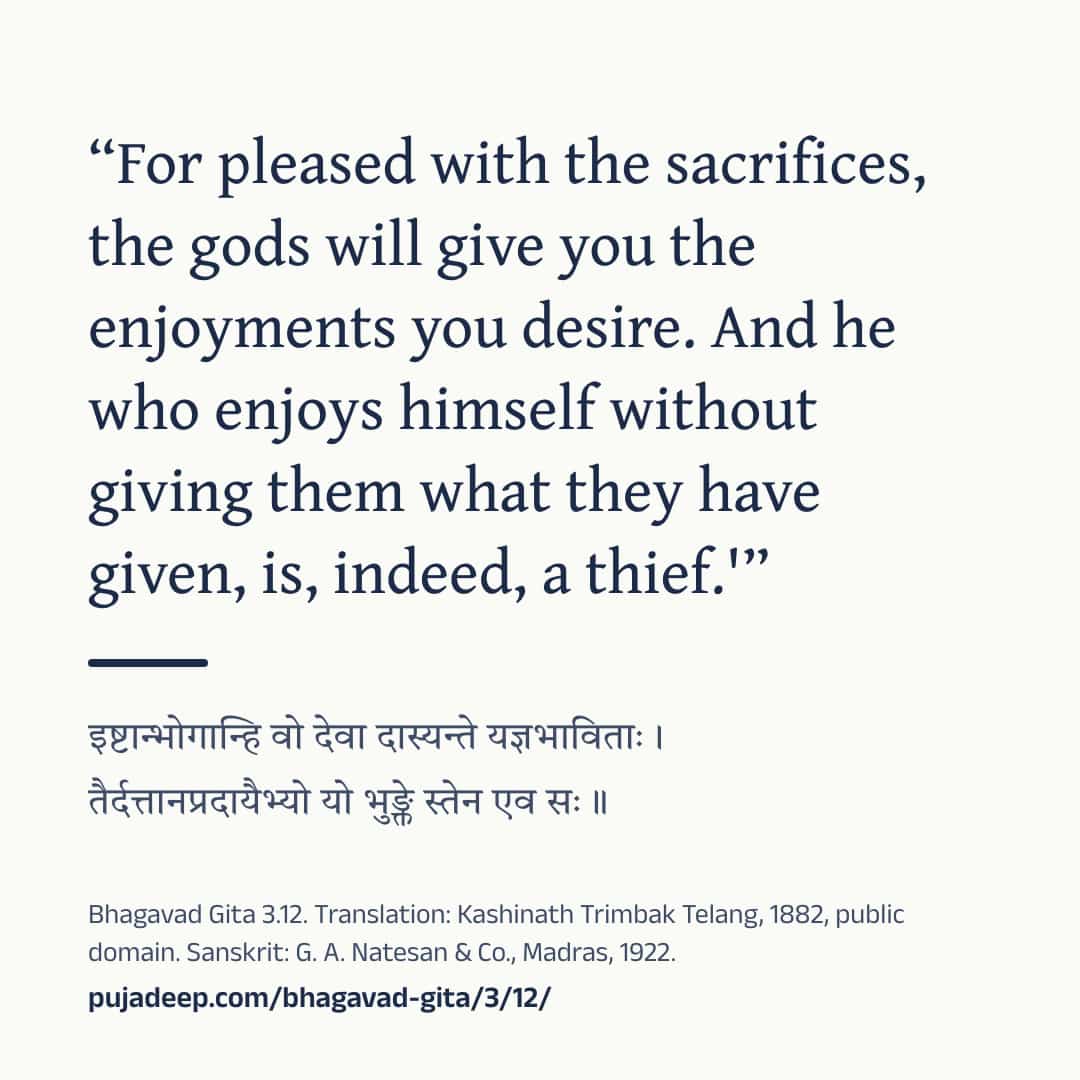
For pleased with the sacrifices, the gods will give you the enjoyments you desire. And he who enjoys himself without giving them what they have given, is, indeed, a thief.'
Compare 3 translations
Kashinath Trimbak Telang, 1882. Public domain. Page 53.
For pleased with the sacrifices, the gods will give you the enjoyments you desire. And he who enjoys himself without giving them what they have given, is, indeed, a thief.'
You are reading this one
Annie Besant, 1895. Public domain. Page 42.
"For, nourished by sacrifice, the Gods shall bestow on you the enjoyments you desire." A thief verily is he who enjoyeth what is given by Them without returning the gift.
You are reading this one
Swami Swarupananda, 1909 (first printed 1907). Public domain. Page 68.
"The Devas cherished by Yajna, will give you desired-for objects." So, he who enjoys objects given by the Devas without offering (in return) to them, is verily a thief.
You are reading this one
Cite this verse
The translation: K. T. Telang, The Bhagavadgîtâ (The Sacred Books of the East, vol. VIII, Oxford: Clarendon Press, 1882), p. 53. Bhagavad Gita 3.12.
The translation: Annie Besant, The Bhagavad Gîtâ, or The Lord's Song (London: Theosophical Publishing Society, 1895), p. 42. Bhagavad Gita 3.12.
The translation: Swami Swarupananda, Srimad-Bhagavad-Gita (Mayavati: Prabuddha Bharata Press, 1909; first printed in Prabuddha Bharata, 1907–1909), p. 68. Bhagavad Gita 3.12.
Our explanation: “Bhagavad Gita 3.12: meaning and translation.” Pujadeep. Updated October 27, 2026. https://pujadeep.com/bhagavad-gita/3/12/
Pujadeep’s explanations are free to quote with credit: name Pujadeep and link to the page. How to credit
Classical readings, by school
No readings by school on this verse yet.
Share
Show the ways to share
Send one picture or the text to one chat. The picture names its source and the address of this page.
Drawing the picture
See the words
Bhagavad Gita 3.12

इष्टान्भोगान्हि वो देवा दास्यन्ते यज्ञभाविताः ।
तैर्दत्तानप्रदायैभ्यो यो भुङ्क्ते स्तेन एव सः ॥

“For pleased with the sacrifices, the gods will give you the enjoyments you desire. And he who enjoys himself without giving them what they have given, is, indeed, a thief.'”
(K. T. Telang, The Bhagavadgîtâ (The Sacred Books of the East, vol. VIII, Oxford: Clarendon Press, 1882), p. 53, public domain)

“"For, nourished by sacrifice, the Gods shall bestow on you the enjoyments you desire." A thief verily is he who enjoyeth what is given by Them without returning the gift.”
(Annie Besant, The Bhagavad Gîtâ, or The Lord's Song (London: Theosophical Publishing Society, 1895), p. 42, public domain)

“"The Devas cherished by Yajna, will give you desired-for objects." So, he who enjoys objects given by the Devas without offering (in return) to them, is verily a thief.”
(Swami Swarupananda, Srimad-Bhagavad-Gita (Mayavati: Prabuddha Bharata Press, 1909; first printed in Prabuddha Bharata, 1907–1909), p. 68, public domain)

Sanskrit: G. A. Natesan & Co., Madras, 1922.
https://pujadeep.com/bhagavad-gita/3/12/ Nothing is sent from this site. Your own app sends it, to the chat you choose. The picture quotes the translation you chose on this page, with its name and year.
Sanskrit text: The Bhagavad-Gita, or The Lord's Song, with the text in Devanagari and an English translation, 1922. Meanings: written for Pujadeep and checked against the cited edition. Source and changes
Questions families ask
Who speaks Bhagavad Gita 3.12?
Krishna speaks this verse, in chapter 3 (Karma Yoga).
Where does the Sanskrit text come from?
Sanskrit text: The Bhagavad-Gita, or The Lord's Song, with the text in Devanagari and an English translation, 1922. Meanings: written for Pujadeep and checked against the cited edition. See the source
Is the meaning on this page a translation?
Explanation written for this site from the sources listed here, and checked against the cited edition. It is not a translation and not the only way to read the text. Free to quote with credit.
Source and licence
- Sanskrit text
- The Bhagavad-Gita, or The Lord's Song, with the text in Devanagari and an English translation (Annie Besant, G. A. Natesan & Co., Madras, 1922). Public domain. The Sanskrit on these pages was read from this printing’s page images.
- Translation
- The Bhagavadgîtâ with the Sanatsugâtîya and the Anugîtâ, translated by Kâshinâth Trimbak Telang (The Sacred Books of the East, vol. VIII, ed. F. Max Müller) (Kashinath Trimbak Telang, F. Max Müller, Clarendon Press, Oxford, 1882). Public domain. Shown verbatim, as printed.
- Translation
- The Bhagavad Gîtâ, or The Lord's Song, translated by Annie Besant (Annie Besant, Theosophical Publishing Society, London, 1895). Public domain. Shown verbatim, as printed.
- Translation
- Srimad-Bhagavad-Gita, with Sanskrit Text; Paraphrase with Word-by-word Literal Translation; English Rendering and Comments, Index, &c., by the Swami Swarupananda (Himalayan Series, No. XX) (Swami Swarupananda, The Editors and Publishers, Advaita Ashrama, Mayavati, Prabuddha Bharata Press, Mayavati, Almora, Himalayas, 1909). Public domain. Shown verbatim, as printed.
- Common wording
- In this text, 32 words follow today's common wording, checked against sanskritdocuments.org; Sanskrit Wikisource; Gita Press, Gorakhpur; GRETIL, Göttingen and Bhaktivedanta Book Trust.
- Our explanation
- Explanation written for this site from the sources listed here, and checked against the cited edition. It is not a translation and not the only way to read the text. Free to quote with credit.
- Checked
- Checked against the cited edition, October 27, 2026.