Bhagavad Gita 3.13: meaning and translation
Chapter 3: Karma Yoga. Krishna says
Krishna says that good people who eat what remains after the sacrifice are freed from all their faults (kilbiṣa), but wrongdoers who cook only for themselves eat sin (agha).
Click or tap a word for its meaning and its dictionary page.
Text and layers
Text and layers
These choices stay in this browser.
Bhagavad Gita 3.13
यज्ञशिष्टाशिनः सन्तो मुच्यन्ते सर्वकिल्बिषैः ।भुञ्जते ते त्वघं पापा ये पचन्त्यात्मकारणात् ॥
Yajnashishtashinah santo muchyante sarvakilbishaihBhunjate te tvagham papa ye pachantyatmakaranat
yajñaśiṣṭāśinaḥ santo mucyante sarvakilbiṣaiḥ |bhuñjate te tvaghaṃ pāpā ye pacantyātmakāraṇāt ||
Our explanation Krishna says that good people who eat what remains after the sacrifice are freed from all their faults (kilbiṣa), but wrongdoers who cook only for themselves eat sin (agha).
हिंदी अर्थ कृष्ण कहते हैं कि यज्ञ से बचा हुआ अन्न खाने वाले सज्जन सब दोषों (किल्बिष) से छूट जाते हैं, पर जो पापी केवल अपने लिए भोजन पकाते हैं, वे पाप (अघ) ही खाते हैं।
Word by word
Every word, with its dictionary page
Word by word
- यज्ञशिष्टाशिनः yajñaśiṣṭāśinaḥ · eating what remains of sacrifice (compound (masculine), nominative plural) Dictionary: yajña, Monier-Williams 1899, p. 839, col. 2 “act of worship or devotion, offering, oblation, sacrifice”; 1. śiṣṭa, Monier-Williams 1899, p. 1076, col. 3 “left, remaining, escaped, residual”; śiṣṭāśin, Monier-Williams 1899, p. 1076, col. 3 “feeding on remnants”; āśin, Monier-Williams 1899, p. 157, col. 1 “ifc. eating, consuming”
- सन्तः santaḥ · good people (noun (masculine), nominative plural) Dictionary: sat, Monier-Williams 1899, p. 1134, col. 2 “good or honest or wise or respectable people”
- मुच्यन्ते mucyante · are freed (present passive, 3rd person plural) Dictionary: 2. muc, Monier-Williams 1899, p. 820, col. 3 “to be loosed, to be set free or released”
- सर्वकिल्बिषैः sarvakilbiṣaiḥ · from all faults (compound (neuter), instrumental plural) Dictionary: sarva, Monier-Williams 1899, p. 1184, col. 3 “whole, entire, all, every”; kilbiṣa, Monier-Williams 1899, p. 284, col. 2 “fault, offence, sin, guilt”
- भुञ्जते bhuñjate · eat (present, 3rd person plural) Dictionary: 3. bhuj, Monier-Williams 1899, p. 759, col. 2 “to enjoy, use, possess, (esp.) enjoy a meal, eat”
- ते te · they (pronoun (masculine), nominative plural) Dictionary: tad, Monier-Williams 1899, p. 434, col. 1 “m. he, f. she, n. it, that, this”
- तु tu · but (indeclinable) Dictionary: 2. tu, Monier-Williams 1899, p. 449, col. 3 “but”
- अघम् agham · sin (noun (neuter), accusative singular) Dictionary: agha, Monier-Williams 1899, p. 6, col. 3 “sin, impurity”
- पापाः pāpāḥ · wrongdoers (adjective (masculine), nominative plural) Dictionary: pāpa, Monier-Williams 1899, p. 618, col. 2 “bad, vicious, wicked, evil”
- ये ye · who (pronoun (masculine), nominative plural) Dictionary: yad, Monier-Williams 1899, p. 844, col. 2 “who, which, what, whichever, whatever, that”
- पचन्ति pacanti · cook (present, 3rd person plural) Dictionary: 2. pac, Monier-Williams 1899, p. 575, col. 1 “to cook, bake”
- आत्मकारणात् ātmakāraṇāt · for their own sake (compound (neuter), ablative singular) Dictionary: ātman, Monier-Williams 1899, p. 135, col. 1 “the individual soul, self”; 1. kāraṇa, Monier-Williams 1899, p. 274, col. 2 “cause, reason”
Old translations
Kashinath Trimbak Telang, 1882. Public domain. Page 53.
The good, who eat the leavings of a sacrifice, are released from all sins. But the unrighteous ones, who prepare food for themselves only, incur sin1.
Footnotes (the translator’s own) - Cf. Maitrî-upanishad, p. 143. ↩
Compare 3 translations
Kashinath Trimbak Telang, 1882. Public domain. Page 53.
The good, who eat the leavings of a sacrifice, are released from all sins. But the unrighteous ones, who prepare food for themselves only, incur sin1.
Footnotes (the translator’s own) - Cf. Maitrî-upanishad, p. 143. ↩
You are reading this one
Annie Besant, 1895. Public domain. Page 43.
The righteous, who eat the remains of the sacrifice, are freed from all sins; but the impious, who dress food for their own sakes, they verily eat sin.
You are reading this one
Swami Swarupananda, 1909 (first printed 1907). Public domain. Page 69.
The good, eating the remnants of Yajna, are freed from all sins: but who cook food (only) for themselves, those sinful ones, eat sin.
You are reading this one
Cite this verse
The translation: K. T. Telang, The Bhagavadgîtâ (The Sacred Books of the East, vol. VIII, Oxford: Clarendon Press, 1882), p. 53. Bhagavad Gita 3.13.
The translation: Annie Besant, The Bhagavad Gîtâ, or The Lord's Song (London: Theosophical Publishing Society, 1895), p. 43. Bhagavad Gita 3.13.
The translation: Swami Swarupananda, Srimad-Bhagavad-Gita (Mayavati: Prabuddha Bharata Press, 1909; first printed in Prabuddha Bharata, 1907–1909), p. 69. Bhagavad Gita 3.13.
Our explanation: “Bhagavad Gita 3.13: meaning and translation.” Pujadeep. Updated October 27, 2026. https://pujadeep.com/bhagavad-gita/3/13/
Pujadeep’s explanations are free to quote with credit: name Pujadeep and link to the page. How to credit
Classical readings, by school
No readings by school on this verse yet.
Share
Show the ways to share
Send one picture or the text to one chat. The picture names its source and the address of this page.
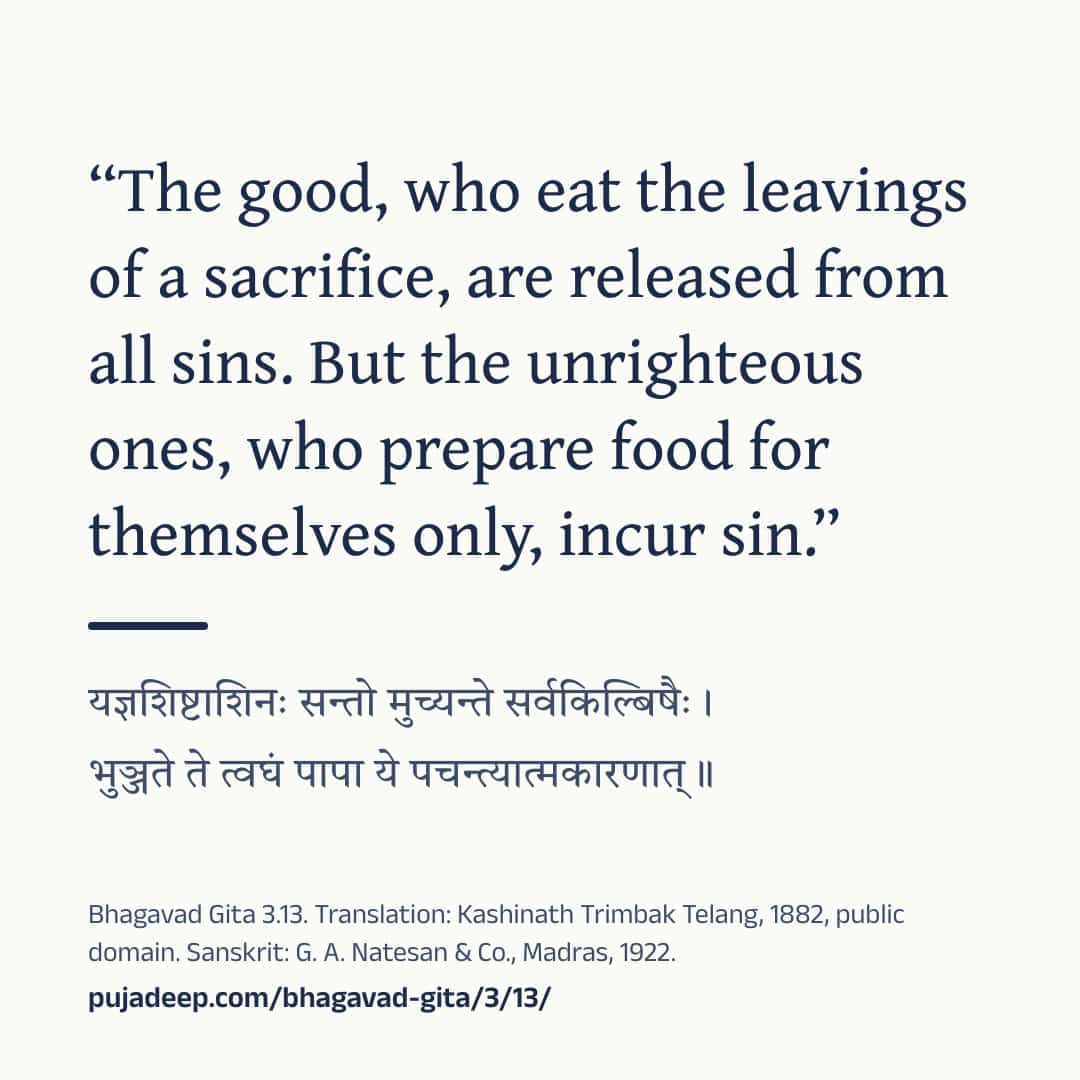
Drawing the picture
See the words
Bhagavad Gita 3.13

यज्ञशिष्टाशिनः सन्तो मुच्यन्ते सर्वकिल्बिषैः ।
भुञ्जते ते त्वघं पापा ये पचन्त्यात्मकारणात् ॥

“The good, who eat the leavings of a sacrifice, are released from all sins. But the unrighteous ones, who prepare food for themselves only, incur sin.”
(K. T. Telang, The Bhagavadgîtâ (The Sacred Books of the East, vol. VIII, Oxford: Clarendon Press, 1882), p. 53, public domain)

“The righteous, who eat the remains of the sacrifice, are freed from all sins; but the impious, who dress food for their own sakes, they verily eat sin.”
(Annie Besant, The Bhagavad Gîtâ, or The Lord's Song (London: Theosophical Publishing Society, 1895), p. 43, public domain)

“The good, eating the remnants of Yajna, are freed from all sins: but who cook food (only) for themselves, those sinful ones, eat sin.”
(Swami Swarupananda, Srimad-Bhagavad-Gita (Mayavati: Prabuddha Bharata Press, 1909; first printed in Prabuddha Bharata, 1907–1909), p. 69, public domain)

Sanskrit: G. A. Natesan & Co., Madras, 1922.
https://pujadeep.com/bhagavad-gita/3/13/ Nothing is sent from this site. Your own app sends it, to the chat you choose. The picture quotes the translation you chose on this page, with its name and year.
Sanskrit text: The Bhagavad-Gita, or The Lord's Song, with the text in Devanagari and an English translation, 1922. Meanings: written for Pujadeep and checked against the cited edition. Source and changes
Questions families ask
Who speaks Bhagavad Gita 3.13?
Krishna speaks this verse, in chapter 3 (Karma Yoga).
Where does the Sanskrit text come from?
Sanskrit text: The Bhagavad-Gita, or The Lord's Song, with the text in Devanagari and an English translation, 1922. Meanings: written for Pujadeep and checked against the cited edition. See the source
Is the meaning on this page a translation?
Explanation written for this site from the sources listed here, and checked against the cited edition. It is not a translation and not the only way to read the text. Free to quote with credit.
Source and licence
- Sanskrit text
- The Bhagavad-Gita, or The Lord's Song, with the text in Devanagari and an English translation (Annie Besant, G. A. Natesan & Co., Madras, 1922). Public domain. The Sanskrit on these pages was read from this printing’s page images.
- Translation
- The Bhagavadgîtâ with the Sanatsugâtîya and the Anugîtâ, translated by Kâshinâth Trimbak Telang (The Sacred Books of the East, vol. VIII, ed. F. Max Müller) (Kashinath Trimbak Telang, F. Max Müller, Clarendon Press, Oxford, 1882). Public domain. Shown verbatim, as printed.
- Translation
- The Bhagavad Gîtâ, or The Lord's Song, translated by Annie Besant (Annie Besant, Theosophical Publishing Society, London, 1895). Public domain. Shown verbatim, as printed.
- Translation
- Srimad-Bhagavad-Gita, with Sanskrit Text; Paraphrase with Word-by-word Literal Translation; English Rendering and Comments, Index, &c., by the Swami Swarupananda (Himalayan Series, No. XX) (Swami Swarupananda, The Editors and Publishers, Advaita Ashrama, Mayavati, Prabuddha Bharata Press, Mayavati, Almora, Himalayas, 1909). Public domain. Shown verbatim, as printed.
- Common wording
- In this text, 32 words follow today's common wording, checked against sanskritdocuments.org; Sanskrit Wikisource; Gita Press, Gorakhpur; GRETIL, Göttingen and Bhaktivedanta Book Trust.
- Our explanation
- Explanation written for this site from the sources listed here, and checked against the cited edition. It is not a translation and not the only way to read the text. Free to quote with credit.
- Checked
- Checked against the cited edition, October 27, 2026.