Bhagavad Gita 3.1: meaning and translation
Chapter 3: Karma Yoga. Arjuna says
Arjuna asks a question.
Click or tap a word for its meaning and its dictionary page.
Text and layers
Text and layers
These choices stay in this browser.
Bhagavad Gita 3.1
अर्जुन उवाच ।
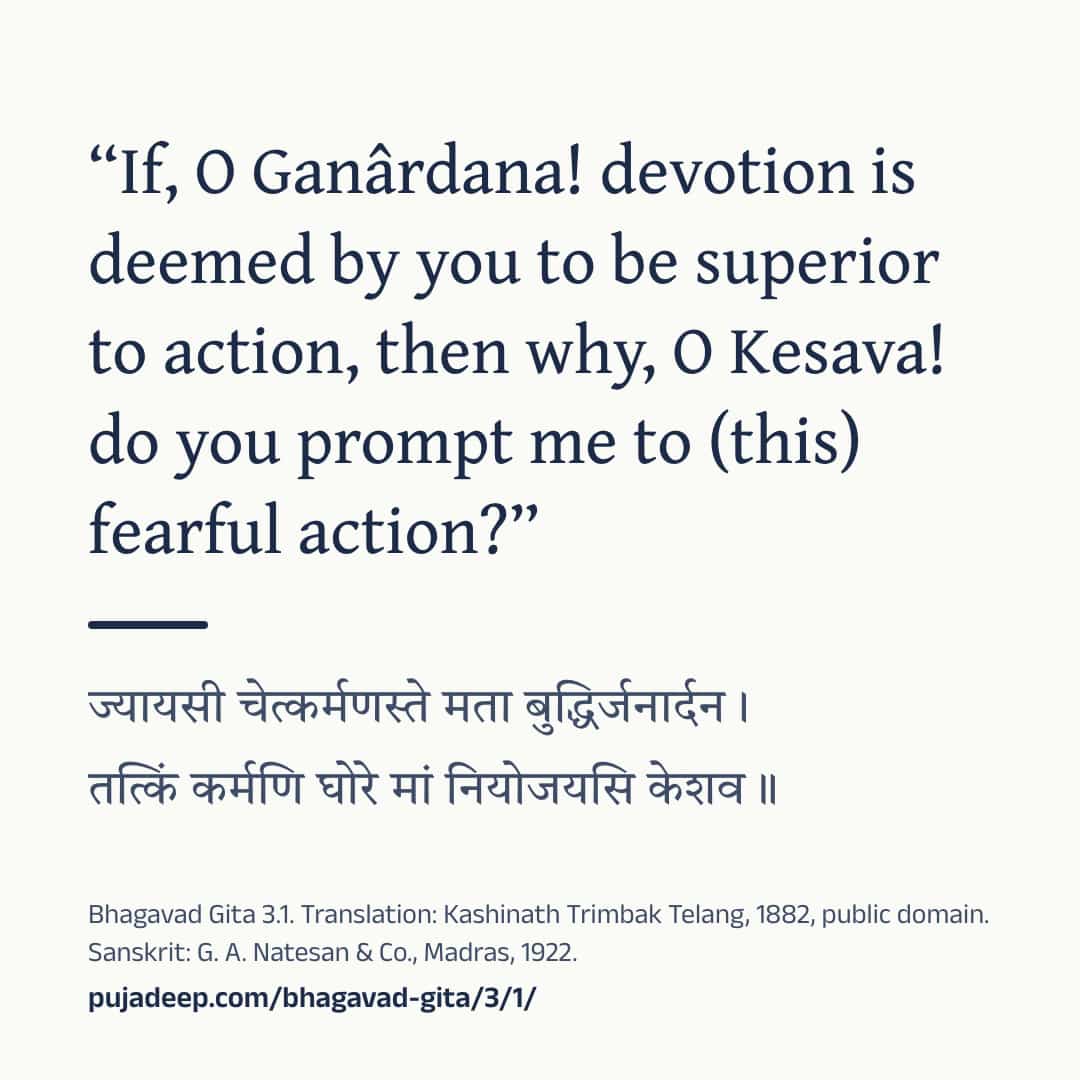
ज्यायसी चेत्कर्मणस्ते मता बुद्धिर्जनार्दन ।तत्किं कर्मणि घोरे मां नियोजयसि केशव ॥
Jyayasi chetkarmanaste mata buddhirjanardanaTatkim karmani ghore mam niyojayasi keshava
jyāyasī cetkarmaṇaste matā buddhirjanārdana |tatkiṃ karmaṇi ghore māṃ niyojayasi keśava ||
Our explanation Arjuna asks a question. If Krishna holds that understanding (buddhi) is better than action, as chapter 2 seemed to say (2.49), why does he urge Arjuna into this terrible action, the war? Arjuna calls Krishna Janardana and Keshava. Besant translates buddhi here as “knowledge”, Telang as “devotion”. The commentators explain the question in different ways (see the views).
हिंदी अर्थ अर्जुन एक प्रश्न पूछते हैं। यदि कृष्ण के मत में बुद्धि कर्म से श्रेष्ठ है, जैसा अध्याय 2 (2.49) से लगता था, तो वे अर्जुन को इस घोर कर्म, यानी युद्ध, में क्यों लगा रहे हैं? अर्जुन कृष्ण को जनार्दन और केशव कहकर पुकारते हैं। बेसेंट यहाँ बुद्धि का अनुवाद 'knowledge' (ज्ञान) करती हैं और तेलंग 'devotion'। टीकाकार इस प्रश्न को अलग-अलग ढंग से समझाते हैं।
Word by word
Every word, with its dictionary page
Word by word
- ज्यायसी jyāyasī · better, higher (comparative adjective (feminine), nominative singular) Dictionary: jyāyas, Monier-Williams 1899, p. 426, col. 3 “superior, more excellent, greater”
- चेत् cet · if (indeclinable) Dictionary: ced, Monier-Williams 1899, p. 401, col. 3 “if”
- कर्मणः karmaṇaḥ · than action (noun (neuter), ablative singular) Dictionary: karman, Monier-Williams 1899, p. 258, col. 2 “act, action, performance, business”
- ते te · by you, in your view (pronoun, genitive singular) Dictionary: 2. tva, Monier-Williams 1899, p. 463, col. 2 “base of the 2nd personal pron.”
- मता matā · held, considered (past participle (feminine), nominative singular) Dictionary: mata, Monier-Williams 1899, p. 783, col. 1 “thought, believed, imagined, supposed, understood; regarded or considered as”
- बुद्धिः buddhiḥ · understanding (noun (feminine), nominative singular) Dictionary: buddhi, Monier-Williams 1899, p. 733, col. 3 “intelligence, reason, intellect, mind, discernment, judgment”
- जनार्दन janārdana · O Janardana (Krishna) (noun (masculine), vocative singular) Dictionary: janārdana, Monier-Williams 1899, p. 410, col. 3 “‘exciting or agitating men,’ Vishṇu or Kṛishṇa”
- तत् tat · then, in that case (indeclinable) Dictionary: tad, Monier-Williams 1899, p. 434, col. 1 “m. he, f. she, n. it, that, this”
- किम् kim · why (indeclinable) Dictionary: kim, Monier-Williams 1899, p. 282, col. 2 “what? how? whence? wherefore? why?”
- कर्मणि karmaṇi · in action (noun (neuter), locative singular) Dictionary: karman, Monier-Williams 1899, p. 258, col. 2 “act, action, performance, business”
- घोरे ghore · terrible (adjective (neuter), locative singular) Dictionary: ghora, Monier-Williams 1899, p. 379, col. 2 “terrific, frightful, terrible, dreadful, violent, vehement”
- माम् mām · "me" (pronoun, accusative singular) Dictionary: 1. mad, Monier-Williams 1899, p. 777, col. 2 “base of the first pers. pron. in the sg. number”
- नियोजयसि niyojayasi · you urge, you engage (causative present, 2nd person singular) Dictionary: ni-yuj, Monier-Williams 1899, p. 552, col. 2 “to enjoin, urge, impel, coerce, appoint”
- केशव keśava · O Keshava (Krishna) (noun (masculine), vocative singular) Dictionary: keśava, Monier-Williams 1899, p. 310, col. 3 “N. of Vishṇu or Kṛishṇa”
Old translations
Kashinath Trimbak Telang, 1882. Public domain. Page 52.
Arguna said:
If, O Ganârdana! devotion is deemed by you to be superior to action, then why, O Kesava! do you prompt me to (this) fearful action?
Compare 3 translations
Kashinath Trimbak Telang, 1882. Public domain. Page 52.
Arguna said:
If, O Ganârdana! devotion is deemed by you to be superior to action, then why, O Kesava! do you prompt me to (this) fearful action?
You are reading this one
Annie Besant, 1895. Public domain. Page 40.
Arjuna said:
If it be thought by Thee that knowledge is superior to action, O Janârdana, why dost Thou, O Keshava! enjoin on me this terrible action?
You are reading this one
Swami Swarupananda, 1909 (first printed 1907). Public domain. Page 63.
Arjuna said:
If, O Janardana, according to Thee, knowledge is superior to action, why then, O Keshava, dost Thou engage me in this terrible action?
You are reading this one
Cite this verse
The translation: K. T. Telang, The Bhagavadgîtâ (The Sacred Books of the East, vol. VIII, Oxford: Clarendon Press, 1882), p. 52. Bhagavad Gita 3.1.
The translation: Annie Besant, The Bhagavad Gîtâ, or The Lord's Song (London: Theosophical Publishing Society, 1895), p. 40. Bhagavad Gita 3.1.
The translation: Swami Swarupananda, Srimad-Bhagavad-Gita (Mayavati: Prabuddha Bharata Press, 1909; first printed in Prabuddha Bharata, 1907–1909), p. 63. Bhagavad Gita 3.1.
Our explanation: “Bhagavad Gita 3.1: meaning and translation.” Pujadeep. Updated October 27, 2026. https://pujadeep.com/bhagavad-gita/3/1/
Pujadeep’s explanations are free to quote with credit: name Pujadeep and link to the page. How to credit
Classical readings, by school
Each reading is named by its school. None is presented as the only meaning.
What Advaita, Vishishtadvaita and Dvaita teach, in short
Shankara Advaita
Shankara reads the question as proof that chapter 2 taught knowledge and action as two separate paths for two kinds of people. If Krishna had meant one person to combine them, Arjuna could not ask why he is urged to act after hearing that knowledge is higher. Shankara argues at length against an earlier commentator who taught that knowledge and works must be combined. For Shankara, liberation comes from knowledge alone.
Source: The Bhagavad-Gita, with the commentary of Sri Sankaracharya, translated by A. Mahadeva Sastri (2nd ed., Mysore: G. T. A. Printing Works, 1901), introduction to chapter 3 and commentary on 3.1, pp. 71–79. Summarised in our own words; none of its text is reproduced.
Ramanuja Vishishtadvaita
Ramanuja says Arjuna had understood that the self is seen through the path of knowledge (jñāna-niṣṭhā), which means drawing the senses and the mind back from their objects. So he asks why Krishna commands him to a violent deed that uses all his faculties.
Source: Sri Bhagavad-Gita with Sri Ramanujacharya's Visishtadvaita commentary, translated by A. Govindacharya (Madras, 1898), commentary on 3.1–2, pp. 90–91. Summarised in our own words; none of its text is reproduced.
Share
Show the ways to share
Send one picture or the text to one chat. The picture names its source and the address of this page.
Drawing the picture
See the words
Bhagavad Gita 3.1

ज्यायसी चेत्कर्मणस्ते मता बुद्धिर्जनार्दन ।
तत्किं कर्मणि घोरे मां नियोजयसि केशव ॥

“If, O Ganârdana! devotion is deemed by you to be superior to action, then why, O Kesava! do you prompt me to (this) fearful action?”
(K. T. Telang, The Bhagavadgîtâ (The Sacred Books of the East, vol. VIII, Oxford: Clarendon Press, 1882), p. 52, public domain)

“If it be thought by Thee that knowledge is superior to action, O Janârdana, why dost Thou, O Keshava! enjoin on me this terrible action?”
(Annie Besant, The Bhagavad Gîtâ, or The Lord's Song (London: Theosophical Publishing Society, 1895), p. 40, public domain)

“If, O Janardana, according to Thee, knowledge is superior to action, why then, O Keshava, dost Thou engage me in this terrible action?”
(Swami Swarupananda, Srimad-Bhagavad-Gita (Mayavati: Prabuddha Bharata Press, 1909; first printed in Prabuddha Bharata, 1907–1909), p. 63, public domain)

Sanskrit: G. A. Natesan & Co., Madras, 1922.
https://pujadeep.com/bhagavad-gita/3/1/ Nothing is sent from this site. Your own app sends it, to the chat you choose. The picture quotes the translation you chose on this page, with its name and year.
Sanskrit text: The Bhagavad-Gita, or The Lord's Song, with the text in Devanagari and an English translation, 1922. Meanings: written for Pujadeep and checked against the cited edition. Source and changes
Questions families ask
Who speaks Bhagavad Gita 3.1?
Arjuna speaks this verse, in chapter 3 (Karma Yoga).
Where does the Sanskrit text come from?
Sanskrit text: The Bhagavad-Gita, or The Lord's Song, with the text in Devanagari and an English translation, 1922. Meanings: written for Pujadeep and checked against the cited edition. See the source
Is the meaning on this page a translation?
Explanation written for this site from the sources listed here, and checked against the cited edition. It is not a translation and not the only way to read the text. Free to quote with credit.
Source and licence
- Sanskrit text
- The Bhagavad-Gita, or The Lord's Song, with the text in Devanagari and an English translation (Annie Besant, G. A. Natesan & Co., Madras, 1922). Public domain. The Sanskrit on these pages was read from this printing’s page images.
- Translation
- The Bhagavadgîtâ with the Sanatsugâtîya and the Anugîtâ, translated by Kâshinâth Trimbak Telang (The Sacred Books of the East, vol. VIII, ed. F. Max Müller) (Kashinath Trimbak Telang, F. Max Müller, Clarendon Press, Oxford, 1882). Public domain. Shown verbatim, as printed.
- Translation
- The Bhagavad Gîtâ, or The Lord's Song, translated by Annie Besant (Annie Besant, Theosophical Publishing Society, London, 1895). Public domain. Shown verbatim, as printed.
- Translation
- Srimad-Bhagavad-Gita, with Sanskrit Text; Paraphrase with Word-by-word Literal Translation; English Rendering and Comments, Index, &c., by the Swami Swarupananda (Himalayan Series, No. XX) (Swami Swarupananda, The Editors and Publishers, Advaita Ashrama, Mayavati, Prabuddha Bharata Press, Mayavati, Almora, Himalayas, 1909). Public domain. Shown verbatim, as printed.
- Commentary
- The Bhagavad-Gita, with the commentary of Sri Sankaracharya, translated by A. Mahadeva Sastri (2nd ed., Mysore: G. T. A. Printing Works, 1901) (Public-domain scan, University of California Libraries). Summarised in our own words; none of its text is reproduced.
- Commentary
- Sri Bhagavad-Gita with Sri Ramanujacharya's Visishtadvaita commentary, translated by A. Govindacharya (Madras, 1898) (Scan uploaded to archive.org (folkscanomy collection)). Summarised in our own words; none of its text is reproduced.
- Common wording
- In this text, 32 words follow today's common wording, checked against sanskritdocuments.org; Sanskrit Wikisource; Gita Press, Gorakhpur; GRETIL, Göttingen and Bhaktivedanta Book Trust.
- Our explanation
- Explanation written for this site from the sources listed here, and checked against the cited edition. It is not a translation and not the only way to read the text. Free to quote with credit.
- Checked
- Checked against the cited edition, October 27, 2026.