भगवद्गीता 6.20: अर्थ और अनुवाद
अध्याय 6: ध्यानयोग। कृष्ण कहते हैं
श्रीमद्भगवद्गीता (Bhagavad Gita) 6.20: कृष्ण एक लंबा वाक्य शुरू करते हैं जो 6.23 तक चलता है।
किसी शब्द पर क्लिक करें या उसे छुएँ, उसका अर्थ और कोश का पृष्ठ देखें।
दिखावट
दिखावट
ये चुनाव इसी ब्राउज़र में रहते हैं।
श्रीमद्भगवद्गीता 6.20
यत्रोपरमते चित्तं निरुद्धं योगसेवया ।यत्र चैवात्मनाऽऽत्मानं पश्यन्नात्मनि तुष्यति ॥
Yatroparamate chittam niruddham yogasevayaYatra chaivatmanatmanam pashyannatmani tushyati
yatroparamate cittaṃ niruddhaṃ yogasevayā |yatra caivātmanā’’tmānaṃ paśyannātmani tuṣyati ||
भावार्थ कृष्ण एक लंबा वाक्य शुरू करते हैं जो 6.23 तक चलता है। वह उस अवस्था का वर्णन करता है जिसमें योग के अभ्यास से रोका गया चित्त शांत हो जाता है, और जिसमें व्यक्ति आत्मा से आत्मा को देखकर आत्मा में ही संतुष्ट रहता है।
English meaning Krishna begins a long sentence that runs to 6.23. It describes the state in which the mind, held still by the practice of yoga, comes to rest, and in which a person, seeing the self by the self, is content in the self.
शब्दार्थ
हर शब्द, शब्दकोश के पृष्ठ के साथ
शब्दार्थ
- यत्र yatra · जहाँ, जिसमें (अव्यय) शब्दकोश: yatra, मोनियर-विलियम्स 1899, पृ. 841, स्तंभ 2
in or to which place, where, wherein, wherever
- उपरमते uparamate · शांत हो जाता है (वर्तमान काल (लट्), प्रथम पुरुष एकवचन) शब्दकोश: upa-ram, मोनियर-विलियम्स 1899, पृ. 204, स्तंभ 3
to cease from action, be inactive or quiet (as a quietist)
- चित्तम् cittam · चित्त (संज्ञा (नपुंसकलिंग), प्रथमा एकवचन) शब्दकोश: citta, मोनियर-विलियम्स 1899, पृ. 395, स्तंभ 3
the heart, mind
- निरुद्धम् niruddham · रोका हुआ (भूतकालिक कृदन्त (नपुंसकलिंग), प्रथमा एकवचन) शब्दकोश: ni-ruddha, मोनियर-विलियम्स 1899, पृ. 554, स्तंभ 1
held back, withheld, held fast, stopped, shut, closed, confined, restrained
- योगसेवया yogasevayā · योग के अभ्यास से (समास (स्त्रीलिंग), तृतीया एकवचन) शब्दकोश: yoga, मोनियर-विलियम्स 1899, पृ. 856, स्तंभ 2
the act of yoking, joining, attaching
; sevā, मोनियर-विलियम्स 1899, पृ. 1247, स्तंभ 1worship, homage, reverence, devotion to
- यत्र yatra · जहाँ (अव्यय) शब्दकोश: yatra, मोनियर-विलियम्स 1899, पृ. 841, स्तंभ 2
in or to which place, where, wherein, wherever
- च ca · और (अव्यय) शब्दकोश: 2. ca, मोनियर-विलियम्स 1899, पृ. 380, स्तंभ 1
ind. and, both, also, moreover, as well as
- एव eva · ही (अव्यय) शब्दकोश: 1. eva, मोनियर-विलियम्स 1899, पृ. 232, स्तंभ 2
just, exactly, very, same, only, even, alone, merely
- आत्मना ātmanā · आत्मा से (संज्ञा (पुंलिंग), तृतीया एकवचन) शब्दकोश: ātman, मोनियर-विलियम्स 1899, पृ. 135, स्तंभ 1
the individual soul, self
- आत्मानम् ātmānam · आत्मा को (संज्ञा (पुंलिंग), द्वितीया एकवचन) शब्दकोश: ātman, मोनियर-विलियम्स 1899, पृ. 135, स्तंभ 1
the individual soul, self
- पश्यन् paśyan · देखते हुए (वर्तमान कृदन्त (पुंलिंग), प्रथमा एकवचन) शब्दकोश: 1. paś, मोनियर-विलियम्स 1899, पृ. 611, स्तंभ 2
behold, look at, observe, perceive, notice
- आत्मनि ātmani · आत्मा में (संज्ञा (पुंलिंग), सप्तमी एकवचन) शब्दकोश: ātman, मोनियर-विलियम्स 1899, पृ. 135, स्तंभ 1
the individual soul, self
- तुष्यति tuṣyati · संतुष्ट होता है (वर्तमान काल (लट्), प्रथम पुरुष एकवचन) शब्दकोश: tuṣ, मोनियर-विलियम्स 1899, पृ. 452, स्तंभ 1
to become calm, be satisfied or pleased with any one
1 छपाई में पाठभेद
संस्करणों के अंतर। कोई दूसरा मुद्रण या पाठ इस स्थान को अलग ढंग से पढ़ता है।
- वर्तनी एक डिजिटल प्रति में पाठ है शब्द वही हैं। 1922 का संस्करण मिले हुए स्वर को अवग्रह से दिखाता है (आत्मनाऽऽत्मानं); यह डिजिटल प्रति ऐसा नहीं करती।
पुराने अंग्रेज़ी अनुवाद
Kashinath Trimbak Telang, 1882। सार्वजनिक डोमेन (कॉपीराइट-मुक्त)। पृष्ठ 69–70।
That (mental condition), in which the mind restrained by practice of abstraction, ceases to work; in which too, one seeing the self by the self1, is pleased in the self; in which one experiences that infinite happiness which transcends the senses, and which can be grasped by the understanding only; and adhering to which, one never swerves from the truth; acquiring which, one thinks no other acquisition higher than it; and adhering to which, one is not shaken off even by great misery; that should be understood to be called devotion in which there is a severance of all connexion with pain. That devotion should be practised with steadiness and with an undesponding heart.
यह वाक्य श्लोक 6.20 से 6.23 तक का है।
पाद-टिप्पणियाँ (अनुवादक की अपनी) - Sees the highest principle by a mind purified by abstraction. ↩
3 अनुवादों की तुलना करें
Kashinath Trimbak Telang, 1882। सार्वजनिक डोमेन (कॉपीराइट-मुक्त)। पृष्ठ 69–70।
That (mental condition), in which the mind restrained by practice of abstraction, ceases to work; in which too, one seeing the self by the self1, is pleased in the self; in which one experiences that infinite happiness which transcends the senses, and which can be grasped by the understanding only; and adhering to which, one never swerves from the truth; acquiring which, one thinks no other acquisition higher than it; and adhering to which, one is not shaken off even by great misery; that should be understood to be called devotion in which there is a severance of all connexion with pain. That devotion should be practised with steadiness and with an undesponding heart.
यह वाक्य श्लोक 6.20 से 6.23 तक का है।
पाद-टिप्पणियाँ (अनुवादक की अपनी) - Sees the highest principle by a mind purified by abstraction. ↩
आप यही पढ़ रहे हैं
Annie Besant, 1895। सार्वजनिक डोमेन (कॉपीराइट-मुक्त)। पृष्ठ 69।
When the mind is quiet, stopped by the practice of Yoga, when he seeth the SELF by the SELF, and in the SELF is satisfied;
यह वाक्य 6.21 में आगे चलता है।
आप यही पढ़ रहे हैं
Swami Swarupananda, 1909 (पहली बार 1907 में छपा)। सार्वजनिक डोमेन (कॉपीराइट-मुक्त)। पृष्ठ 131–132।
When the mind, absolutely restrained by the practice of concentration, attains quietude, and when seeing Self by the self, is satisfied in his own Self; when he feels that infinite bliss—which is perceived by the (purified) intellect and which transcends the senses, and established wherein he never departs from his real state; and having obtained which, no other acquisition is regarded superior to that, and where established, he is not moved even by heavy sorrow;—let that be known as the state, called by the name of Yoga,—a state of severance from the contact of pain. This Yoga should be practised with perseverance, undisturbed by depression of heart.
यह वाक्य श्लोक 6.20 से 6.23 तक का है।
आप यही पढ़ रहे हैं
इस श्लोक का हवाला दें
अनुवाद: K. T. Telang, The Bhagavadgîtâ (The Sacred Books of the East, vol. VIII, Oxford: Clarendon Press, 1882), पृष्ठ 69–70। भगवद्गीता 6.20–23।
अनुवाद: Annie Besant, The Bhagavad Gîtâ, or The Lord's Song (London: Theosophical Publishing Society, 1895), पृष्ठ 69। भगवद्गीता 6.20।
अनुवाद: Swami Swarupananda, Srimad-Bhagavad-Gita (Mayavati: Prabuddha Bharata Press, 1909; first printed in Prabuddha Bharata, 1907–1909), पृष्ठ 131–132। भगवद्गीता 6.20–23।
हमारी व्याख्या: “भगवद्गीता 6.20: अर्थ और अनुवाद”। पूजादीप। अद्यतन 25 अक्टूबर 2026। https://pujadeep.com/hi/bhagavad-gita/6/20/
पूजादीप की व्याख्याएँ श्रेय देकर उद्धृत की जा सकती हैं: पूजादीप का नाम और पृष्ठ का लिंक दें। श्रेय कैसे दें
शास्त्रीय व्याख्याएँ, संप्रदाय के अनुसार
इस श्लोक पर अभी संप्रदायों की व्याख्या नहीं है।
भेजें
साझा करने के तरीके दिखाएँ
एक तस्वीर या पाठ एक चैट में भेजें। तस्वीर पर उसका स्रोत और इस पृष्ठ का पता लिखा है।
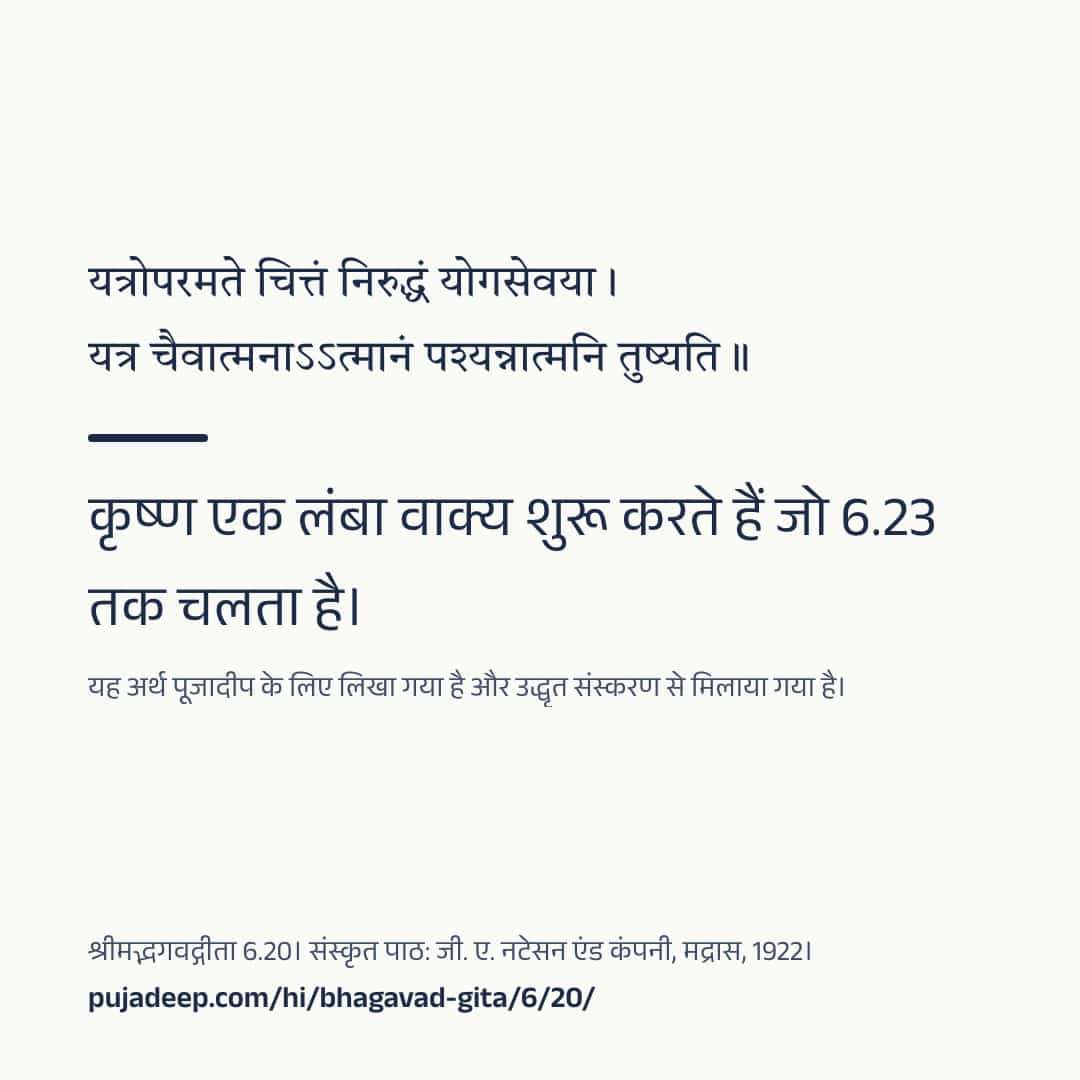
तस्वीर बन रही है
शब्द देखें
श्रीमद्भगवद्गीता 6.20

यत्रोपरमते चित्तं निरुद्धं योगसेवया ।
यत्र चैवात्मनाऽऽत्मानं पश्यन्नात्मनि तुष्यति ॥

“That (mental condition), in which the mind restrained by practice of abstraction, ceases to work; in which too, one seeing the self by the self, is pleased in the self; in which one experiences that infinite happiness which transcends the senses, and which can be grasped by the understanding only; and adhering to which, one never swerves from the truth; acquiring which, one thinks no other acquisition higher than it; and adhering to which, one is not shaken off even by great misery; that should be understood to be called devotion in which there is a severance of all connexion with pain. That devotion should be practised with steadiness and with an undesponding heart.”
(K. T. Telang, The Bhagavadgîtâ (The Sacred Books of the East, vol. VIII, Oxford: Clarendon Press, 1882), pp. 69–70, public domain)
यह वाक्य श्लोक 6.20 से 6.23 तक का है।

“When the mind is quiet, stopped by the practice of Yoga, when he seeth the SELF by the SELF, and in the SELF is satisfied;”
(Annie Besant, The Bhagavad Gîtâ, or The Lord's Song (London: Theosophical Publishing Society, 1895), p. 69, public domain)
यह वाक्य 6.21 में आगे चलता है।

“When the mind, absolutely restrained by the practice of concentration, attains quietude, and when seeing Self by the self, is satisfied in his own Self; when he feels that infinite bliss—which is perceived by the (purified) intellect and which transcends the senses, and established wherein he never departs from his real state; and having obtained which, no other acquisition is regarded superior to that, and where established, he is not moved even by heavy sorrow;—let that be known as the state, called by the name of Yoga,—a state of severance from the contact of pain. This Yoga should be practised with perseverance, undisturbed by depression of heart.”
(Swami Swarupananda, Srimad-Bhagavad-Gita (Mayavati: Prabuddha Bharata Press, 1909; first printed in Prabuddha Bharata, 1907–1909), pp. 131–132, public domain)
यह वाक्य श्लोक 6.20 से 6.23 तक का है।

संस्कृत पाठ: जी. ए. नटेसन एंड कंपनी, मद्रास, 1922।
https://pujadeep.com/hi/bhagavad-gita/6/20/
इस साइट से कुछ नहीं भेजा जाता। आपका अपना ऐप उसे आपकी चुनी हुई चैट में भेजता है। तस्वीर में वही अनुवाद है जो आपने इस पृष्ठ पर चुना है, उसके नाम और वर्ष के साथ।
संस्कृत पाठ: 1922 का मद्रास मुद्रण। अर्थ: पूजादीप के लिए लिखे और जाँचे गए। स्रोत और बदलाव
परिवारों के प्रश्न
गीता 6.20 कौन कहता है?
यह श्लोक कृष्ण कहते हैं, अध्याय 6 (ध्यानयोग) में।
संस्कृत पाठ कहाँ से लिया गया है?
संस्कृत पाठ: 1922 का मद्रास मुद्रण। अर्थ: पूजादीप के लिए लिखे और जाँचे गए। स्रोत देखें
क्या इस पृष्ठ का अर्थ अनुवाद है?
इस साइट के लिए यहाँ दिए स्रोतों के आधार पर लिखी और उद्धृत संस्करण से मिलाई गई व्याख्या। यह अनुवाद नहीं है, और पाठ को पढ़ने का एकमात्र तरीका भी नहीं है। श्रेय देकर आप इसे उद्धृत कर सकते हैं।
स्रोत और लाइसेंस
- संस्कृत पाठ
- The Bhagavad-Gita, or The Lord's Song, with the text in Devanagari and an English translation (Annie Besant, G. A. Natesan & Co., Madras, 1922). सार्वजनिक डोमेन (कॉपीराइट-मुक्त)। इन पृष्ठों का संस्कृत पाठ इसी मुद्रण के पृष्ठ-चित्रों से पढ़ा गया है।
- अनुवाद
- The Bhagavadgîtâ with the Sanatsugâtîya and the Anugîtâ, translated by Kâshinâth Trimbak Telang (The Sacred Books of the East, vol. VIII, ed. F. Max Müller) (Kashinath Trimbak Telang, F. Max Müller, Clarendon Press, Oxford, 1882). सार्वजनिक डोमेन (कॉपीराइट-मुक्त)। जैसा छपा है, वैसा ही दिखाया गया।
- अनुवाद
- The Bhagavad Gîtâ, or The Lord's Song, translated by Annie Besant (Annie Besant, Theosophical Publishing Society, London, 1895). सार्वजनिक डोमेन (कॉपीराइट-मुक्त)। जैसा छपा है, वैसा ही दिखाया गया।
- अनुवाद
- Srimad-Bhagavad-Gita, with Sanskrit Text; Paraphrase with Word-by-word Literal Translation; English Rendering and Comments, Index, &c., by the Swami Swarupananda (Himalayan Series, No. XX) (Swami Swarupananda, The Editors and Publishers, Advaita Ashrama, Mayavati, Prabuddha Bharata Press, Mayavati, Almora, Himalayas, 1909). सार्वजनिक डोमेन (कॉपीराइट-मुक्त)। जैसा छपा है, वैसा ही दिखाया गया।
- प्रचलित पाठ
- इस पाठ में 32 शब्द आज के प्रचलित रूप में हैं; इन्हें sanskritdocuments.org; संस्कृत विकिस्रोत; गीता प्रेस, गोरखपुर; ग्रेटिल, गॉटिंगेन और भक्तिवेदांत बुक ट्रस्ट के पाठ से मिलाकर जाँचा गया।
- हमारी व्याख्या
- इस साइट के लिए यहाँ दिए स्रोतों के आधार पर लिखी और उद्धृत संस्करण से मिलाई गई व्याख्या। यह अनुवाद नहीं है, और पाठ को पढ़ने का एकमात्र तरीका भी नहीं है। श्रेय देकर आप इसे उद्धृत कर सकते हैं।
- जाँच
- उद्धृत संस्करण से मिलाया गया, 15 अक्टूबर 2026।
- अद्यतन
- 25 अक्टूबर 2026